The “Budget” Lie: Why Most Couples Overpay For Underwhelm

Where Your Fear Of Looking Cheap Gets Weaponized
You’re afraid people will judge the album as a reflection of what you spent, so you’re already negotiating against yourself before comparing a single option. The mechanism is simple: vendors price according to what they know you’ll pay, not what the product costs to make. Wedding pricing exists in a different market than consumer printing because couples operate under emotional duress and artificial time pressure. You’re not buying rationally. They know this.
The gap between actual production cost and the price tag on a “luxury wedding album” has nothing to do with materials and everything to do with positioning. A premium brand charges 40 to 60 percent markup because the word “wedding” entered the conversation. The same paper stock, binding method, and layout design cost the same whether it ships to a couple or a corporate client. Vendors exploit the emotional premium you’re already willing to pay, then dress it up with vague language about “quality” and “craftsmanship” to justify the gap.
What Actually Determines Print Quality
Binding durability and paper weight are the only mechanical factors that meaningfully affect how an album performs over time. In materials science terms, the tensile strength of the binding determines whether pages stay attached or separate after repeated handling. Don’t confuse finish type with quality. A matte cover doesn’t outlast a glossy one because it feels more refined. The finish is aesthetic preference, not longevity.
Most budget albums fail not because of cheap materials but because of poor construction decisions made upstream. Spiral binding and perfect binding (glued spine) both hold for years if executed correctly, but cheap labs skip reinforcement steps that cost pennies. Ask suppliers directly: Do they reinforce the gutter (the inner fold)? Do they use PVA adhesive or cheaper alternatives? These specifics predict whether your album stays intact after your grandkids handle it, not the price point or brand name printed on the cover.
The 3 Tiered Photo Album Protocol: Your Personal Value System

What Your Album Actually Needs To Do
You’re worried you’ll pick wrong and regret it. Here’s the mechanism: most couples buy based on what competitors offer, not what their specific album will face over time. Think of it like material science—durability depends on matching the material to its environment. A budget album sitting on a shelf requires different specifications than one handled weekly by guests or archived in humidity. Define whether your album is a display piece, a keepsake that moves between homes, or reference material. This single decision eliminates 70 percent of irrelevant features you’d otherwise pay for.

The longevity question isn’t romantic—it’s practical. Acidic paper stock yellows in five years. Cheap binding separates at the spine after fifty page turns. Adhesive bindings fail faster than sewn ones under temperature swings. Know your album’s actual job before comparing vendors. If it lives in a climate-controlled drawer, you can accept lower specifications. If it travels or sees daylight, you need genuine photo paper and quality binding. Spend thirty minutes documenting where the album will physically exist and how often it will be opened.
Features Worth Paying For Versus Everything Else
The standard advice says prioritize what matters to you, which is useless because you don’t know what matters until production fails. Instead, separate hard requirements from preferences based on failure consequence. Hard requirements: binding integrity, paper that won’t yellow, color accuracy on skin tones. Preferences: matte versus glossy finish, leather cover options, custom page layouts. One category costs you credibility if it breaks. The other just feels less special.
Budget printing services cut corners on three things: paper quality, color calibration, and binding durability. You cannot fix paper after printing. You cannot restore color accuracy once it fades. You cannot reglue pages that separate after six months. Identify which of these matters for your specific album’s use case, then verify the vendor’s specifications in writing. Skip everything else. The difference between a sixty-dollar album and a ninety-dollar album is usually one real feature plus five marketing ones. Know which is which before you order.
Deconstructing “Quality”: What Actually Lasts (and What Doesn’t)
Paper Stock And Binding Are Where Durability Lives
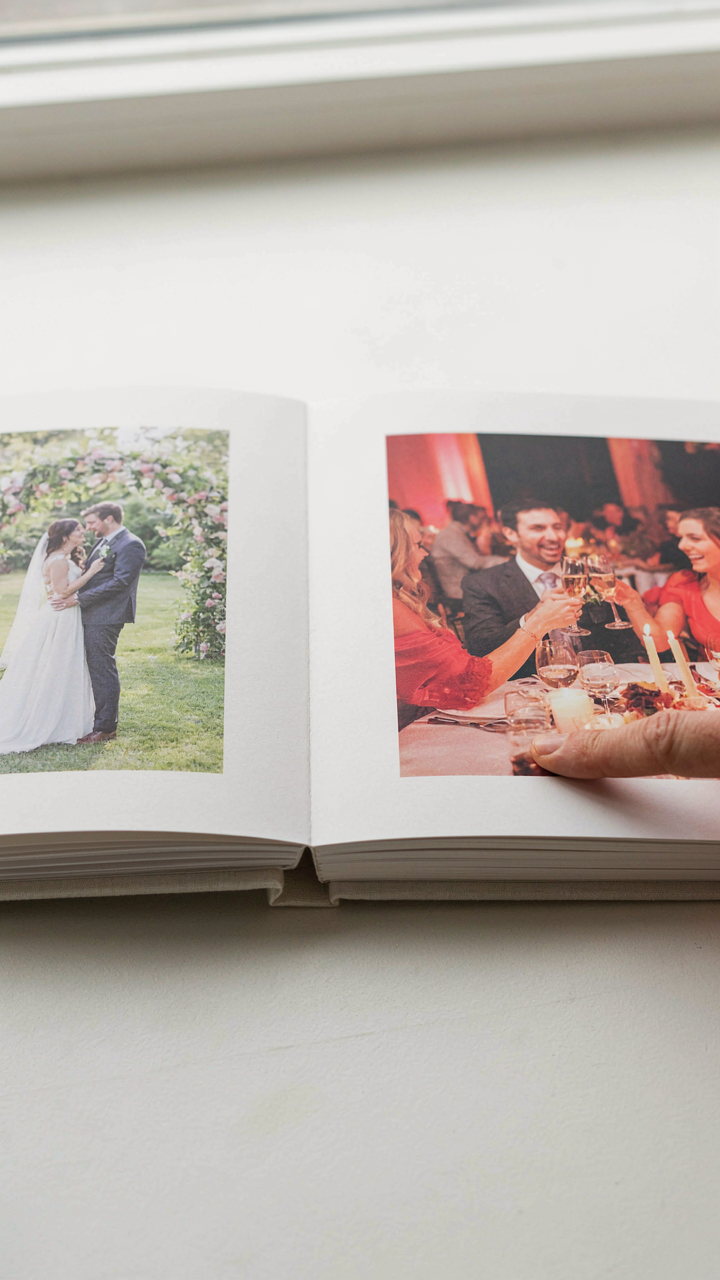
You care about this because you don’t want to spend money on something that falls apart in five years. Here’s the mechanism: durability in printed albums functions like structural engineering. The load-bearing components are paper stock and binding method. Cheap albums use wood-pulp paper that yellows and becomes brittle because acid remains in the fibers. Premium budget options use acid-free paper that resists degradation. The binding method determines whether pages stay attached or separate from the spine under repeated opening.

Most budget services use perfect binding, which glues pages to the spine. This fails predictably because the adhesive dries and cracks after 500-1000 page turns. Lay-flat binding uses a sewn spine that allows pages to open fully without stress on the glue line. Coated papers hold up better than uncoated, but coating adds cost. The real move: ask the vendor for their paper’s acid content and whether pages are sewn or glued. Sewn binding outlasts perfect binding by years. Specify acid-free stock during order to guarantee you’re not buying obsolescence.
Print Resolution And Color Stability Over Time
Resolution and color fidelity seem technical but they determine whether your photos fade or stay true. The standard metric for printed photo quality is dots per inch, measured at 300 dpi minimum for acceptable detail at close viewing distance. Budget printers often operate at 150-200 dpi, which causes visible pixelation in large prints and details blur in backgrounds. Higher dpi costs more but matters only if your original files are high resolution.
Color fidelity depends on ink type and paper finish. Dye-based inks are cheaper and produce richer color initially but fade within 5-10 years under light exposure. Pigment-based inks cost more and resist fading for 25-50 years depending on paper type. Matte paper hides ink saturation issues that glossy paper exposes immediately. Budget vendors cut costs by using dye-based inks on matte stock, which masks fading problems until it’s too late. Specify pigment-based inks in writing before ordering and request a sample printed on the exact paper stock they’ll use in your album.
The “DIY Wedding Album Inspiration” Fallacy: When Saving Money Costs More

Hidden Time Costs Of Self Design And Proofing
You think DIY album design saves money because you’re not paying a designer. That’s the trap. The real mechanism is opportunity cost from economics: you have a fixed number of hours before the wedding, and each hour spent designing is an hour not spent on something with higher return. Most couples underestimate this completely.

Self-design requires deciding layout, spacing, photo sequencing, and typography. You’ll make decisions, second-guess them, remake pages, and loop your partner in for approval cycles. Budget printing services like Shutterfly and Artifact Uprising charge 15 to 40 percent less than professional design studios precisely because they shift this labor to you. You’re not saving money. You’re trading cash for dozens of hours of unpaid work that compounds through revision rounds.
Software Learning Curves And Revision Cycles
Design software doesn’t work the way your brain works. Whether you use Canva, Adobe Creative Suite, or a printer’s proprietary template tool, you’ll hit friction immediately: layer management, image resolution, bleed margins, color space conversion. Most couples discover these problems mid-project and have to restart sections. The learning curve isn’t a one-time cost. It multiplies across every album page you create.
Revision cycles kill DIY budgets. Your mom wants a different photo on page six. Your partner hates the font choice you spent an hour perfecting. You remake it. Then the printer’s proofing tool shows your colors rendered differently than your screen displayed them, so you adjust and reorder prints. A budget album service uses fixed templates that eliminate these friction points entirely. You select photos, click submit, and stop making decisions. The template absorbs the technical variables so revision rounds stay minimal.
Optimizing For Impact: How To Personalize Wedding Albums Beyond The Cover
The Sequence That Matters More Than Individual Photos
You want people to feel something when they open your album, and you think better photos are the answer. They’re not. The real mechanism is narrative architecture. Photographers have known this for decades: the order of images controls the emotional trajectory. Budget printing services often give you unlimited page layouts, but most couples dump photos chronologically and call it done. That’s waste.

Think of sequencing like film editing, not photography. In film theory, montage isn’t about individual shots—it’s about what the cut between two shots creates in the viewer’s mind. Apply this to your album: place a wide ceremony shot, then cut to an extreme close-up of the ring. The contrast generates tension and release. Budget albums win when the sequence tells a three-act story: anticipation, climax, reflection. This costs nothing extra at print time.
Texture And Whitespace Over Decoration
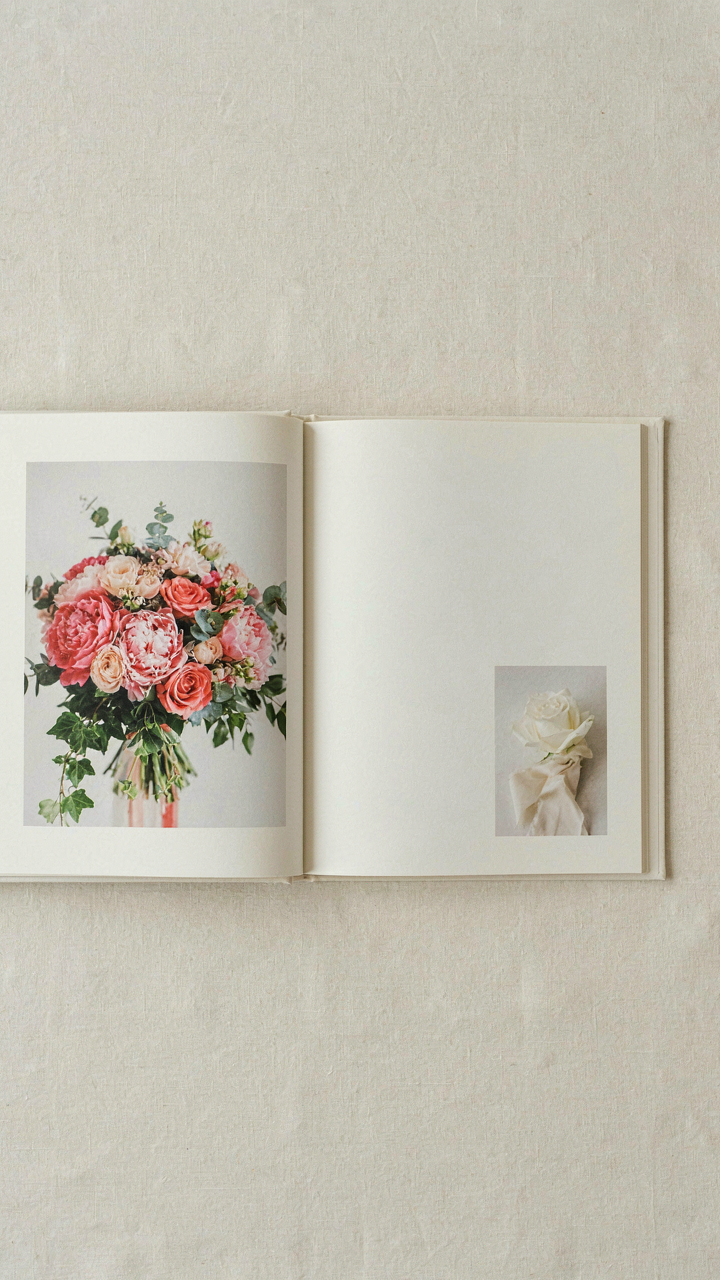
The common advice says add borders, throw in metallics, fill every page. Wrong. Minimalist design came from constraint, not taste. With budget printing, your real leverage is negative space and paper choice. Most budget services offer matte, gloss, and semi-gloss finishes on standard cardstock. The matte finish absorbs light and feels intentional. Gloss feels cheap because every budget album uses it. Choose matte, leave pages half-empty, let photos breathe.
Whitespace functions as a design element because it forces attention. When a full page is blank except for one photo and a margin, the eye has nowhere else to go. Luxury albums use this technique constantly because restraint reads as confidence. A tight crop of a detail shot surrounded by blank space costs the same to print as a bordered collage. Pick edge-to-edge bleeding for hero images, then pair them with mostly-blank pages. This rhythm makes budget albums feel deliberate.
The “Best Wedding Photo Books” Deception: Unmasking Marketing Hype

Where Reviews Live And Lies Die
You’re searching for reviews because you don’t want to waste $200 on a bad album, and you’re hoping someone else already did the damage for you. The mechanism is simple: marketing teams seed five-star reviews on their own sites and partner platforms, while real complaints surface only on Reddit, Facebook groups, and Trustpilot where they can’t control the narrative. A four-point-nine rating on a company’s homepage tells you nothing. A two-star Trustpilot review from someone showing actual binding failure tells you everything.

The gap between advertised durability claims and what customers experience in year two reveals the real story. Brands claim “archival quality” and “museum-grade materials” while using standard lab-tested papers that yellow under indoor light within five years. Read reviews older than two years. New reviews mean nothing. Look for complaints about color shift, spine separation, and page adhesive failure. These aren’t edge cases. They’re patterns disguised by algorithmic sorting that buries negative feedback below glowing testimonials from people who’ve owned the album for three months.
Hidden Fees And Shipping Economics
Shipping cost economics explain why budget album prices often crater at checkout: companies absorb initial margin to convert you, then recapture it through logistics. A $35 album quoted online becomes $62 when shipping gets added because they’ve priced the product artificially low to win the search click. The real cost structure sits hidden until the final step.
- Shipping charges on orders under $100: Most budget printers charge $8-16 for standard delivery on single albums. Rush shipping adds $15-25. Compare this to companies offering free shipping at $75+ thresholds, which simply frontload that cost into their base price.
- Material upgrades presented as upsells: Premium paper stocks, lay-flat binding, and custom covers appear optional but carry $15-30 premiums each. Competitors include these in their “budget” package price, making their base cost look higher but total cost lower.
- Return and reprint policies: Some vendors charge restocking fees of 15-20% if you reject quality issues. Others offer one free reprint. This shifts risk entirely onto the customer and inflates true cost-of-ownership for anyone receiving a defective first print.
- International and regional surcharges: Printers add 20-40% fees for orders shipped outside major metros or to certain ZIP codes. Their advertised pricing assumes you live in a high-volume delivery zone.
- Binding method price gaps: Perfect binding costs $8-12 more than saddle stitching but appears as a buried option. Wire binding and lay-flat binding add another $12-18 each, turning a $25 album into a $55 reality before you see the final invoice.
Compare the true all-in cost by building identical albums at three different vendors and running each through checkout to the payment screen. The lowest advertised price never wins. The vendor with transparent itemization and no surprise fees at step four wins.
Applying Economic Principles To Wedding Photo Album Ideas
What You’re Really Trading Away
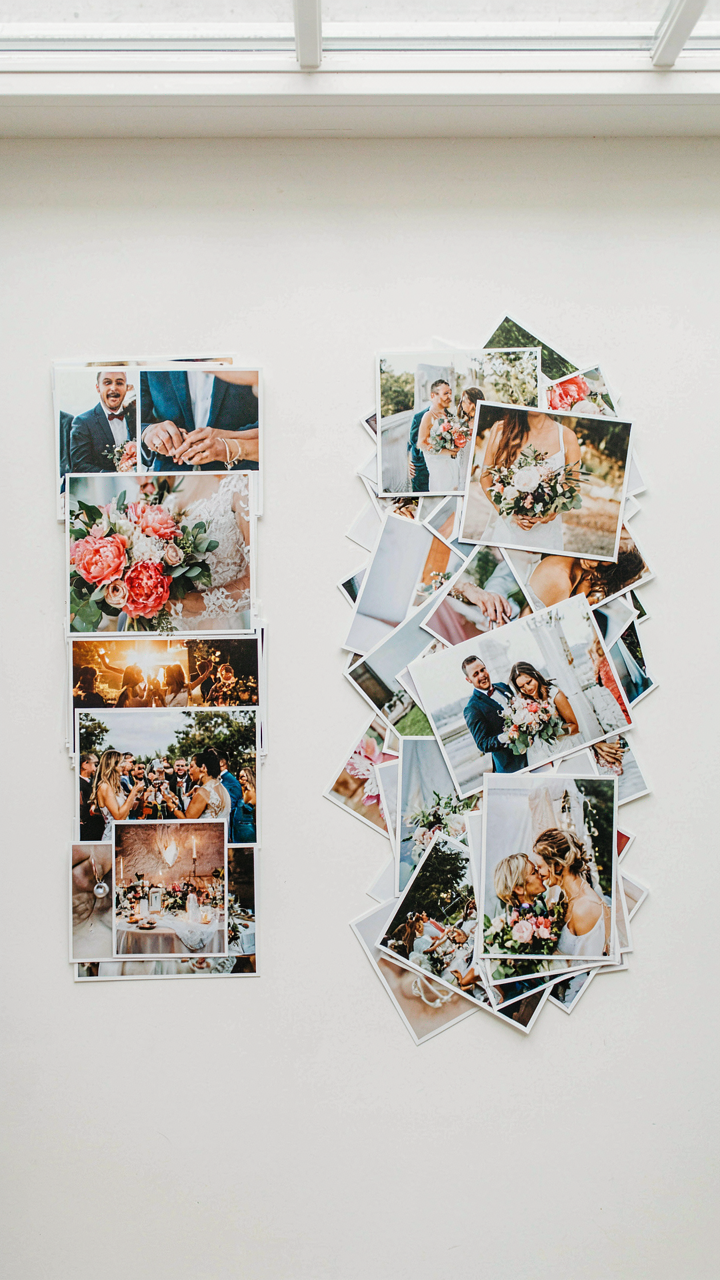
You want to feel like you made the smart choice with your budget. Here’s what actually happens: every photo you include is a photo you’re not including, and every page you print costs money that could go toward better paper stock or binding. This is opportunity cost. You have a fixed budget and limited album pages. Adding a mediocre shot of the cocktail hour means removing either the first kiss or the family portraits. Most couples don’t think in these terms, so they end up with bloated albums that feel scattered instead of purposeful.

The mechanism is simple. Print costs scale linearly with page count at most budget vendors. A 40-page album costs roughly twice what a 20-page album costs. But your emotional return doesn’t double. Thirty photos of similar moments hit diminishing returns fast. You’re paying for volume instead of impact. The actual strategy is ruthless curation before you ever open a design tool. Pick your shots. Lock the count. Then design around that constraint, not the other way around.
The 80 Percent That Matters
Economics borrowed the 80/20 principle from Vilfredo Pareto’s observation about resource distribution. In album printing, it translates directly: roughly 80 percent of your album’s emotional value comes from 20 percent of your photos. You don’t need 120 images. You need 24. The ceremony, the first kiss, the couple’s portraits, key family moments, and candid reception details. That’s the frame. Everything else is filler that bloats your page count and your invoice.
Most budget printers charge per page or per spread. The math favors selectivity. Cutting from 60 images to 24 might reduce your album cost by 30 to 40 percent while actually improving the final product. The constraint forces narrative. You start thinking about story instead of coverage. Which moments tell the truth about the day? Print those. Skip the fifteen angles of the same scene. This is how you move from “we have photos” to “we have an album worth opening.”
Beyond Generic Templates: Wedding Album Design Psd For Distinction

Templates Without The Designer Tax
You want a custom-looking album without paying three grand for design work. That’s not shallow. It’s math. The mechanism is simple: professional PSD templates already contain the structural decisions a designer would charge you to make. Fonts are paired. Spacing is calibrated. Color hierarchy is set. You’re buying the framework, not reinventing it.

Most budget printers include basic templates, but they’re often flat and undersized for print. Hunt templates on marketplaces like Creative Market or Etsy designed specifically for print-ready albums at 300 DPI. The difference between screen resolution and print resolution kills albums more than bad design choices do. Download the PSD file, drop your images in the designated layers, and you skip the $2,000 design phase entirely.
Custom Touches Through Constraint
The common advice here is wrong: people think adding more customization makes an album better. It doesn’t. Constraint makes it better. Pick one element to modify across the template—maybe the accent color or the font pairing for titles. This creates coherence, not chaos.
Open the PSD in Photoshop or Affinity Photo and work only within the layer structure the template provides. Change the overlay color on the master page, update text in the type layers, swap images in the smart objects. Export as PDF at print specifications your vendor requires, usually CMYK at 300 DPI with 0.125-inch bleed. This process takes two hours max and produces something that reads as intentional rather than templated.
The Longevity Equation: Protecting Your “Beautiful Wedding Albums” Investment

How Physical Albums Actually Degrade
You want these albums to survive long enough to matter to people who aren’t you yet. That’s the real fear underneath. Here’s the mechanism: paper and ink degrade through oxidation, and budget printing accelerates this because cheaper materials have weaker protective barriers. Acid migration from low-quality paper stocks eats through emulsion layers on printed photos over decades. Temperature swings and humidity spikes speed the process. The albums don’t fail catastrophically, they fade incrementally. You won’t notice until the colors are already gone.

Store albums spine-up on shelves, never stacked flat. Keep them in climate-controlled spaces between 60-70 degrees Fahrenheit with 30-40% relative humidity. Avoid basements and attics entirely. UV light fades inks faster than anything else, so keep albums away from direct sunlight. Use acid-free boxes if you must store them long-term. Check them annually for mold or discoloration. The investment in stable storage costs almost nothing upfront but determines whether your album survives intact or becomes a faded reminder of poor planning.
Store Originals Separately From Prints
Digital backups aren’t insurance, they’re redundancy against catastrophic loss. Think of this like data replication in systems architecture: the primary copy lives in one place, backup copies live in isolated environments with no common failure mode. Your photographer probably retained files on their end. Request them explicitly and verify ownership transfer in writing. Store your own copy on an external drive kept in a fireproof safe. Cloud storage is faster and easier than it sounds because it survives hardware failure and physical disasters simultaneously.
Make one backup copy immediately after receiving albums. Don’t wait. Store it in a different physical location from the album itself, ideally in the home of a trusted family member or a safety deposit box. JPEG format outlasts proprietary file types because software to read them will exist for decades. Update your digital backup location every few years if you relocate. The goal isn’t perfection, it’s ensuring that if your house burns down or floods, the visual record still exists somewhere else.
The Single Most Overlooked Factor In Wedding Albums

The Marker That Outlasts The Marriage
You’re worried the album won’t look expensive enough. That’s the real reason you’re reading this section. Here’s what nobody says plainly: a wedding album is a storage device for memory, not a display of taste. In information theory, signal degrades over time without reinforcement. A printed album reinforces that signal every time someone opens it. Digital photos degrade through format obsolescence, device failure, and the simple human fact that nobody retrieves a folder called “2024 Wedding” five years later. The album sits on the table. It gets touched. It survives.
The mechanism is tactile retrieval. Your grandmother doesn’t open a cloud drive. She opens a book. That physical act of reaching for an object, turning pages, pointing at faces with her finger creates neural pathways that digital scrolling never builds. Budget printing services often cut corners on binding durability and paper stability, but the core function remains intact: the album exists in physical space independent of technology. That’s not nostalgia talking. That’s how human memory works.
Why Your Children Will Actually Care
Print decay accelerates in low-quality albums because cheap binding allows moisture infiltration and acid migration from poor paper stock into images. Think of archival science’s concept of preservation potential. A budget album printed on cellulose paper with unstable dyes has low preservation potential compared to acid-free alternatives. But here’s what changes the equation: a poorly preserved album that exists is more valuable to your family than a perfectly preserved digital file nobody knows how to access. The presence matters more than the condition, at least initially.
Future family significance isn’t determined by print quality alone. It’s determined by whether the album gets pulled from a shelf or stays locked in a password-protected account. Cheap albums from reputable budget services use adequate binding and archival-grade options at lower price points. The distinction isn’t between budget and premium. It’s between albums people touch and files people forget. Your children inherit stories they can hold, not a recovery project requiring technical troubleshooting. Choose a budget service that uses perfect binding or spiral binding rather than glue-only construction, then stop optimizing and print the book.
Your Greatest Obstacle Isn’t The Price Tag; It’s Your Inability To Define What Truly Matters

You’re paralyzed by options because you haven’t decided what album actually does for you. Is it proof the day happened? A coffee table flex? Something your grandkids touch in thirty years? Answer that one question before you compare a single printer. Then go pull three albums you actually own and study them. Notice what you remember. That’s your benchmark, not the marketing copy. Stop optimizing for cheap and start optimizing for kept.