The Experience Design Imperative: Beyond Mere Distraction

Cheap Games Die Fast
You want lawn games to feel like an afterthought so nobody judges your budget. That’s the real fear here. But here’s the mechanism: cost and memorability are not inversely related. A cornhole set costs thirty dollars. A poorly designed cornhole experience costs nothing and delivers exactly that in return. The problem isn’t price. It’s intention. Guests remember games that require them to do something they can’t do alone at home, that create legitimate stakes, and that produce a visible outcome someone else cares about watching.
Throwing things into holes is not inherently interesting. The setup, the rules, the social friction, and the winner announcement determine whether guests play twice or play for an hour. A budget constraint forces you to be more specific about what you’re actually optimizing for, not less. Cut decoration. Amplify function. The game itself must be the experience, not a prop filling dead air between dinner and dancing.
Engineered Interaction Over Chance Alone
Behavioral economics calls this the “agency problem”: people engage deeper with outcomes they influence. A lawn game built entirely on luck generates one interaction. A lawn game that requires skill, decision-making, and visible performance generates ongoing engagement and natural spectator formation. Couples often miss this. They buy yard games and assume people will use them. People won’t. They need a reason to pay attention.
The mechanism is simple: games with turn-based play, public scoring, and incremental progress create observer density. Observers become players. Players generate social proof. More people join. The game becomes the venue’s focal point without additional effort. Plant a scoreboard. Make scores visible. Announce winners loudly. You’ve engineered organic clustering and turned a game into a social engine that runs itself.
The Scarcity Principle: Leveraging Less For More Impactful Outdoor Wedding Games

Choose Games Over Game Collections
You want to pack your reception with options because you fear dead air and bored guests. That’s the real anxiety here. The mechanism is simple: more choices create decision paralysis and dilute attention. Economics calls this the paradox of choice. With lawn games, abundance kills momentum. Two well-executed games generate more conversation and participation than six mediocre ones scattered across your yard. Your guests don’t need variety. They need clarity and a reason to commit.

Pick three games maximum. Arrange them in sequence so guests know what’s next. This creates natural flow. When one game ends, people move to the next station instead of wandering. Tournaments require winners, which means repeat play. One cornhole setup with a bracket beats cornhole, ladders, giant Jenga, croquet, spikeball, and frisbee golf all competing for attention.
Depth Over Distribution
Commit your budget and setup time to making one game exceptional rather than spreading resources thin across many. A single horseshoe pit with regulation dimensions and proper stakes plays better than three DIY setups. Guests notice quality. They also notice effort. When you signal that you care enough to do one thing right, they reciprocate with genuine engagement instead of performing enthusiasm.
Install one game in a high-traffic area where people naturally gather between dinner and dancing. Make it impossible to ignore. A well-placed cornhole setup with excellent lighting creates a focal point. Guests choose to participate because the game demands attention, not because you’ve given them a list of options. This is how you get actual behavior instead of theoretical interest.
DIY Garden Games Wedding: The Authenticity Dividend

Handmade Games Signal Intentionality
You want people to think you’re not just throwing money at a problem. Here’s the mechanism: handmade objects trigger a specific neural response. Your brain registers effort. When guests see a cornhole board you built versus one you rented, they perceive scarcity and personal investment, not convenience. That perception reshapes how they engage with the game itself.

The Gestalt principle of completion applies here. Your guests mentally “finish” the story of a handmade game by projecting intention onto it. Rough edges, visible joints, and imperfect paint become proof of care. This works because mass-produced games signal interchangeability. Handmade games signal choice. The difference is not aesthetic. It’s psychological and operates at the level of how your guests value their participation in your event.
Building Games With Your Inner Circle
The common advice here is wrong. Craft tutorials tell you to involve people in the creative process for “fun bonding.” That misses the real leverage. When your wedding party or close friends build games with you, they become invested stakeholders in the event’s success. Their attention during the reception sharpens. They explain the games to other guests because they helped construct them. That’s not sentimentality. That’s distributed marketing of your own event.
Start the building sessions four to six weeks before the wedding. Set specific tasks with clear endpoints. Assign one person to sand cornhole boards while another stains them. Don’t create open-ended craft time. People need structure and defined roles to avoid the session becoming passive socializing. This method transforms your event team into active participants in the day itself, creating a feedback loop where effort invested early compounds into engagement on the day.
The “Event Horizon” Protocol For Wedding Lawn Games Placement
Deploy Games Like Territory, Not Decoration
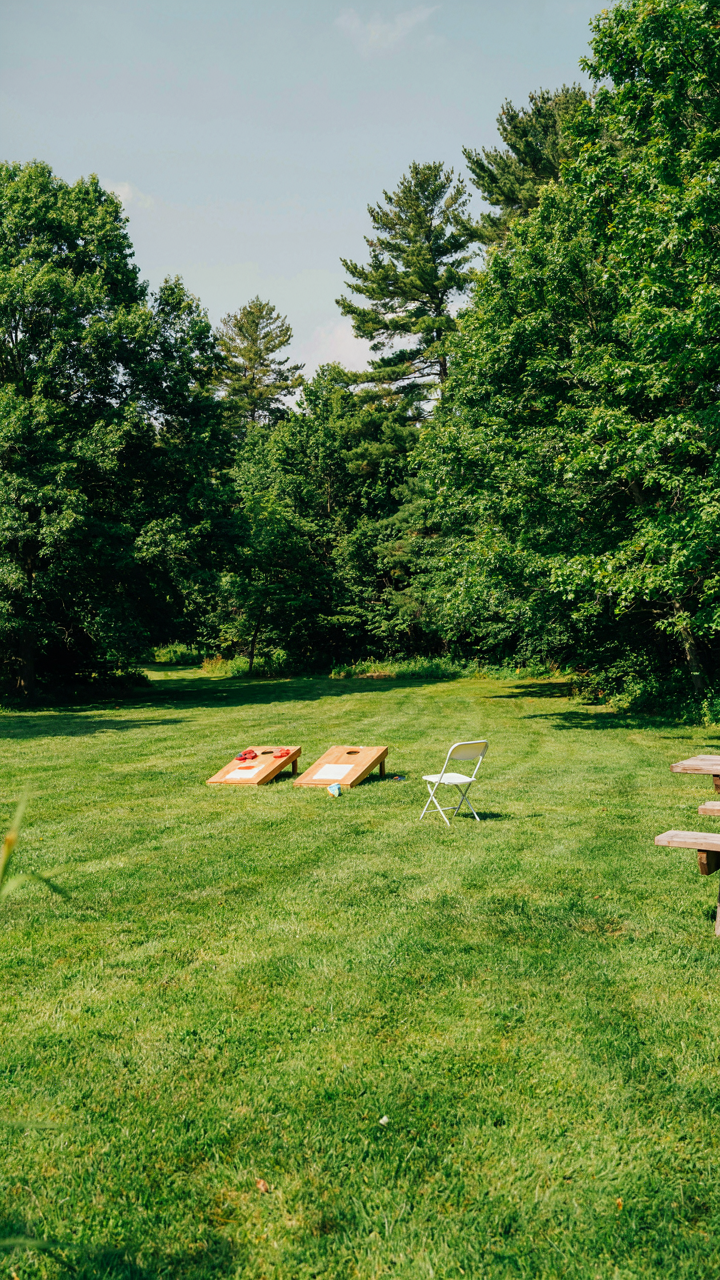
You want guests moving because stillness reads as awkward, and you’re terrified of the dead zone where people cluster by the bar avoiding eye contact. Military strategy calls this “force projection”—the deliberate positioning of assets to control space without announcing it. Lawn games work the same way. Place cornhole at the far perimeter, not ten feet from the reception tent. The distance forces a micro-commitment. Guests who walk that far have already decided to engage. The game becomes the destination, not the afterthought they stumble into.

Spacing matters more than the game itself. Standard reception layouts fail because they cluster all activities in one visible zone, creating a bottleneck. Spread your games across the lawn using the natural geometry of the space. If your venue has tree lines, gazebos, or elevation changes, use them as anchors for game stations. Each station should exist in its own visual field so guests can’t see all options at once. Mystery pulls people forward. They’ll explore a lawn they think has hidden corners. One concrete move: measure thirty paces from your main tent, then place your first game station there.
Funnel Movement Without Announcing The Path
Most advice says “arrange games in a circle” or “spread them evenly.” That’s lazy. You need a hidden current that moves people through zones without feeling choreographed. Think of it like water flow—guests should move toward games because the lawn’s geometry makes them feel like natural gathering points, not because you drew arrows on a map. Place your highest-energy game (cornhole, ladder toss) in the middle distance where it’s visible but requires intent to reach. Position lower-noise games (giant Jenga, card games) closer to seating areas for people who want to participate but not broadcast it.
The sequence matters. Someone arrives, sees the middle-distance game, walks toward it. That walk passes your second station organically. After they finish, the next game site is visible from where they stand. You’ve created a loop without a rope. Test this by walking your lawn from the guest entrance. Mark where your eye naturally stops. Those stops are your station points. If you have to look hard to find the next game, so will your guests. The goal is attention flow: guests see the next station before they finish the current one.
Repurposed Play: Upcycling For Unique Lawn Games For Wedding

Turn Trash Into Playable Assets
You want to look resourceful without looking broke. The real mechanism is this: constraint forces specificity. When you build games from objects you already own or source cheaply, you eliminate the generic. You’re not buying a cornhole set that fifty weddings bought. You’re solving a specific problem with a specific solution, and that becomes memorable.

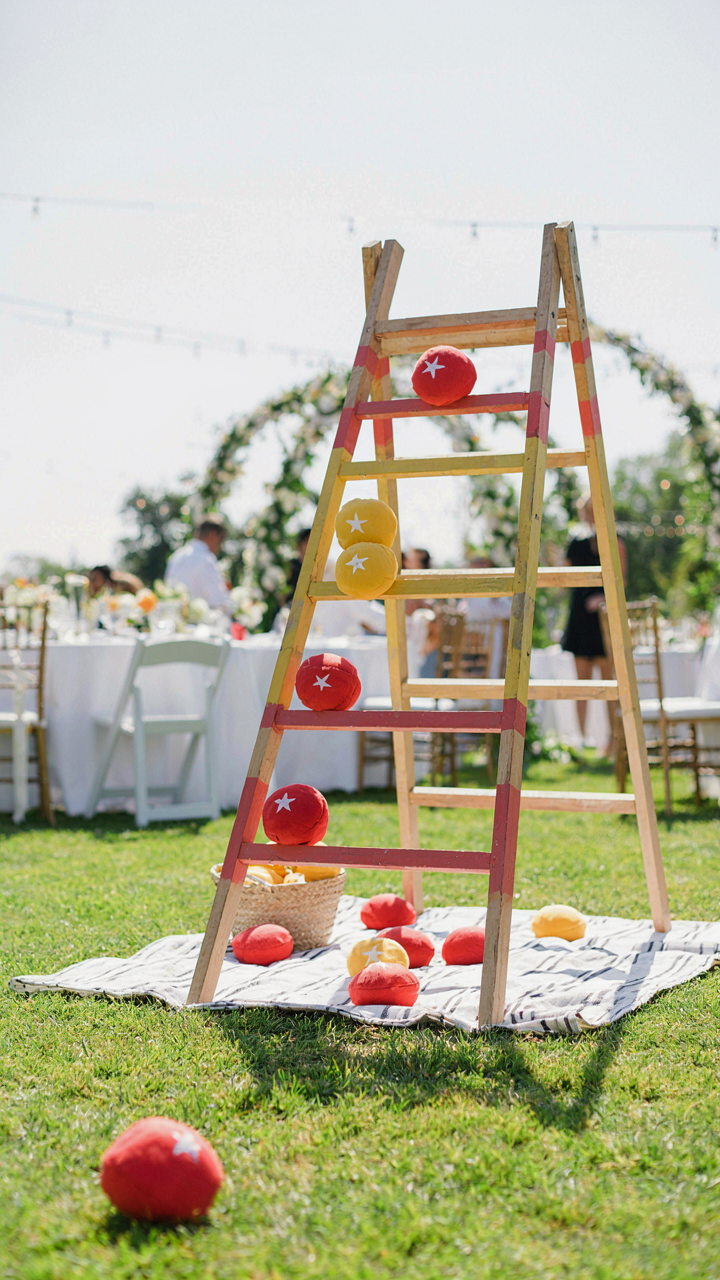
Upcycling borrows from systems thinking in industrial design. In that field, designers map “material flows” to eliminate waste. For lawn games, you reverse the flow: you take discarded materials and redirect them into entertainment. A wooden ladder becomes a toss target. Mason jars become ring-toss vessels. Wine bottles become bowling pins. The constraint isn’t a limitation. It’s your competitive advantage.
Source Materials Without Paying Retail
Most advice says “check Facebook Marketplace and thrift stores.” That’s incomplete. The real sourcing happens before you search. You need to define what materials your games require, then hunt for those materials specifically. A pallet upcycled cornhole game needs two pallets and plywood. Vintage bottle toss needs glass bottles. Once you know what you need, you search Craigslist, estate sales, Buy Nothing groups, and local Facebook Marketplace with exact terms.
The speed of finding materials matters because your wedding date is fixed. Start material sourcing six to eight weeks before the event. Estate sales and auctions produce the highest volume of cheap, unusual objects. Online marketplaces move faster but cost slightly more. Buy Nothing groups move slower but are free. Hit all three channels simultaneously. When you find the right material, commit to it immediately. Availability of specific items is not reliable enough to delay.
The Low Fi Engagement Rule For Outdoor Wedding Activities For Guests

Rules That Don’t Require A Rulebook
You want lawn games at your wedding because you think they signal sophistication and planning. They don’t. They signal you understand a basic mechanism from systems design: friction kills participation. The fewer rules guests must hold in their head before playing, the more bodies actually show up. Games with one objective and two constraints outperform complex rule sets every time, regardless of how clever the rules are.

Cornhole works because people understand it in five seconds. Ladder toss works for the same reason. The cognitive load stays under the threshold where guests decide it’s not worth their energy. Write your rules on a single card. If they don’t fit, you’ve already lost half your audience before they touch the equipment. Test this by reading instructions aloud to three people who weren’t at planning meetings. If anyone asks clarifying questions, cut the rules down further.
Removing The Setup Barrier Entirely
Most wedding game instructions fail because they front-load explanations before people touch anything. This is backward. Borrowing from behavioral economics, you want to minimize what researchers call activation energy—the effort required before someone tries something new. Games that let guests figure out the basic mechanic through one attempt generate immediate participation. Games that require listening to a five-minute explanation generate excuses to check phones instead.
Cornhole again: people see two boards, one bag, one hole. They throw. They learn. Washer toss works the same way. Giant Jenga needs no explanation. The mechanism here is simple—let people discover the game through action, not words. Set up your game stations with one example completed and let guests copy it. Don’t assign someone to stand there explaining. The social pressure of watching others play teaches faster and feels less like work.
Beyond Board Games: The Power Of Oversized Wedding Outdoor Games
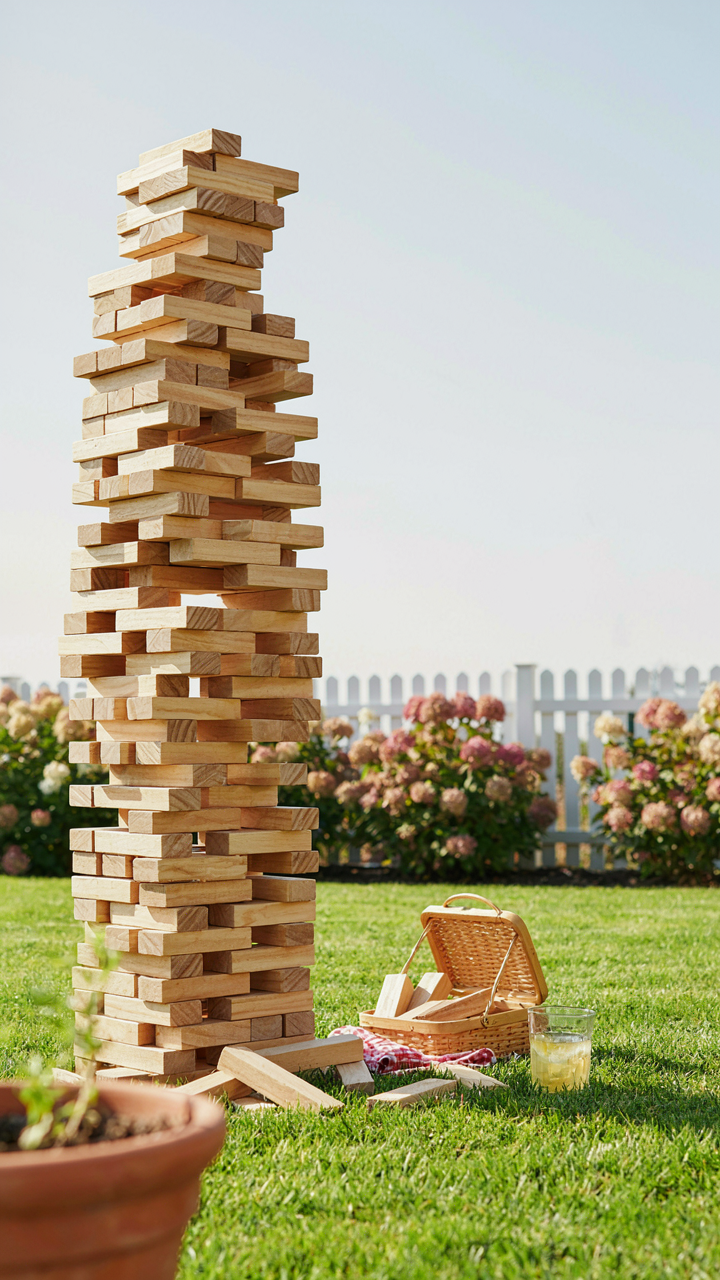
When Scale Becomes The Venue
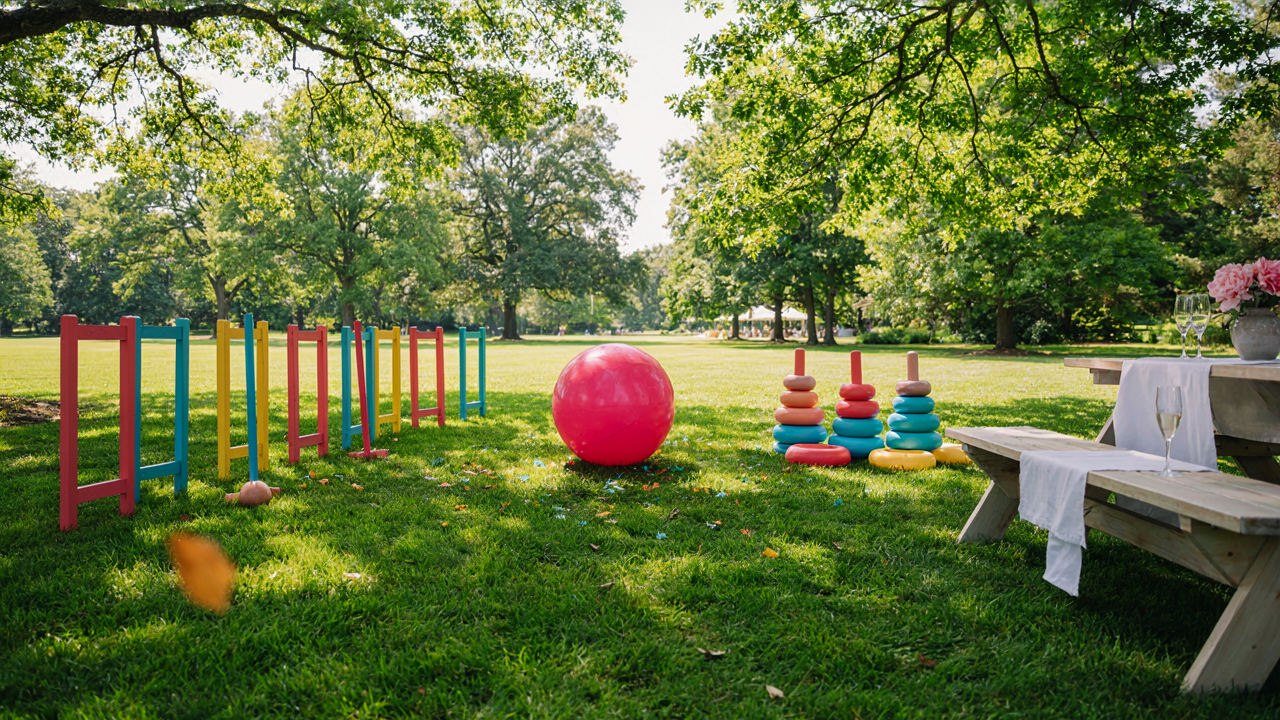
You want people to talk about your wedding for years. That’s the real reason you care about this section. Scale is attention. Oversized games create focal points that shrink the physical space psychologically, borrowing from architecture’s concept of “prospect and refuge”—people feel drawn toward and contained by large structures. A six-foot Jenga tower doesn’t just entertain. It commands the lawn and forces guests into proximity with each other.

The mechanism is simple: humans process size before detail. A standard cornhole setup disappears into the landscape. A four-by-four-foot lawn Uno board becomes geography. Your guests organize themselves around it without thinking. This transforms passive lawn sitting into active participation zones. You’re not decorating the space. You’re redesigning it.
Building Scaled Versions That Actually Work
Most advice says “just make it bigger.” That’s lazy. The real problem is structural integrity and playability at scale. Giant Jenga requires wood that doesn’t warp—typically 2×4 pine or pressure-treated lumber cut to exact lengths so stacking remains true. Giant cornhole needs weighted bags heavy enough to fly straight in wind, not feather boards that tilt in the grass. Oversized versions fail when people ignore physics: weight distribution, wind resistance, and ground stability matter more than size.
Build with material that won’t fail mid-game. Use galvanized hardware for outdoor durability. Test your scaling math before construction—if standard dice are one inch, a three-foot die requires proportional weight so it rolls without getting stuck in grass. Most DIY giant games fail because builders prioritize visual size over playable mechanics. The game stops being fun when it doesn’t work consistently.
The Curation Framework: Selecting Impactful Wedding Games Outdoor

Know Your Crowd First
You want games that make you look thoughtful, but you’re actually afraid of dead airtime and awkward silence. That’s the real problem. The mechanism is this: games only work when they match the energy level and social comfort of your specific guests, not some imaginary ideal wedding crowd. A cornhole tournament kills momentum with your introverted aunt’s friend group but lands perfectly with your college crew. Demographic matching isn’t about pigeonholing people. It’s about friction reduction. Lower friction means higher participation, which eliminates the void that makes receptions feel flat.
- Age Range: Younger guests gravitate toward physical games with speed components like relay races or giant Jenga. Older guests prefer strategic games with lower injury risk like ladder toss or horseshoes with longer rounds.
- Athletic Ability: Mixed fitness levels need games where skill matters less than luck or team dynamics. Lawn bowling and bocce ball work across ability ranges; three-legged races expose gaps in coordination.
- Social Proximity: Guest groups who already know each other engage faster in competitive games. Strangers need cooperative or observational games first to build comfort before head-to-head matchups.
- Cultural Background: Some guest groups have existing game traditions or sports preferences. Badminton resonates strongly in Indian and Southeast Asian crowds. Recognize these patterns and build on them.
- Alcohol Consumption Patterns: A heavy-drinking crowd needs games with built-in downtime and lower coordination demands. Sober or moderate-drinking crowds tolerate faster-paced games with tighter skill requirements.

Run a quick audit before finalizing your game selection. Scan your guest list for obvious clusters: work friends, college friends, family units, and outliers. Pick one game per cluster and cross-test it mentally against that group’s typical behavior. If you can’t visualize them playing it without friction, swap it out. This step prevents the waste of setup time and the social awkwardness of nobody joining in.
Alignment With Your Visual Theme
Thematic consistency isn’t decoration. It’s a signal that reduces cognitive load on your guests. When your games match your wedding’s stated aesthetic, people instantly understand what they’re supposed to do and feel. This is borrowed from environmental psychology and specifically, the principle of affordance: an object signals its own use through design. A vintage lawn game setup with distressed wood and muted colors affords “relaxed, nostalgic participation.” The same game in neon with blaring music affords “high-energy, competitive vibes.” Your guests read these signals unconsciously and adjust their behavior accordingly.
A bohemian wedding with macramé and earth tones needs games that feel organic and communal: giant Jenga, croquet, or cornhole. A modern minimalist wedding wants games with clean lines and simple rules: ladder toss or giant Connect Four. A black-tie formal event accommodates lawn games only if they’re presented as ironic, retro touches, not primary entertainment. The disconnect between your theme and your games creates jarring moments where guests feel like they’ve walked into a different event. Solve this by selecting games that reinforce your stated aesthetic. The game hardware, the scoring display, the photo backdrop around it, and the way you announce it all need to whisper the same story your flowers and music are already telling.
Maintenance & Management: Keeping Outdoor Wedding Lawn Games Flowing
The Setup Protocol That Prevents Chaos
You’re worried about looking unprepared, which is why you’re reading this. The real issue isn’t complexity—it’s that most couples treat game setup like decoration instead of operations. Borrow from event production: your lawn games need a load-in sequence. This means designating zones before guests arrive, staging equipment in order of deployment, and running a single test round with your crew to catch friction points.

Write down the exact order games appear and disappear. Assign one person per game station starting thirty minutes before cocktail hour ends. That person checks equipment for damage, resets scoring, and manages the flow of groups rotating through. This isn’t optional busywork—it’s the difference between smooth engagement and a graveyard of abandoned cornhole boards.
Assigning Roles Without Burning Out Your People
Don’t ask your best man to “manage games.” That’s vague and he’ll either micro-manage or ghost. Instead, create three specific roles: equipment lead (handles setup and breakdown), station monitor (watches one or two games during service), and score tracker (keeps records if you’re running a tournament). Match these roles to people based on their actual capacity, not their title in the wedding party.
The equipment lead gets a checklist and starts two hours before guests arrive. Each station monitor covers a ninety-minute window and rotates out. The score tracker only engages if you’re running a bracket or leaderboard—otherwise skip this role entirely. Brief all three roles in a five-minute huddle forty minutes before guests eat. Make it clear that their job ends when the last game stops, not when they feel like walking away.
The Real Obstacle Isn’t Your Budget; It’s Your Willingness To Transcend Generic Expectations And Truly Design For Engagement

Most couples default to cornhole and lawn jenga because they’re safe defaults, not because they’re good design. You have permission to reject that. Pick one game from this list that genuinely excites you, then spend thirty minutes today customizing it to your actual guests. Make it weird. Make it yours. The couples people actually remember aren’t the ones who played it safe with their lawn games, they’re the ones bold enough to build something nobody expected.