The “No Fluff” Wedding RSVP Wording Protocol

Ask What You Actually Need To Know
You care about this because vague RSVP language costs you money and creates chaos weeks before the event. The mechanism is simple: every word on an RSVP card either captures actionable data or it wastes space. Most couples write what sounds nice instead of what solves the problem. You need questions with one correct answer, not interpretive guesswork.
Standard advice says “keep it warm and friendly.” That’s incomplete. Warmth doesn’t feed people or assign seating. Your RSVP card is a data collection tool dressed in etiquette. Strip away the decorative language and ask for attendance, meal choice, dietary restrictions, and song requests if relevant. Nothing else belongs on that card.
Collect Only What Moves The Plan Forward
Guest count determines catering costs. Meal preference determines menu quantities and kitchen workflow. Dietary restrictions determine what plates you prepare. Song requests determine what your DJ plays. Everything else is decoration. This follows information design from systems thinking: capture the minimum viable data set required to execute the event.
Write lines like “Will you attend?” with yes or no boxes. Then “Entrée choice” with three options. Then “Dietary restrictions” with space for text. Then nothing. Every field you add increases response friction and creates interpretation work. The couple who asks for the guest’s favorite cocktail is gathering data they cannot action. Strip it. Your card should take sixty seconds to complete, not two minutes.
How To Word Rsvp Cards For Wedding: Beyond “Delightfully Accept”

Say What You Mean, Not What Sounds Fancy
You’re worried the wrong phrasing makes you look unsophisticated. The mechanism is simpler: guests respond to clarity, not vocabulary. “Delightfully accept” performs status but kills comprehension. Your job is to extract a binary decision from each guest, nothing more. Strip the performance.

Use direct language that forces specificity. “We will attend” beats “we would be delighted to accept your kind invitation.” Say the meal choice plainly: “Chicken or fish” instead of “protein selection.” Guests decode fast language instantly. They stumble on ornate phrasing and second-guess their own responses. The card’s job is to reduce friction, not to showcase diction.
Stop Hiding Behind Passive Construction
The common advice says to stay formal and proper. That’s incomplete. Passive voice in RSVP wording creates ambiguity around who does what, which tanks response rates. Replace “your presence is requested” with “we need your response by June 15th.” One names action. The other names a passive request.
Write active sentences that assign clear responsibility. “Please reply by this date” outperforms “replies are requested by this date.” The first tells guests what they own. The second diffuses responsibility into the ether. One sentence structure cuts response delays measurably. The other invites procrastination because no one feels directly addressed.
The Budgeter’s RSVP Blueprint: Cost Control Through Clarity
Lock Down Your Headcount First
You care about this because an unclear RSVP kills your budget before the caterer even quotes you. Headcount precision is like inventory control in operations management: every unit you fail to track becomes invisible waste. Your RSVP card must force a binary choice on meal selection. No “let us know later.” No “dietary preferences TBD.” Strip the ambiguity that lets guests defer decisions and inflates your final numbers by 10 to 15 percent.

State the deadline as a specific date, not “two weeks before.” Name the exact number of guests each party can bring. If children attend, list them separately. If you need a plus-one decision, make it a yes-or-no box, not a name field. The moment you allow open-ended input, you’ve handed control to people who don’t care about your margins. Your card should read like a legal document, not an invitation to negotiate.
Stop Hidden Costs Before They Form
Common advice says to be “warm and welcoming” on your RSVP text. That’s incomplete. You need to state what you are and are not paying for upfront, or guests will assume coverage that tanks your budget. Explicit wording about alcohol, dietary accommodations, and plus-one policies prevents the email cascade two weeks out where someone asks if their fiancé counts as their plus-one.
If your caterer charges per-plate and per-person costs vary by meal type, your RSVP must specify each option and its implications. Say “select one entrée per person” not “let us know your preference.” Include language that locks in numbers: “Guest count after [date] cannot change.” This removes the social friction that makes people hesitate to enforce boundaries. You build cost control into the card itself, not into awkward follow-up conversations nobody wants to have.
How To Word RSVP On Wedding Invitation: The Information Architecture

What Your Guests Actually Need To Decide
You care about this because unclear RSVP wording tanks your headcount accuracy, which destroys catering math and floors your vendor timeline. The mechanism is simple: your guests process information in layers. They scan first, read second, and decide third. Most wedding RSVP cards violate this order by burying the actual question under decorative text. Strip the card to its functional skeleton and guests respond faster and more accurately.

The information hierarchy on an RSVP card mirrors how the human eye moves through printed material, borrowed from graphic design’s Z-pattern principle. Your card’s visual weight determines what guests process first. The guest name line, the response deadline, and the actual RSVP question must occupy different visual zones. Cramming all three into equal type sizes creates cognitive friction. Guests hesitate. Some miss the deadline entirely. Others guess at what you’re asking.
Scannable Format Trumps Symmetry
Centered, symmetrical layouts look traditional but destroy scannability. Guests stop reading after the first line. Left-aligned blocks with clear white space force the eye to move intentionally through each decision point. Your deadline should not hide in tiny type at the bottom. The meal choice should not be an afterthought squeezed into a corner. Establish visual dominance through type size and spatial separation, not decoration.
Use line breaks aggressively between sections. One blank line between the guest name field and the response date. Another blank line before meal options. Each section occupies its own spatial territory. This makes the card feel less cluttered, even when it contains more information. Guests move through it methodically instead of scanning randomly and missing critical details. The RSVP response itself should be the visual anchor: the line or checkbox that drives the entire card’s layout.
What To Write On RSVP Card: The Psychology Of Response

How Small Friction Changes Behavior
You care about this because a low RSVP rate feels like rejection, and you want proof that people actually want to come. The real mechanism is friction. Behavioral economics shows that tiny obstacles kill behavior completion. Every extra step a guest must take to RSVP tanks your response rate. Handwritten addresses require effort. Phone calls require commitment. Online forms with three pages require decision fatigue. Your RSVP card wording removes friction by making the action so simple that compliance becomes automatic.

The mechanism works because humans default to inaction. A guest receives your invitation and intends to respond. Then life happens. They set it down. Three weeks pass. Your card disappears. But if your wording makes response a two-second task, you bypass the delay entirely. Eliminate questions. Kill ambiguity. Make yes or no the only viable options. This is why RSVP card wording matters more than the card’s color or the invitation’s design budget.
The Deadline As Commitment Device
Scarcity and commitment principles from economics apply directly here. A deadline without teeth is just text. Your RSVP card deadline only works if three conditions align: a specific date stated clearly, a reason that justifies the date, and zero exceptions communicated in advance. Most couples write “Please respond by June 15th” and wonder why responses trickle in after the wedding. The date exists but carries no weight. You need the deadline to feel like a real constraint, not a suggestion.
State the deadline with one sentence that names the consequence. “We need final headcount by June 1st to confirm seating and menu selections with our venue.” This ties the deadline to something guests understand. Commitment psychology says people honor deadlines they perceive as necessary for someone else’s planning, not arbitrary cutoffs. Your deadline is the hinge point where casual interest becomes active commitment. Place it visibly on the card. Make it impossible to miss. Then enforce it by stopping responses after that date without exception.
Wedding RSVP Wording Etiquette: Debunking Tradition For Efficiency
When Formality Becomes A Liability
You care about “proper” phrasing because you’re afraid of looking cheap or careless, but tradition on RSVP cards actually tanks response rates. The mechanism is simple: ornate language creates friction. Guests skip cards they don’t understand or that feel performative. Victorian-era phrasing made sense when RSVPs were formal social signals. Now they’re logistics tools. The difference matters. Couples who strip away archaic language and replace it with clear directives get faster, more complete responses.

Standard templates tell you to write “The pleasure of your company is requested.” That’s wrong. It’s vague, it sounds like an obligation, and it doesn’t tell guests what to actually do or when. The real move is naming the specific action and deadline in plain English. “Please respond by June 15” beats “Kindest regards, your timely reply is anticipated” every single time. One communicates. The other performs.
Clarity Over Courtesy
Response rates track directly with instruction simplicity, a principle borrowed from systems design where friction equals abandonment. Your RSVP card operates like a conversion funnel: the fewer steps and clearer the call, the higher your completion rate. Most couples bury the deadline in decorative text and scatter response methods across multiple sentences. Guests then guess whether they’re mailing a card, texting a number, or using a website. Some do nothing because the path isn’t obvious.
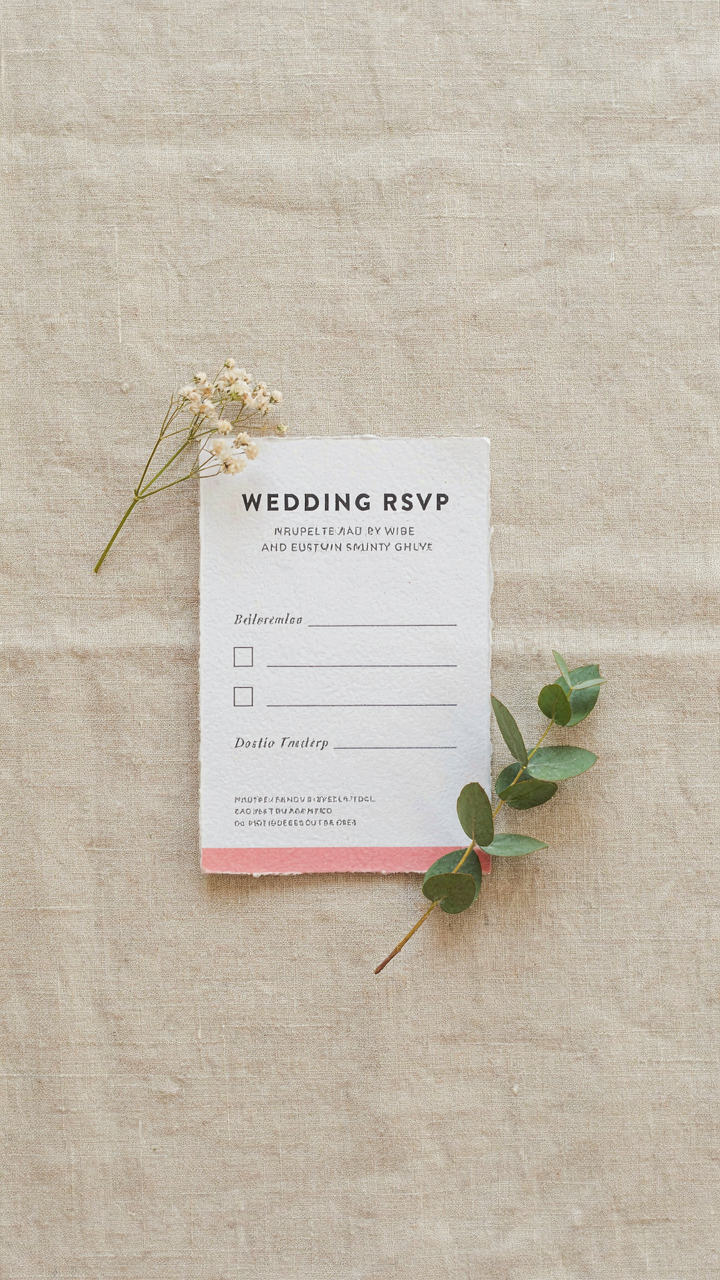
Cut the ceremony. Put “RSVP by [date]” at the top in bold or a larger font. List one response method directly below it. Use a checkbox for “attending” and “not attending” rather than fill-in-the-blank phrasing that feels like homework. Include meal choices only if they’re actually different enough to affect catering. Remove every word that doesn’t move a guest toward a yes or no answer. The card that gets responses isn’t the prettiest one. It’s the one that makes deciding take five seconds.
Wedding Reply Card Wording: Digital Vs. Physical RSVP Efficiency

When To Use Online RSVPs
You want online RSVPs because they feel modern and cost-effective. The real mechanism is tracking and compliance. Digital systems capture responses in real time, eliminate handwriting errors, and automatically compile guest counts. Paper cards introduce friction at every step: mail delays, illegible names, manual data entry, lost responses. The tradeoff is psychological. Guests treat physical cards as artifacts worth responding to. Digital requests feel optional.

Online RSVPs work when your guest list skews younger or tech-comfortable. Response rates drop 10 to 20 percent when you ask people to navigate a custom wedding website or fill a form on their phones. Paper cards still generate higher compliance rates, particularly among older guests and those unfamiliar with your specific platform. Choose based on your actual guest demographics, not what sounds efficient.
When Paper Cards Still Win
Physical RSVP cards create friction that improves response rates. The mechanism comes from behavioral economics: friction increases commitment. A guest who writes their name on a card and addresses an envelope experiences a small act of compliance that makes cancellation harder. Digital responses allow for passive abandonment. No completed form means no guilt. Paper cards demand active refusal.
The wording on a paper card must eliminate every barrier to response. Remove ambiguity about where the card goes, when to send it, and what information you need. Print a return address in full. State the deadline date twice: once as “by” and once as the actual date. Ask only for names and meal preferences. Remove the question “Number of guests attending” and replace it with specific lines for each guest’s name. One unclear line kills your response rate.
The Uninvited Plus One Elimination Method
State Your Numbers Upfront
You’re worried about losing control of your guest list. Here’s the mechanism: ambiguity on the RSVP card creates a vacuum that people fill with their own assumptions. The economics of weddings demand scarcity pricing, and your card is the contract that sets the price. Be explicit about who gets a plus-one and who doesn’t. Vague wording signals negotiation room, which you don’t have.
- “Number of Guests in Your Party”: State the exact count on the card itself. Write “2” or “3” directly on the line, not as a blank to be filled. Removes interpretation entirely.
- “Guest Names Required”: List spaces for each invited person by name. Pre-print names if you know them. Makes it impossible to add mystery attendees without crossing out your printed text.
- “Plus-One Included” or “No Plus-Ones”: Write this sentence clearly at the top of the response section. No hedging, no euphemisms. One sentence, one meaning.
- “Children Under 12 Not Invited”: If you’re not inviting kids, state it directly. Prevents the “I assumed my toddler was welcome” conversation after the fact.
- “Additional Guests May Request Approval”: If you want flexibility without opening the floodgates, name the process. Make them ask you directly, not fill a blank on cardstock.

Most couples skip this because they fear looking rude. You’re not being rude. You’re being clear. Clarity is the only tool that stops the person who calls two days before the wedding asking if they can bring their cousin who’s in town.
What To Do When They Ignore The Card
People will still try to add names. This happens whether your card is explicit or vague. The difference is your leverage. When someone calls or emails requesting an addition not listed on your card, you have grounds to decline. You didn’t fail to communicate. They ignored your communication.
Set a single point of contact for these requests and respond within 24 hours with a simple answer: yes or no. Don’t apologize. Don’t over-explain. If capacity allows, approve it. If not, decline and suggest they attend solo. Make the protocol clear so your wedding coordinator or a trusted friend can handle overflow requests without escalating to you constantly.
Wedding Invitation Response Wording: Post RSVP Follow Up Strategy

When Non Responders Become Your Problem
You’re stressed about headcount because you’ve already paid deposits and you need numbers now. Here’s the mechanism: non-responders aren’t rude or forgetful—they’re uncertain. They haven’t made a decision yet, so your RSVP card wording hasn’t resolved their internal conflict. Most couples wait until three days before the deadline to send reminders, which is too late. The real play is embedding a response deadline directly into your card wording that feels like a natural fact, not a nag.

Your wording should state the deadline as a hard cutoff: “Kindly respond by March 15” works better than “We’d love to hear from you soon.” The first version removes ambiguity. The second version creates wiggle room in the responder’s mind. Set your actual deadline ten days before your final headcount needs to go to catering. This gives you a buffer to contact no-shows before they think about it more.
Direct Communication Beats Automation
Automated reminder emails and texts look impersonal because they are. The psychology comes from sales funnels, not wedding etiquette—a threshold concept where repeated exposure increases compliance, but only when the sender appears human. Most couples send one generic reminder and call it done. That fails because a single touchpoint doesn’t break through decision paralysis.
Your follow up should be a direct phone call or text to people you know personally, and a second email to distant guests. The email should reference their original invitation by date and restate the deadline. Don’t apologize or ask if they received it. Simply say: “We need your response by March 15 to finalize catering. Can you confirm attendance?” This removes social friction and forces a yes or no. Document every response in a spreadsheet so you know exactly who hasn’t answered before you make final calls to venues.
The Real Obstacle Isn’t Wording; It’s Your Fear Of Direct Communication

You’re overthinking the wording because you’re afraid to ask for what you need. Your guests don’t care about fancy phrasing. They care that you’re clear. Stop hiding behind template language and write what matters: how many people you’re feeding, when they need to tell you, and what happens if they don’t. Pick up your phone right now and text one friend exactly what you’d say face to face. That’s your card. People respect directness because it means you respect their time.