The Illusion Of “Affordable” Rooftop Wedding Packages

Package Deals Bleed Your Budget Dry
You want the peace of mind that comes with an all-in-one price. That’s the real draw here, not savings. Venues use packages to anchor your perception of cost and hide margin. They bundle high-markup items (bar minimums, service charges, rental fees) with low-margin basics (tables, chairs) so the bundle looks reasonable while they extract maximum revenue per guest.
The math works against you because packages force you to pay for services you don’t need at quantities you didn’t choose. You get charged for a full bar minimum even if half your guests don’t drink. You pay for their preferred caterer at their negotiated markup. You accept their timeline and staffing levels because “it’s included.” The venue makes money three ways: the package price, the overages you’ll hit, and the vendor kickbacks embedded in the deal.
Unbundling Services For True Cost Control
Economics calls this “decoupling”—separating bundled offerings so each component prices independently. Do this with your rooftop bar wedding. Negotiate the venue rental fee separate from catering, bar service, and rentals. This forces transparency and removes the vendor’s ability to hide margins in the bundle.
Request an itemized breakdown of what the package actually includes: hourly rental cost, staffing costs, bar setup fees, equipment rentals, service charges, and gratuity percentages applied separately. Then price those items with outside vendors. Most rooftop bars will reduce their rental fee if you bring your own caterer and bar service. You’ll find you save 15 to 25 percent by unbundling, and you control exactly what you’re paying for each service. Demand the venue provide this breakdown before you commit to anything.
Rooftop Party Venues: Beyond Peak Season Extortion

Off Peak Dates Leverage Market Inefficiencies
You’re afraid you’ll miss the “right” season and end up with a mediocre wedding. That’s what venues exploit. In economics, this is called price discrimination: vendors charge different rates based on perceived demand. Rooftop bars use season as the lever. June through October commands 40 to 60 percent premiums over November through March, not because the space changed, but because couples believe peak season matters more than it does.

The actual mechanism is simple: venues front-load their calendar with peak dates at high rates, then discount off-peak slots to fill capacity. November through early March sits empty on their books. They’d rather book a Friday in February at 30 percent off than leave it vacant. Contact venues in late summer about winter dates. You’ll find negotiable pricing that peak-season couples never see. The roof doesn’t care what month it is. Your guests won’t either if the weather works.
Weekday Weddings Exploiting Demand Dips
Friday and Saturday weddings command premiums because that’s when most people expect weddings to happen. Demand creates price. A Wednesday or Thursday rooftop wedding costs 25 to 50 percent less for the same space and service, yet delivers identical quality. Venues staff these nights anyway, so the marginal cost to them is near zero. They profit on every Thursday booking they’d otherwise lose entirely.
The real play: weekday weddings also reduce competition for vendor time. Photographers, caterers, and bartenders price lower on Tuesdays because their calendar is thinner. You stack savings across every vendor, not just the venue. Book your rooftop for Wednesday through Thursday in off-peak months, and you compress your budget by half while securing better rates from your entire team. The venue gets predictable revenue. You get the same rooftop at a fraction of peak pricing.
The “DIY Or Die” Rooftop Wedding Reception Protocol
Pick Vendors By Function, Not Portfolio
You want to hire the name-brand vendor because their Instagram makes you feel secure. That’s the real reason, and it’s costing you thousands. The mechanism is simple: you’re confusing brand equity with competence in a one-off event. A rooftop bar wedding needs vendors who excel at solving specific problems, not vendors who solved them beautifully for someone else’s vision.
- Catering: Find restaurants or caterers who already operate in your building or neighborhood. They know the kitchen, the load-in logistics, and the fire code constraints. Skip the wedding-specific catering company unless your rooftop has zero food prep capacity.
- Photography: Hire someone shooting real estate or restaurant openings. They understand harsh sunlight, reflective surfaces, and tight spaces. Wedding photographers often overprice because they’ve learned to market emotion rather than solve technical problems.
- Sound and Lighting: Ask the rooftop bar’s existing tech team what they can handle in-house. Most bars already have sound systems and some lighting. A standalone AV company will quote you double what a tech-savvy bar operator charges to augment their own rig.
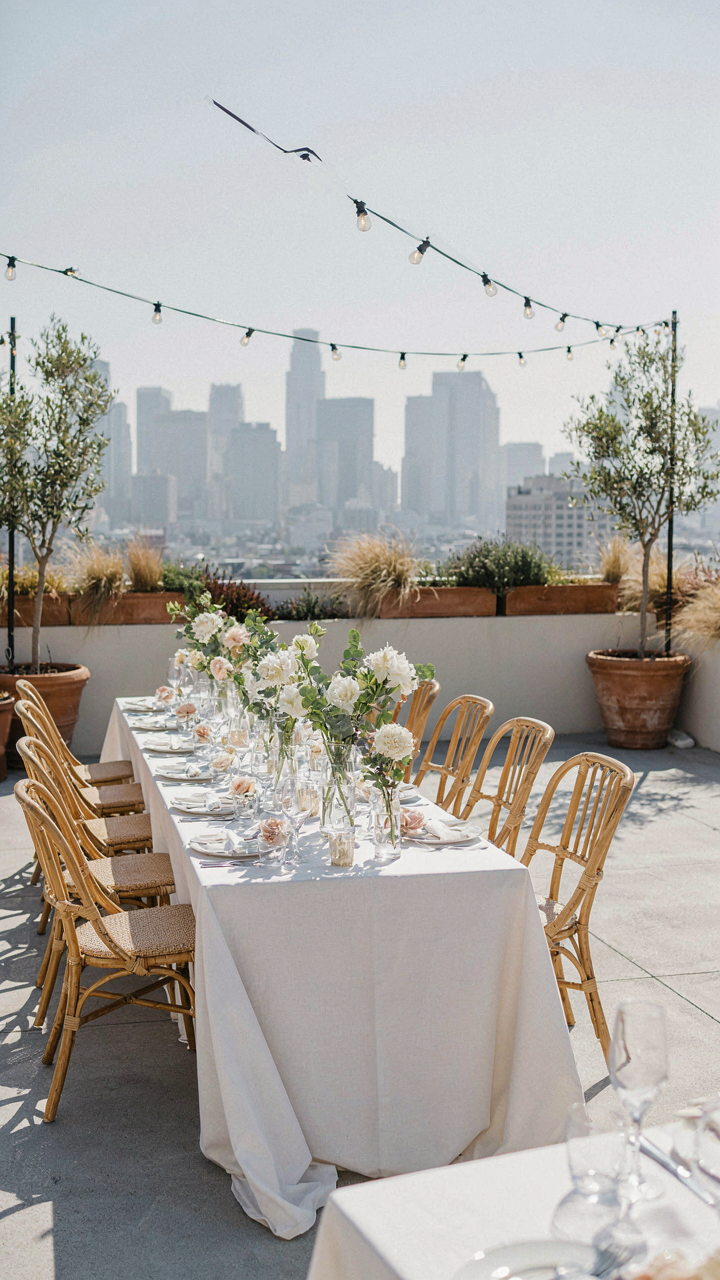
- Floral and Decor: Work with local florists who do restaurant installations or event design, not wedding specialists. They cost 30 to 40 percent less and understand spatial constraints because they work in constrained spaces constantly.
- Rentals: Compare independent table and chair rental companies against the big players. Independents move inventory faster and will negotiate on rooftop-specific items like weather covers or weighted bases. Call five companies and you’ll find a $1,500 swing on the same order.

The real move is this: call the rooftop bar’s general manager and ask who they already trust. They’ve seen dozens of vendors perform under pressure. Their recommendations come with proof, not marketing.
Assign Roles Before You Assign Tasks
The common advice is “delegate.” That’s useless. Vague delegation creates chaos and forces you to manage the same task twice. Use an assignment matrix from operations management: define role, authority level, and decision boundary for each person before the first task lands on their desk.
Your maid of honor owns timeline and vendor communication, period. Your best man handles day-of coordination and troubleshoots on the spot. A competent friend runs the music queue and keeps the sound level consistent. Your partner’s sister who works events? She runs the food service flow. Write these down and send them before anyone feels confused. Each person needs to know not just what they own, but what they’re allowed to decide without asking you. That boundary saves your sanity and prevents bottlenecks on the wedding day itself.
Rooftop Engagement Party: Micro Events, Macro Impact

The Brutal Guest List Edit
You want to invite everyone because saying no feels like rejection. Here’s the mechanism: every additional guest on a rooftop venue multiplies your per-person cost, but more importantly, it dilutes the actual experience you’re trying to create. Engagement parties work because they’re intimate. Fifty people on a rooftop bar costs differently than twenty. You pay for space rental, minimum bar spend, and staffing based on headcount. Cut ruthlessly.

The real math is simple. A rooftop bar in most markets charges per-person minimums between forty and one hundred dollars depending on location and time. Twenty guests at eighty dollars minimum is sixteen hundred. Fifty guests is four thousand. The difference isn’t just numbers on a spreadsheet. It’s whether your bartender remembers names or treats it like a transaction. It’s whether conversations actually happen or people stand in clusters checking their phones. Invite the people who will talk to each other, not the people you feel obligated to.
Moments Over Decor
Generic wedding advice says fill a rooftop with flowers and linens. That’s wrong. You’re renting a venue with a view already built in. The moment doesn’t need props. It needs proximity, good drinks, and a reason people showed up. Engagement parties fail when they become about Instagram aesthetics and succeed when they become about the actual people in the room.
Budget constraint forces clarity here. Skip the centerpieces, the uplighting, the rented furniture you’ll return unused. Spend money on a solid bartender who knows how to make drinks, good music at appropriate volume, and maybe one intentional detail that matches your taste, not a trend. That detail could be a custom cocktail menu, a specific record on rotation, or nothing visual at all. The rooftop bar venue budget compresses when you stop treating decor as mandatory and start treating presence as the product.
Rooftop Wedding Ceremony: The Spartan Aesthetic Principle

Amplify The Existing View
You want permission to spend less and still look intentional. That’s the real ask here. The mechanism is borrowed from graphic design: negative space. Empty room costs nothing but reads as control. A rooftop with a view is already doing the visual work. Your job is removal, not addition.

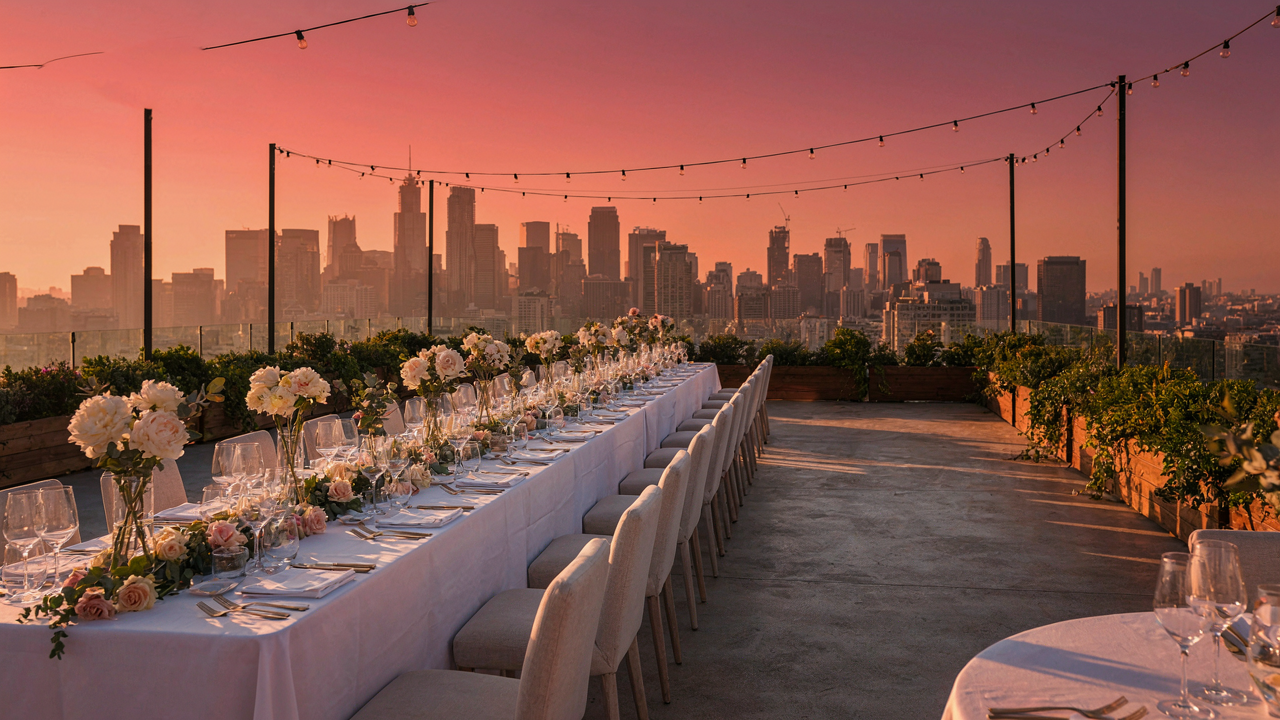
Most couples fight the site and lose. They drape fabric, hang Edison bulbs, plant florals everywhere. They turn a $40,000 view into a $15,000 backdrop. The spartan move is inverse: let the skyline breathe. Three statement pieces beat thirty scattered ones. A single floral arch frames the ceremony without competing. Low table arrangements let guests see the city, not flower stems.
Golden Hour Mechanics
Light is physics applied to your wallet. The term from cinematography is motivation, which means your light source must justify its presence narratively. Here, golden hour is free fill light that softens skin, deepens colors, and makes mediocre decor look crafted. Schedule your ceremony ninety minutes before sunset and you eliminate the need for uplighting or rental string lights.
Vendors will upsell you on lighting. Ignore them until after 6 PM. A rooftop at sunset requires zero artificial enhancement. You pay for what the sun already gave you. Book your slot early enough that natural light does the work photography relies on. The concrete detail: confirm your rooftop faces west or has clear western exposure before booking.
The Bartering Economy Of Rooftop Wedding Ideas

Trade Your Skills For Vendor Discounts
You want to cut your venue costs without looking cheap. Here’s what nobody says plainly: the rooftop bar wedding vendor economy runs on barter because cash margins are thin and vendors need services they’d otherwise pay for. Think of this as supply chain economics applied to weddings. A photographer needs edited footage. A caterer needs social media content. A venue manager needs website copywriting. You have a skill they actually need.

The mechanics work like this. You identify what your vendor lacks operationally. Then you propose a direct exchange: your skill reduces their overhead, they reduce your bill. This only works if you state the value clearly. Don’t offer vague help. Say exactly what you’ll deliver, the timeline, and the financial reduction you expect. Most couples never try this because it feels awkward. Most vendors never hear it because couples assume prices are fixed. The moment you reframe the conversation as mutual cost reduction instead of discount begging, the dynamic shifts.
Your Network Is A Discount Multiplier
Social capital converts to cash discounts faster than asking for them directly. A rooftop bar venue doesn’t discount your price because you’re friendly. They discount because you’re connected to future clients or have influence they can leverage. This is network economics applied to venue pricing. Your actual network size and quality determines your negotiating power more than your budget does.
Start by mapping who you know that the venue cares about. If you work in tech and your connections represent corporate events, say so. If you have a following or frequent high-visibility venues, mention it. Venues track referral ROI obsessively because word-of-mouth drives their booking pipeline. Offer them a structured referral agreement: they discount your wedding now, you send verified leads their way for the next twelve months. You become a consistent source instead of a one-time customer. Document referrals in writing so both sides track what’s actually happening and the vendor can measure the deal’s real value against your discount.
Wedding Venues: Renegotiating Reality With Scarcity Mindset

The Power Of Walking Away
You care about this because you’re afraid the venue owns you. They don’t, unless you act like it. In military strategy, terrain advantage shifts the moment a force recognizes it has supply lines. Your rooftop bar wedding venue budget has the same mechanic: leverage only exists when you’re willing to use an alternative. Most couples never build a real alternative list, so venues price accordingly. They know desperation when they see it.

Build three concrete alternatives before talking numbers with any venue. Call competitors. Get proposals. Make it real enough that you could actually book elsewhere. This isn’t theater. Venues have booking systems that track inquiry-to-booking conversion. When you contact three places in the same week, they can sense a genuine shopper. The moment a venue suspects you’re serious about walking, their negotiating position weakens. Price suddenly becomes flexible where it was fixed before.
Reading The Room You’re Actually In
Everyone says “find what the venue needs” like it’s a fortune cookie. That’s incomplete. You need to map their actual economic pressure. Economics teaches us that entities maximize for what they lack, not what they have. A rooftop bar with high occupancy on weekends has zero incentive to discount Friday bookings. A rooftop bar sitting half-empty on Sundays will bend on price to fill inventory. These aren’t the same negotiation.
Walk the venue at different times. Talk to staff casually about their bookings. Ask the manager directly: “What day of the week moves slowest?” Most will tell you. Then offer them a solution to their problem, not a discount request to yours. Book their slow day and offer to sign a contract two weeks faster than normal. Offer to refer other couples if the space works. Offer a smaller headcount upfront with a bump option later. Each of these solves their cash flow or certainty gap, not your budget gap. That shift in framing gets you 15 to 30 percent off the posted rate.
Rooftop Bar Wedding: The Drink Menu Arbitrage
Limited Open Bar: Focus On Signature Cocktails
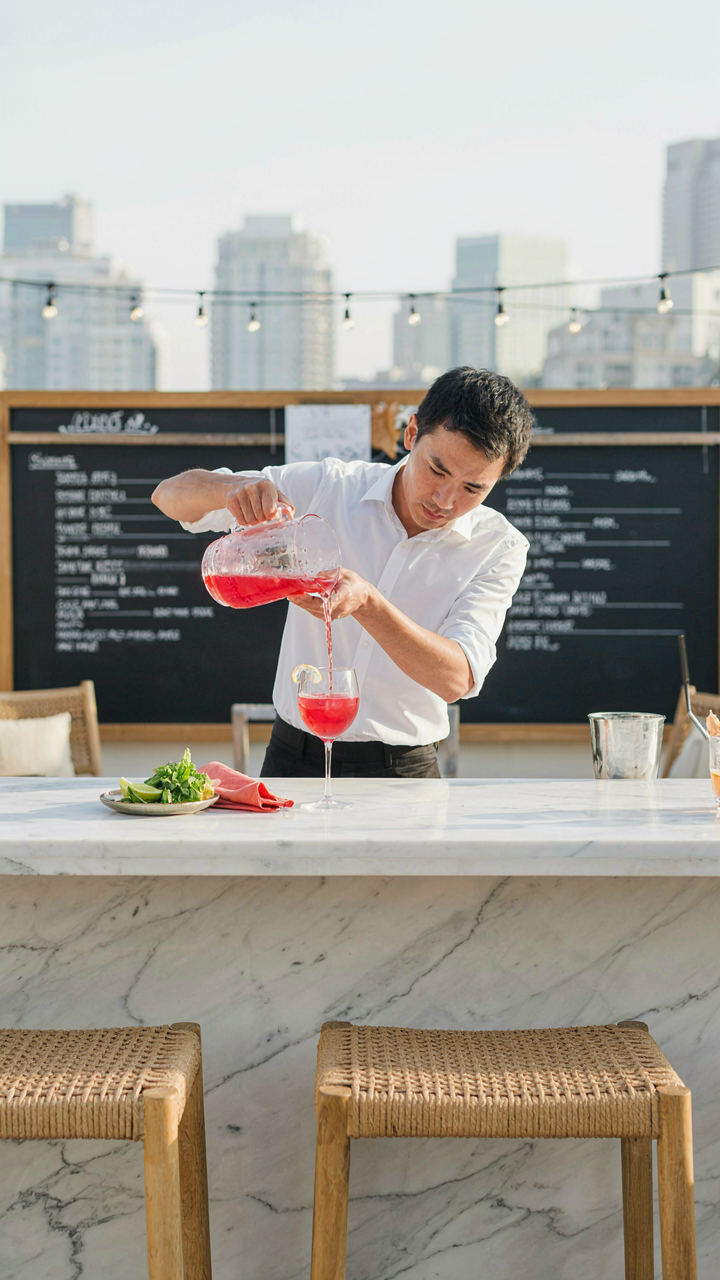
You want to look generous without hemorrhaging money on every guest’s third vodka soda. This is economics talking: constraint forces efficiency. Unlimited bars don’t scale on small budgets because you’re paying per drink poured, and guests drink differently when the cost signal disappears. A signature cocktail model flips the equation. You pre-batch drinks, control portion sizes, and cap your per-head spend while appearing thoughtful instead of cheap.
- Batched Cocktails: Mix large quantities beforehand in pitchers. Guests serve themselves or bartenders dispense from one station. This cuts labor costs and eliminates waste from custom orders.
- Two Signature Options: Offer one spirit-forward drink and one lighter option. Covers preferences without forcing you to stock everything. Vodka and gin, for instance, handle most requests.
- Beer and Wine Only Beyond Cocktails: Let guests choose between your cocktails or house beer and wine. No premium liquor, no frozen margarita machine, no surprise tab creep.
- Pricing Per Hour Not Per Drink: Negotiate with the rooftop venue or bartender for an hourly rate covering all signature cocktails. Removes the per-drink cost variable entirely.
- Cash Bar for Premium Spirits: Guest wants top-shelf bourbon? They pay. You’ve set the baseline with your signatures. This is fair and expected.

Signature cocktails also solve a hidden problem: decision fatigue. Fewer options actually make guests happier because they’re not paralyzed by choice. You control the narrative around your wedding’s bar culture instead of letting it control your budget.
Cash Bar Integration: Guest Choice, Not Your Burden
Forget the assumption that a cash bar feels stingy. That’s outdated consensus built on class anxiety. A hybrid model where you provide excellent signature cocktails and guests fund their own add-ons is standard practice at rooftop venues. You’re not refusing to buy drinks. You’re refusing to subsidize every guest’s preference for premium vodka.
The mechanism here is transparency and upfront communication. State your bar structure on the invitation or wedding website. Guests prepare mentally and bring cash or cards. Most rooftop bars already run tabs, so the infrastructure exists. You cover the base experience. Guests cover their own upgrades. This removes the financial burden of guessing how much alcohol your crowd will consume, which is inherently unpredictable and why unlimited bars destroy small budgets.
Wedding Reception Themes: Authenticity Over Aspiration

Theme Congruence Beats Trend Chasing
You want the theme to look intentional because you’re afraid it looks cheap. Here’s the mechanism: rooftop bar venues have fixed architectural constraints. A rooftop bar already has sightlines, exposure, and urban context. Borrowing from systems design, your theme is a load-bearing wall, not decoration. It either supports the existing structure or fights it. Fight it, you spend money masking reality. Align with it, you spend money amplifying what’s already there.

Most advice says pick a theme first, then find a venue. That’s backwards for rooftop bars on budget. The venue dictates the theme’s ceiling. A raw concrete rooftop with exposed HVAC doesn’t need industrial theme overlay—it needs permission to exist as itself. A rooftop with city views doesn’t need destination fantasy. It needs restraint. Your budget scales when the theme works with the venue’s bones instead of against them.
Your Story Replaces Concept Rent
Personal narrative costs nothing to execute. A concept theme—”Moroccan garden” or “1920s speakeasy”—requires props, rentals, and labor to convince the space to pretend it’s somewhere else. Your story doesn’t pretend. It names why these people matter, why this date matters, why this rooftop matters to both of you. That specificity reads as intentional at every price point.
The mechanism is contrast. Generic themes flatten a space because they apply everywhere. Your specific story creates texture because it applies nowhere else. You share how you met, what inside jokes matter, what this venue meant to you before it was a wedding venue. The rooftop bar becomes a stage for your narrative instead of a blank canvas requiring expensive scenery. Execute this during the invitation phase and the design work becomes clarification, not creation.
Your Budget Isn’t The Obstacle; Your Imagination, Shackled By Expectation, Is

Most couples blow their rooftop bar budget on things nobody remembers. The expensive flowers. The fancy favors. The Instagram moment nobody actually posts. You remember the vibe, the people, and whether you felt alive. Stop asking what a rooftop wedding costs and start asking what experience you want to create with real constraints. Call three venues today. Ask them what they’ve seen work cheap. Your constraint isn’t money, it’s courage to build something real instead of copying what Pinterest sold you.