The Cognitive Dissonance Of Wedding Spending

Why Conventional Advice Creates Anxiety, Not Solutions
You care about this because you’re terrified of looking cheap on a day everyone will photograph and judge. The real mechanism is simple: conventional wedding advice tells you to “cut costs” without addressing the actual conflict driving overspending. You’re caught between two opposing forces—the budget you set and the social expectation you internalized—and nobody addresses that tension directly. Instead, you get generic tips about DIY centerpieces that waste your time and solve nothing.
Wedding spending operates like cognitive dissonance in psychology. You hold two contradictory beliefs simultaneously: “I must spend less” and “A real wedding costs more.” This internal conflict doesn’t resolve through tips or hacks. It resolves only when you name the actual trade-off and choose consciously. Most couples never do this. They whittle away at line items instead of deciding what the wedding is actually for. The gap between your stated budget and what you actually spend isn’t a planning failure. It’s proof you never resolved the conflict in the first place.
Unmasking The Hidden Motivations Behind Overspending
Overspending on a tight budget isn’t accidental. It’s the result of specific, avoidable decisions made under social pressure, and you can identify the pattern before you spend the money. Your parents expect a certain guest count. Your partner’s family expects a specific venue type. You expect to look a certain way in photos. Each expectation carries an unspoken cost, and you absorb it without negotiating. The mechanism isn’t weak discipline. It’s unexamined obligation.
The real driver of overspending is treating your wedding as a referendum on your worth. You unconsciously believe that spending less reflects poorly on you, your relationship, or your family’s status. This isn’t logical, but it’s powerful. It silences your budget objections before you voice them. You slip $500 into flowers instead of the $200 you planned because somewhere inside, you believe people notice and judge. The solution isn’t motivation or willpower. It’s ruthlessly identifying which specific people you’re performing for and deciding if their approval is worth the financial strain.
The “Scarcity Mindset” Fallacy On Your Wedding Day
Constraints Force Better Decisions
You’re worried a tight budget means your wedding won’t matter or won’t look like the ones you saw on Instagram. That fear is the real problem, not the money. Scarcity economics teaches us that limited resources force prioritization—which is exactly what separates intentional weddings from bloated ones. When you have unlimited funds, you buy your way out of decisions. When you don’t, you actually choose what matters.

The mechanism is simple: constraints eliminate noise. You can’t afford every vendor, every detail, every upgrade. So you strip down to what you and your partner actually value instead of what the wedding industry convinced you to want. This isn’t deprivation. It’s clarity. Couples with tight budgets make faster, better decisions because they have to. They skip the meaningless add-ons that couples with deep pockets second-guess later.
What You Actually Need Versus What You’ve Been Sold
Most advice on this topic is incomplete. It tells you to “prioritize what matters” without helping you separate genuine priorities from internalized expectations. Your genuine non-negotiable is something you feel in your gut when you imagine the day without it. Your societal pressure is something you feel when you imagine other people’s judgment if you skip it.
Test each element this way: Remove it from your day in your mind. Does the absence bother you, or does the idea of others noticing the absence bother you? Your photographer capturing first dances matters because you want those memories. A second cocktail hour matters only because you think guests expect it. Your budget forces you to choose between them. Choose the first one. Document the protocol by listing every vendor and element you initially planned, then mark each as genuine or pressure-driven, then delete every pressure item until your budget aligns with your actual values.
The Tactical Resource Allocation Protocol For A Budget Wedding

Experience Trumps Decoration
You’re worried people will judge you for a cheap wedding. They won’t. They’ll judge you for a boring one. The mechanism is simple: guests remember how they felt, not what hung from the ceiling. A well-fed, comfortable guest at a plain venue leaves happy. A hungry guest in a decorated room leaves resentful. Food, drink, and comfort move the needle. Decoration does not.

This means your budget allocation starts by asking what guests actually experience moment-to-moment. They eat for thirty minutes, drink throughout, sit for two hours. They don’t stare at centerpieces for more than ten seconds total. Redirect money from florals and linens into quality catering and open bar service. Your guest satisfaction metric improves measurably. The wedding photographs worse but registers better in lived experience, which is the only metric that matters after day one.
Where Impact Actually Concentrates
Military strategy calls this “concentration of force”—you don’t spread resources evenly across the battlefield. You stack them where they break the enemy line. Apply this to your budget: identify the two or three moments where guests form their core impression, then load your resources there exclusively.
For most weddings, those moments are ceremony entry, cocktail hour flow, and the first dance. Botch the ceremony logistics and people feel chaos before anything begins. Run out of drinks during cocktails and resentment builds. Skimp on sound for the first dance and you kill momentum. Everything else is peripheral. Cut florals, reduce decor, shrink the guest list if needed, but ensure those three moments feel intentional and well-resourced. This is where you spend. This is where guests notice you didn’t cut corners.
The “Value Arbitrage” Method: How To Have A Cheap Wedding

Vendors Nobody Thinks To Ask
You’re scanning vendor lists because you’re terrified of looking cheap on your wedding day. That fear makes you invisible to the real opportunity: most couples ask the same five vendors everyone else asks, which means pricing is locked in stone. But entire categories of providers exist outside that consensus loop.

Florists doing corporate events price differently than wedding florists. Videographers building portfolios charge less than established names. Photography students from legitimate programs deliver technical competence at a fraction of the rate. The mechanism is simple: demand determines price. Lower demand means lower price, even when output quality is identical. Find vendors with expertise but no wedding-specific brand positioning, and you extract the same value at a different cost basis.
Negotiating From Actual Leverage
Everyone tells you to “ask for discounts.” That’s useless advice because it assumes the vendor cares about your request. They don’t. You have leverage only when you understand what they actually need, not what they claim to charge.
Vendors have seasonal dead zones. A photographer with no bookings in February operates differently than one with a packed summer schedule. A caterer between contracts will negotiate on minimum guest counts. A venue with open dates needs bodies in seats. You don’t ask for discounts. You identify when their supply exceeds demand, then propose a trade they can’t refuse: lower rate for a guaranteed date, a referral commitment, or portfolio usage rights. The negotiation works only when you move first with something they want, not by pleading for mercy on their standard price.
Leveraging Network Effects For Frugal Wedding Ideas
Your Network Is Inventory You Haven’t Counted
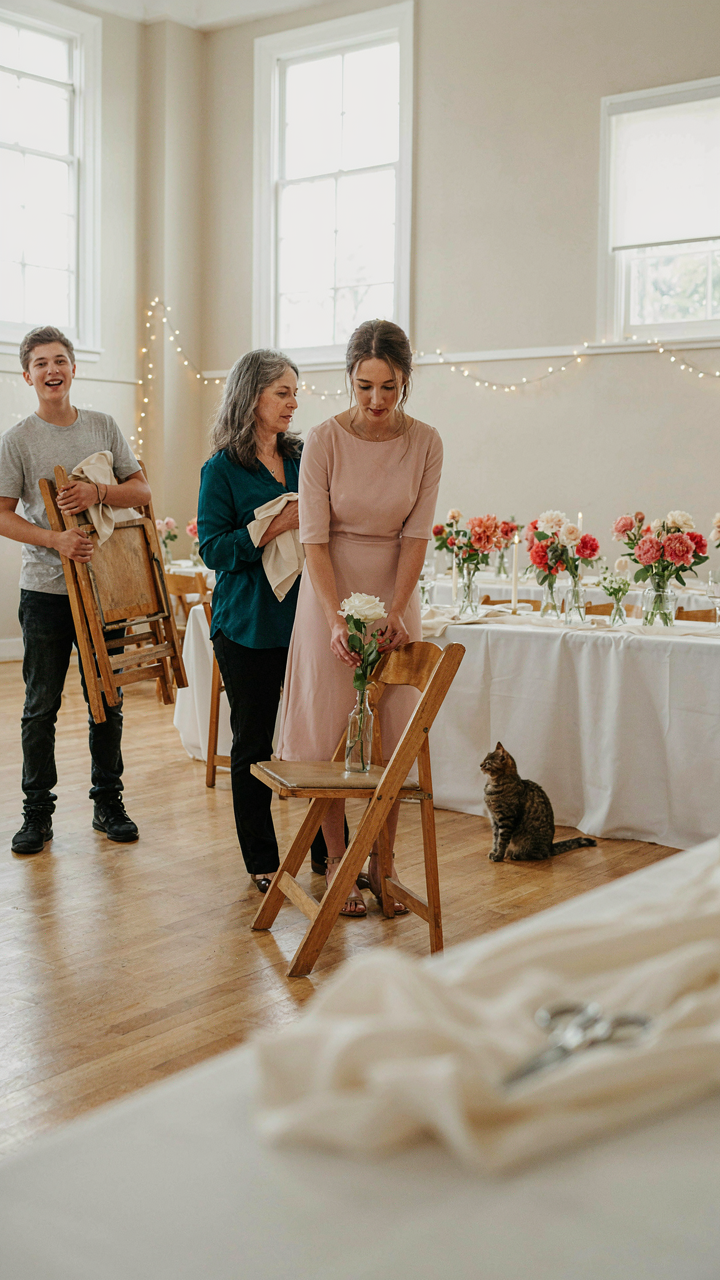
You want to feel like you pulled off something impressive without spending money. That’s the real reason you’re reading this. The mechanism at work here is simple: your social circle contains skills, equipment, and connections you’ve already built trust with. You don’t need to hire a vendor. You need to recognize who in your orbit can solve a specific problem on your wedding day.

Think of network effects from economics. In that field, value multiplies as more nodes connect. On a tight wedding day budget, each person you activate becomes a node that compounds your resources without adding expense. Your uncle who shoots photography might shoot portraits for free. Your friend with a truck transports rentals. Your cousin’s catering background means competent food prep. Stop treating your network as social connections and start treating it as operational infrastructure.
- Photography or videography: A friend or family member with a decent camera can document key moments. Frame it as “help me capture the day” rather than a full professional shoot. Clear expectations on which moments matter most.
- Setup and teardown labor: Recruit 4-6 people for two-hour blocks before and after the event. Assign specific zones so nothing falls through cracks. Feed them properly during breaks.
- Audio or DJ services: Someone with music knowledge and a speaker system can run a curated playlist or MC duties. Provide a detailed timeline and song list. Test audio equipment the morning of.
- Coordination or timeline management: A detail-oriented friend manages the schedule, cues people, coordinates outfit changes. This role prevents chaos more than any single service does.
- Baking or food assembly: A home baker in your circle might bake a tiered cake at cost. A group of friends can assemble appetizers the morning of if you prep ingredients and set up stations.
The key is specificity. Don’t ask someone to “help with the wedding.” Ask them to “handle florals from 2 to 4 PM” or “coordinate the cocktail hour setup.” Vague asks create liability and resentment. Clear asks create ownership and follow-through.
When Asking Costs More Than Paying
The real cost of favors isn’t money. It’s the emotional debt and the risk that someone doesn’t execute properly on your timeline. People help when they understand what you need and when you need it. They flake when the ask is vague or they sense you’re taking them for granted. Reciprocity works only when both parties feel the exchange is fair.
Before you ask anyone for a favor, understand what you’re actually asking them to do. Don’t ask your best friend to “coordinate the day” without defining what that means. Don’t ask your brother to handle drinks without telling him exactly how many people and which drinks to prepare. The gap between what you assume they’ll do and what they actually do is where resentment lives. Get specific, get it in writing, and confirm the day before. On your wedding day, follow through by managing their experience, not just their task.
The Principle Of Diminishing Returns In Wedding Spending

The Point Where Money Stops Working
You’re afraid you’ll look cheap. That’s why you care about this section. The real mechanism is simple: after a certain threshold, throwing more money at a wedding element produces no measurable difference in guest perception or memory. Economics calls this diminishing returns. On a tight budget, it’s your operating system. Most couples never identify where the curve flattens because they assume more spending always equals more impact. It doesn’t. A $400 flower arrangement and a $1200 one create identical visual satisfaction in a room of 80 people at 6 p.m. One vendor knows this. One doesn’t.

Identifying the flattening point saves money you can redirect to elements guests actually register. The difference between adequate and excellent lies in specific categories. Generic advice says “invest in photography and catering.” That’s incomplete. The real question is: at what dollar amount does this specific element stop returning value? A photographer shooting your ceremony for $800 versus $2000 produces different output. A plated dinner at $35 versus $55 per head produces different guest experience. But cake at $3 per slice versus $6 creates zero perceptual difference once it’s plated. You need to know where you sit on that curve for each budget line item before the wedding day starts.
The 80 20 Rule Applied To Your Budget
The Pareto principle states that 80 percent of outputs come from 20 percent of inputs. On your wedding day, this translates directly: 80 percent of guest memory and satisfaction derives from roughly 20 percent of your spending categories. Identify those categories first. Guests remember how they felt when they arrived, what they ate, the music during dinner, and whether the ceremony ran smoothly. They don’t remember linens, favors, or the color of the escort card table. Common advice ignores this and spreads budget evenly across all 17 budget categories. That’s how you end up broke with nothing to show for it.
The mechanism is behavioral, not mathematical. Guests experience a wedding as a sequence of moments, not a sum of details. Allocate 60 percent of your remaining budget to the three elements that dominate those moments: venue ambiance, food quality, and audio. Everything else gets a minimal spend designed to function, not impress. This isn’t compromise. It’s efficiency. Spend your money where it compounds into memory. Spend minimally everywhere else. Your job on the wedding day itself is to verify those three elements are working as planned, not to stress about unnoticed details you overfunded months ago.
Eliminating “Budget Bloat”: Simple Easy Wedding Execution

Pare Down Your Guest List And Vendor Stack
You’re afraid that cutting people means they’ll feel rejected. That’s not the mechanism at work. The real cost of a tight budget isn’t the money spent on each guest—it’s the complexity each person adds to your day’s execution. Every additional guest increases coordination points, seating variables, and contingency decisions. Every vendor beyond your core team creates another dependency, another timeline, another person to brief on your constraints.

Reducing your guest list and vendor commitments works like supply chain optimization in manufacturing. You’re eliminating nodes of friction. Start by identifying your true audience: people whose presence directly matters to you, not people you feel obligated to invite. Then consolidate vendors ruthlessly. One photographer instead of a second shooter. One caterer instead of multiple food stations. One DJ instead of a live band plus DJ. Each elimination removes a decision tree from your day.
Strip The Logistics Nightmares
Most wedding advice about cutting costs focuses on what looks cheap. That’s backwards. You should cut what complicates your day’s actual execution. Multi-course plated dinners require more staff coordination than a single-course buffet. Cocktail hours in separate spaces force guests to move multiple times. Complex timelines with ceremony, cocktail hour, reception transition, and dinner service each create failure points. Simple is cheap because simple is manageable.
Identify what requires extra coordination, extra timing precision, or extra contingency planning on the day itself. Eliminate it. A straightforward timeline: guests arrive, ceremony happens, food and drinks follow immediately. No transitions. No separate rooms. No elaborate service sequences. One coordinator manages fewer moving parts than ten vendors manage an intricate dance. The person running your day needs clarity, not complexity.
Post Wedding Financial Detox Beyond The Wedding Affordable Day

The Debt Trap Nobody Names
You’re reading this because you’re afraid you’ll spend money you don’t have, then spend the next year resenting your spouse for it. The mechanism is simple: weddings create a psychological permission structure. You’ve been told it’s your day, it’s special, you deserve it. That language disables your normal financial judgment. The real problem isn’t the wedding itself—it’s the debt hangover that follows because you borrowed against future income to fund one afternoon. The damage compounds when couples treat post-wedding months as a recovery period instead of a repayment sprint.

Avoidance starts before the ceremony ends. If you’re financing pieces of the day, you need a payoff date locked in before the first bill arrives. Most couples drift into minimum payments and carry balances for eighteen months or longer. That’s not healing from your wedding. That’s quietly funding someone else’s business while pretending the debt isn’t there. The moment the venue confirms your booking, establish when every vendor balance is due and when you’ll have that money transferred. No flexibility. No grace period. Treat it like a tax deadline.
Rebuild Your Financial Position First
Economics teaches opportunity cost: every dollar spent on debt repayment is a dollar not deployed elsewhere. Your post-wedding months operate under the same principle. If you carry wedding debt into year two, you’re not saving for a house down payment, emergency reserves, or retirement contributions. You’re funding yesterday while your future gets smaller. The couples who recover fastest from tight budgets don’t try to resume normal spending immediately. They enter a controlled contraction phase where every surplus dollar goes directly to eliminating what they owe.
Create a specific payoff protocol with no ambiguity. List each vendor balance, the due date, and your planned payment amount. Build a separate tracking document you review weekly. This isn’t punishment. It’s accountability. When you see the balance dropping, the psychological effect is real—you’re not drowning in abstract debt but watching a concrete number shrink. Set a hard finish date three to six months out, not one to two years. The faster you eliminate wedding debt, the faster your financial baseline returns to normal and you stop making decisions from a position of scarcity.
The Psychological ROI Of A Budget Wedding

The Confidence Of Constraints
You care about this section because you’re afraid people will judge you for spending less. They won’t. The mechanism is simple: financial discipline on your wedding day builds a specific kind of confidence that lavish spending cannot touch. In economics, we call this “revealed preference”—your actions show what you actually value. A tight budget forces you to choose what matters. That choice is visible to everyone. People respect the person who knows their limits and operates within them more than the person who borrowed to impress.

Regret follows wasteful spending because it outlasts the event. You feel the budget constraint in the months after the wedding when bills arrive. You don’t feel the regret of skipping an expensive floral installation. What you do feel is the clarity of having made deliberate decisions. That clarity compounds. Six months later, you’re not thinking about the centerpieces. You’re thinking about how you didn’t panic, didn’t overextend, and didn’t lie awake calculating what you owed. The quiet confidence of financial discipline has no expiration date.
Real Experience Over Display
The common advice says “prioritize what matters to you.” That’s incomplete. What actually matters isn’t what you announce—it’s what creates a moment you remember. Those moments rarely cost money. They happen in conversation, laughter, or a specific exchange with someone you love. Expensive elements fade from memory. Cheap moments stick because they’re authentic, not performed.
A tight budget removes the pressure to prove anything. You stop asking whether the venue is impressive enough or the food is fancy enough. You start asking whether the people in the room will actually connect. That shift in focus is where real ROI lives. When you’re not distracted by display, you notice things: your partner’s expression during vows, a friend’s laugh, the light at a specific moment. Document one concrete moment on your wedding day that had zero production value. That moment will matter more than any element you paid premium money for. That’s how you measure a wedding day that worked.
The Real Cost Was Never The Money; It Was Your Insecurity

You spent this whole day worried people were judging your budget. They weren’t. They were too busy eating, laughing, and watching you marry someone you love. That’s the entire game. Stop designing your wedding for strangers’ approval and start designing it for the person standing next to you. Text them right now and tell them one thing you loved about today that had nothing to do with money. That’s what people remember.