The Pre Dawn Reconnaissance: Eliminating Surprises

Spot The Breaking Points Before They Break
You want a calm morning because you’re afraid it won’t be. That fear is rational. The mechanism is simple: surprises cause friction, friction causes stress, stress cascades through a small group faster than it does a large one. With fewer people, each person’s emotional state becomes contagious. One bridesmaid panicking infects everyone. Find what breaks before the day starts.
Walk through the physical space the night before. Check bathroom access, mirror availability, outlet locations for hair tools, natural light at the time you’ll be getting ready. Identify bottlenecks. If two people need to use one bathroom for hair and makeup, that’s a friction point. If the lighting is dim, that’s another. If the coffee maker is in a different room, that matters. Write these down. Don’t rely on memory.
Assign Roles With Explicit Boundaries
The common advice says “delegate” and leaves it there. That’s incomplete. Delegation without boundaries creates confusion, not calm. Take a page from military operations: each person gets a specific task with a defined start time and end time, not a vague responsibility.
One person handles hair and makeup timing. One person manages clothing and pressing. One person handles food and hydration. One person manages the photographer and timing cues. One person is the “calm voice” for redirecting panic. These aren’t suggestions or backup roles. They’re assignments. Each person knows exactly what they own and when their part ends. Write these down and send them two weeks before the wedding.
The “Getting Ready Wedding Photos Bridesmaids” Deception

Hand Off Photo Direction To One Person
You want getting-ready photos because you think they prove your wedding was effortless and intimate. They’re not. The real mechanism here borrows from production management: you need a single point of failure. In logistics, this means one person owns the timeline so nothing falls between cracks. Assign your photographer or a trusted bridesmaid to manage all photo requests and timing. Everyone else gets a simple instruction: show up, get ready, don’t negotiate with the photographer about angles or timing.

The common advice says “communicate your photo timeline to everyone.” That’s incomplete. The problem isn’t communication. It’s that multiple people trying to coordinate with the photographer creates bottlenecks and decision fatigue. You’ll have bridesmaids asking if they can do one more outfit change, the photographer asking where people are, and you answering questions while trying to put on makeup. One delegated person kills this. They handle requests, they handle timing, they handle logistics. You stay out of it entirely.
Lock Photo Time To Thirty Minutes Maximum
Getting-ready photos eat time because no one defines when they end. Thirty minutes maximum. That’s it. Longer windows create the illusion of flexibility, which means people delay getting ready because they think they have time. They don’t. Start photos at a fixed time, finish at a fixed time, then everyone switches into getting fully dressed and doing final checks.
The photographer works faster under constraint. Small bridal parties move faster under constraint. Everyone knows the deadline, so decisions get made without debate. You’re not being rigid for control. You’re being rigid because constraint is the only thing that prevents a calm morning from turning into a rushed one. Set the timer, hold the line, move forward.
The 3 Tiered Delegation Protocol For Morning Of Wedding
What Actually Has To Happen
You’re worried someone will drop a ball and you’ll look unprepared. That’s not the real problem. The real problem is you haven’t decided what tasks matter and what tasks just feel urgent. Most wedding morning chaos stems from treating everything as equally critical when your small bridal party has zero bandwidth for that fiction.

Think of this like triage in emergency medicine. Doctors don’t treat every injury the same. They categorize by survival necessity. Your morning tasks need the same ruthless sorting: what directly impacts whether the ceremony happens on time, and what’s just noise pretending to be important. The tasks that genuinely break the timeline get assigned first and get accountability. Everything else gets the leftover attention it deserves.
The Actual Must Do Tasks
Hair and makeup completion by the hard stop time. Dress getting zipped and fitted by the departure window. Marriage license in someone’s actual hands who knows where it is. Bride eating something. Getting to the venue on time. That’s it. Those five things determine if the wedding happens. Nothing else does.
Assign one person to own each task. Not everyone responsible for everything. One hair person. One makeup person. One dress handler. One food person. One logistics person who tracks the timeline and calls the start of getting in cars. When three people think they’re managing hair, all three freeze and nothing happens. When one person owns it, they move.
Everything Else Waits Until After
Steam the bouquets. Touch up the groom’s shirt. Instagram the getting-ready shots. Calm the mother-in-law. Confirm the caterer arrived. All of this happens only if time exists after the five critical tasks lock in. Most wedding morning stress comes from treating these secondary tasks like they’re on the critical path when they’re not.
Assign a buffer person for secondary work. Someone whose only job is handling whatever pops up that isn’t in the core five. They own the chaos so the core team stays focused. This person answers questions, handles fires, adjusts timelines. Everyone else ignores the non-critical because one person is specifically tasked with managing it. This is how small bridal parties stay calm instead of fragmenting into panic.

The Cybernetics Of Calm System

Real Time Adjustments Without Panic
You want this section because you’re terrified of something going wrong and having no way to fix it without looking incompetent. Here’s the mechanism: cybernetics is the study of feedback loops and control systems. A calm morning needs negative feedback, not positive. Positive feedback amplifies problems. Negative feedback corrects drift. The difference between a small bridal party morning that spirals and one that stays level is whether someone catches deviations early and adjusts without announcing them to the room.
Assign one person to track time against the actual schedule, not the ideal one. They don’t announce delays. They silently communicate to the next checkpoint owner via text or a single glance. This person sees the 10-minute slip before it becomes 30 minutes. They know hair is running late, so they signal the photographer to push the couple photos back. No group panic. No dramatic rushing. The loop corrects itself in real time because information flows downward to the people who can act, not upward to create anxiety.
Predetermined Moves For Common Failures
Most wedding advice says to stay flexible. That’s useless. Flexibility without a plan is just reactive chaos. Pre-program your responses to the exact failures that will happen: someone runs late, a vendor delays, the couple gets emotional, equipment fails. Write these scenarios down and decide now what the response is. Not during the morning. Now.
Create a one-page protocol sheet. If the florist is 20 minutes late, you move photos to the venue instead of doing them pre-ceremony, and you notify those involved via group text in that exact order. If someone cries and needs 15 minutes alone, the bridal party waits in the separate room you’ve already identified. If the videographer’s battery dies, you have a phone backup filming protocol. The small party means you can coordinate this tightly. When a deviation happens, you execute the predetermined move, not invent a response under pressure.

Defeating The “Getting Ready Wedding” Time Sink

Strip The Schedule To Core Tasks Only
You’re scared of forgetting something important, so you pad the timeline with buffer tasks that don’t matter. This is the mechanism: uncertainty breeds activity. With a small bridal party, you have no excuse for this bloat. Every minute spent on hair touch-ups, makeup adjustments, or “getting in the mood” is a minute spent in a heightened state of nervous energy that compounds itself.
Start with the three non-negotiable tasks: hair, makeup, and getting dressed. Everything else is scaffolding you built to feel in control. Remove it. The calm morning isn’t created by doing more things slowly. It’s created by doing fewer things with clarity, which means your nervous system doesn’t stay activated for five hours before you walk down the aisle. Set a hard cutoff time. When that time hits, you stop preparing and start existing in the space you’ve prepared.
Batch Tasks By Person And Location
Think of task batching like assembly line production, where you move through stations rather than jumping between operations. Instead of having your makeup artist work, then your hair person, then back to makeup for fixes, you run one person through all their stations in sequence. This eliminates context switching, which kills calm faster than anything else.
Map out the physical flow: hair station in one room, makeup in another, getting dressed in a third. Move people through in order. If you have two bridesmaids, one gets hair done while the other does makeup. They swap. You never have multiple people waiting or multiple people finishing at different times, which creates dead air and anxiety. The bride goes last through the full sequence so she’s the last to be ready, not the first to sit and spiral for two hours.

Morning Getting Ready Wedding: The Unspoken Truth About Beauty
Hand Off The Decisions
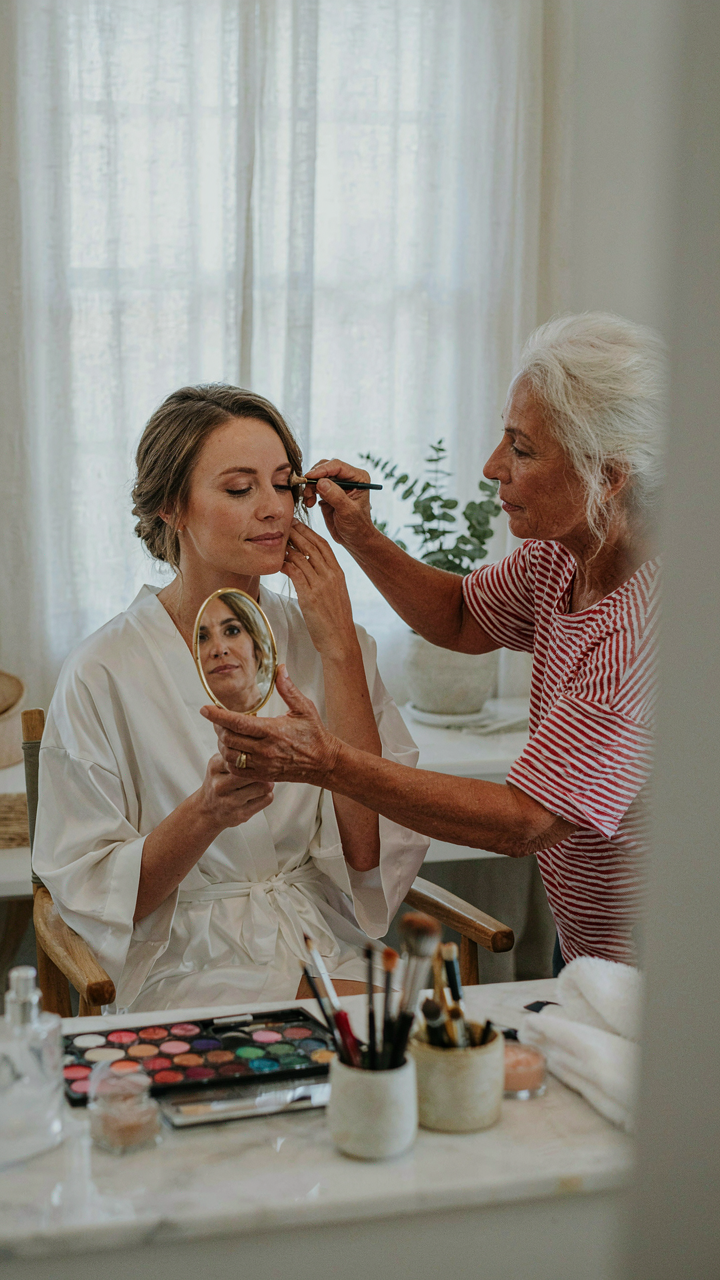
You want control because you think it signals competence, but the real mechanism here is time dilation. Supply chain theory teaches us that bottlenecks slow the entire system, and your personal grooming choices are the chokepoint that stalls everyone else. Hire a professional hair and makeup team to show up at a fixed time with a locked schedule. They work in parallel, not sequence. You stop being the decision maker and become a station on their assembly line.
The payoff isn’t just speed, it’s psychology. When you’re not the one choosing between contouring techniques or lipstick shades, you eliminate the anxiety that masquerades as perfectionism. A professional brings constraints, which paradoxically feel like freedom. You sit down, they execute, you move on. The bridal party watches this happen and mirrors the calm.
Strip Your Morning Involvement
Common advice says do a trial run weeks before. That’s incomplete. The real problem is decision fatigue compounding across the morning, and you amplify it by being hands-on. Don’t do your own makeup. Don’t style your own hair. Don’t oversee the process. Delegate every grooming task to the professionals you hired, then physically remove yourself from the getting-ready space until thirty minutes before you need to leave.
This sounds extreme because we’ve normalized the bride as the conductor of beauty operations. She’s not. She’s the asset being prepped. Your job is to show up, sit still, and let trained people work. This removes your ability to second-guess, adjust, or interfere. The bridal party gets a calm authority figure instead of an anxious micromanager. Everyone’s cortisol stays lower when there’s clarity about who owns what.

The “Wedding Shot List” Illusion

Separate Must Haves From Nice To Haves
You want the photographer to capture everything because you’re afraid of missing a moment you’ll regret. That fear is the real problem. The mechanism is simple: unlimited shot lists create unlimited chaos. Your photographer spends the morning hunting for shots instead of being present for the actual moments. With a small bridal party, you have fewer people to photograph, which means fewer excuses for bloat.
Cut your shot list to what you actually need. Ceremony processional. First kiss. Family formals. Couple alone. That’s the skeleton. Everything else is optional decoration. Tell your photographer you’re intentionally minimalist. This removes the pressure they feel to “earn their fee” by documenting every angle and moment. They relax. Your morning stays calm.
Communicate Photo Priorities Clearly
The common advice is to “share your vision.” That’s vague and useless. What works is a ranked list with hard stops. Give your photographer a three-tier system: essential, important, and bonus. Essential shots happen no matter what. Important shots happen if time permits. Bonus shots only exist if everything else is locked.
- Essential shots: Ceremony entry, first kiss, couple’s portrait, family photos. These are your non negotiables and should take ninety percent of the photographer’s energy.
- Important shots: Bride getting ready details, groom reaction, reception toasts. These matter but won’t break the day if they’re missed.
- Bonus shots: Candid moments between ceremonies, detail shots of flowers or rings, guest interactions. Nice but expendable if timing gets tight.
- Timing boundaries: Specify exact windows for each shot phase. “Getting ready photos from 8 to 9 AM, then we move to ceremony prep.” Boundaries create calm.
- Communication method: Send this list by email at least one week before. Follow up verbally the day before. Repetition kills misalignment.
A small bridal party means you can communicate directly with your photographer without playing telephone through a coordinator. Use this advantage. The moment your photographer understands you’re not chasing perfection, they stop performing and start observing. Your morning becomes documentation instead of production.

Strategic Isolation: The Uncomfortable Peace

The Locked Door Rule
You want people around you on your wedding morning because you’re afraid of being alone with your own thoughts. That’s the real mechanism. The solution isn’t more company—it’s controlled absence. Designate a physical space, typically the bridal suite or groom’s preparation room, as off-limits to everyone except the person getting married and one designated handler. This isn’t rudeness. This is containment. You’re creating a buffer zone where ambient anxiety can’t compound through group nervous energy.
The small bridal party makes this feasible where larger weddings fail. With four to six people total, you can actually enforce a boundary. Lock the door from 6 AM to 7:30 AM. No messages, no check-ins, no “quick questions.” The handler manages all communication from outside. This hour and a half of forced solitude breaks the feedback loop where one person’s stress triggers everyone else’s. You’re not hiding. You’re resetting your nervous system before the machinery starts.
Who Gets Input, Who Doesn’t
The common advice says “listen to your bridal party’s opinions.” That’s how you end up with five conflicting visions for your hair and a decision paralysis that wastes two hours. Cut it instead. The bride or groom makes all decisions about appearance, timing, and sequence by 8 PM the night before. Period. During the morning, your handler executes the plan. Everyone else executes their role. No suggestions. No “what ifs.” No committee voting.
A small party means you can actually pull this off without seeming dismissive. Tell your attendants explicitly the night before: “Tomorrow morning, I’m not taking input. I need you to follow the timeline and handle your own prep.” This removes the false obligation people feel to contribute ideas. They show up. They do their job. They don’t carry the weight of decision-making. The person getting married stays calm because decisions are already made. The party stays calm because they’re not responsible for solving problems that don’t exist.

The Unavoidable Truth Of Wedding Morning: Serenity Through Surrender

Stop Treating Mistakes As Failures
You’re reading this because you’re afraid something will go wrong and expose you as disorganized. The actual mechanism is that you’re trying to control variables that don’t matter. Wedding mornings with small bridal parties fail in calm not because everything runs perfect, but because you’ve decided in advance what counts as acceptable. Lipstick smudges. Hair pins fall out. Someone cries. None of this breaks the day.
The common advice says “plan everything.” That’s incomplete. You need to plan what you’ll ignore. Decide now which imperfections you won’t address. Will you touch up makeup if it smears? Will you reshoot the getting-ready photos if the lighting shifts? Will you delay the ceremony for a wardrobe malfunction? Answer these before dawn. This removes the decision-making tax that eats your mental bandwidth during the actual morning.
The Ceremony Matters, The Process Doesn’t
Think of a wedding morning like a physics problem where you’re optimizing for end state, not trajectory. Most couples obsess over the journey to the altar and forget that guests show up for the marriage, not the hair and makeup timeline. A small bridal party means fewer people to coordinate, which means you can afford to focus narrowly on what actually reaches the guest experience.
Build your morning schedule around the ceremony start time and work backward exactly two hours. Anything beyond that is waste. You don’t need six hours of preparation for four people. Assign one person to time management, not aesthetics. Their job isn’t to make things pretty, it’s to move people forward. When the schedule slips, they cut non-essential segments, not extend the timeline. This keeps energy stable and prevents the spiraling panic that kills calm.
The Illusion Of Control Is The Real Obstacle To Your Peace
You don’t need more tips. You need to stop treating your wedding morning like a military operation. The small party exists so you can breathe, not so you can micromanage every minute. Control is the drug that kills presence. Today, text your bridal party one sentence: “We’re keeping this simple and staying loose.” Watch what happens when you actually let people show up instead of perform. Your peace lives on the other side of surrender.