The Illusion Of Expense: Why “Cheap” Is A Mindset
Budget As Strategic Advantage
You’re worried people will think you cut corners. That’s the real concern here, not the price tag itself. But economics teaches us about scarcity, and scarcity isn’t about money—it’s about information asymmetry. A budget wedding pocket square works the same way: most people overpay because they can’t see the actual value exchange happening. They conflate price with quality and miss the mechanism entirely.
The groomsmen pocket square market is deliberately fragmented. Department stores mark up basics 200 percent because they own shelf space. Online retailers undercut them by 40 percent selling identical fabric and construction. Your task isn’t to find cheap—it’s to find where the markup disappeared. That gap reveals actual value. A ten-dollar pocket square from a manufacturer’s direct channel often beats a thirty-dollar version from a luxury brand that’s really just packaging and logo placement.
The Perceived Luxury Trap
Generic advice tells you to invest in quality fabric and timeless patterns. That’s incomplete. Perceived luxury is a design problem, not a material problem. Most groomsmen pocket squares fail because they’re trying to look expensive instead of intentional. A wrinkled silk square screams luxury gone wrong. A pressed cotton-poly blend in a restrained pattern reads as put-together, which is the actual signal people decode.
The trap activates when you believe thread count, fiber origin, and brand name determine whether your groomsmen look sharp. They don’t. Construction determines it: clean edges, proper hemming, proportional fold. A budget pocket square with tight stitching and correct dimensions outperforms an expensive square with loose seams and sloppy finishing. The mechanism is visibility—people notice execution flaws faster than they notice fabric provenance. Buy based on construction quality and pattern restraint, not on what the tag says.
Pocket Square Design: Beyond The Obvious Patterns

Restraint Wins More Ground Than Novelty
You want your groomsmen to look like they belong in the photo, not like they’re trying to prove something. That’s the real reason you’re reading this. The mechanism is constraint: the fewer visual elements competing for attention, the more each one lands. In design, this follows signal-to-noise ratio from information theory. A busy pocket square creates noise. A restrained one becomes signal. Most budget pocket squares fail because they cram pattern and color together to justify the low price. The inverse works better.

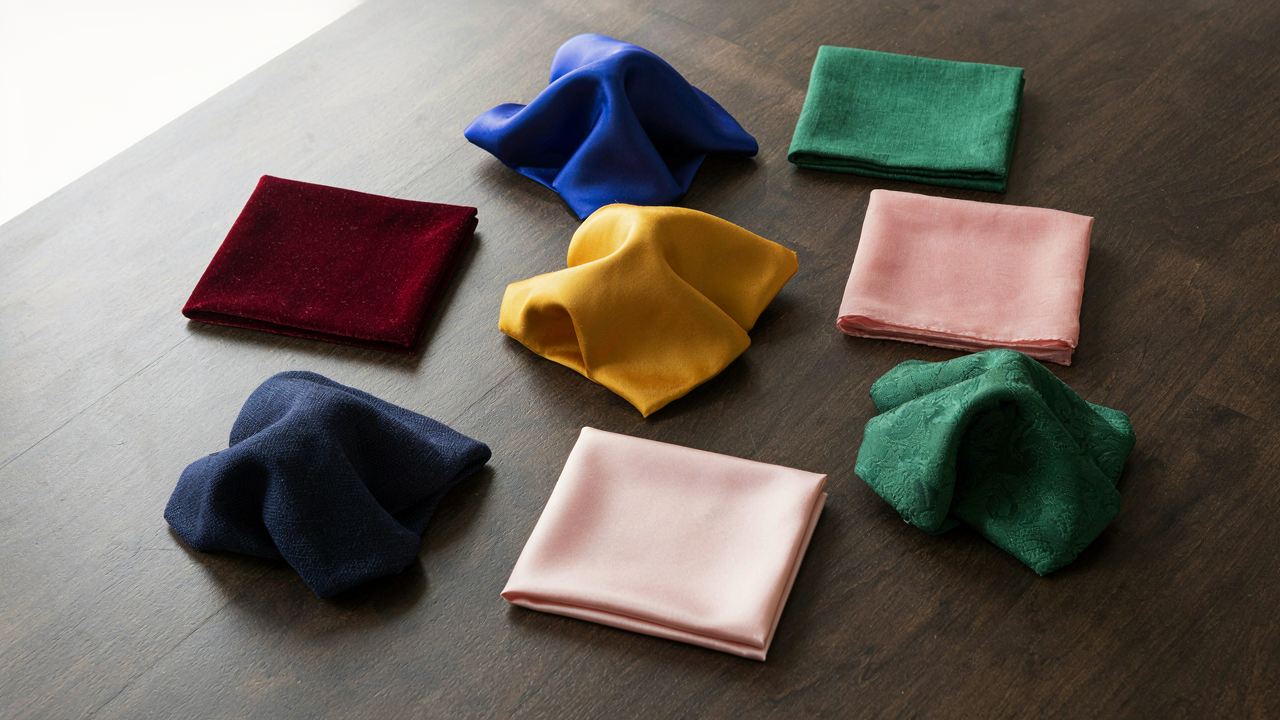
Solid colors and single-thread textures dominate high-end menswear for a reason. They age well, pair with multiple suits, and keep focus on cut and fit. Budget squares with minimalist design sidestep the trap of cheap-looking novelty prints. A solid silk pocket square in charcoal, navy, or cream costs the same as a patterned one but reads expensive because it requires no visual rescue from pattern. Choose a single texture: woven silk, linen, or cotton blend. Avoid anything with more than one dominant design element.
Color And Texture Do The Heavy Lifting
Forget the advice that pocket squares must match ties. It’s incomplete and leads to visual flatness. The real play is contrast within a narrow value range. If your tie is mid-tone blue, your pocket square works better in white, cream, or a complementary texture in the same blue family. Texture becomes your second lever when color options are limited by formality or venue.
Budget constraints force you to be deliberate: choose one pocket square per wedding that works with multiple suit colors. A natural linen square in cream handles navy, charcoal, and burgundy suits without needing coordination. Textured cotton blends in neutral tones create depth without pattern. Buy based on your most common groomsmen suit color first, then verify it transitions to the backup suit. This removes the need for multiple squares and keeps costs genuinely low.
Fabric Selection: The Unseen Lever Of Value
Fabrics That Read Expensive On A Thin Budget
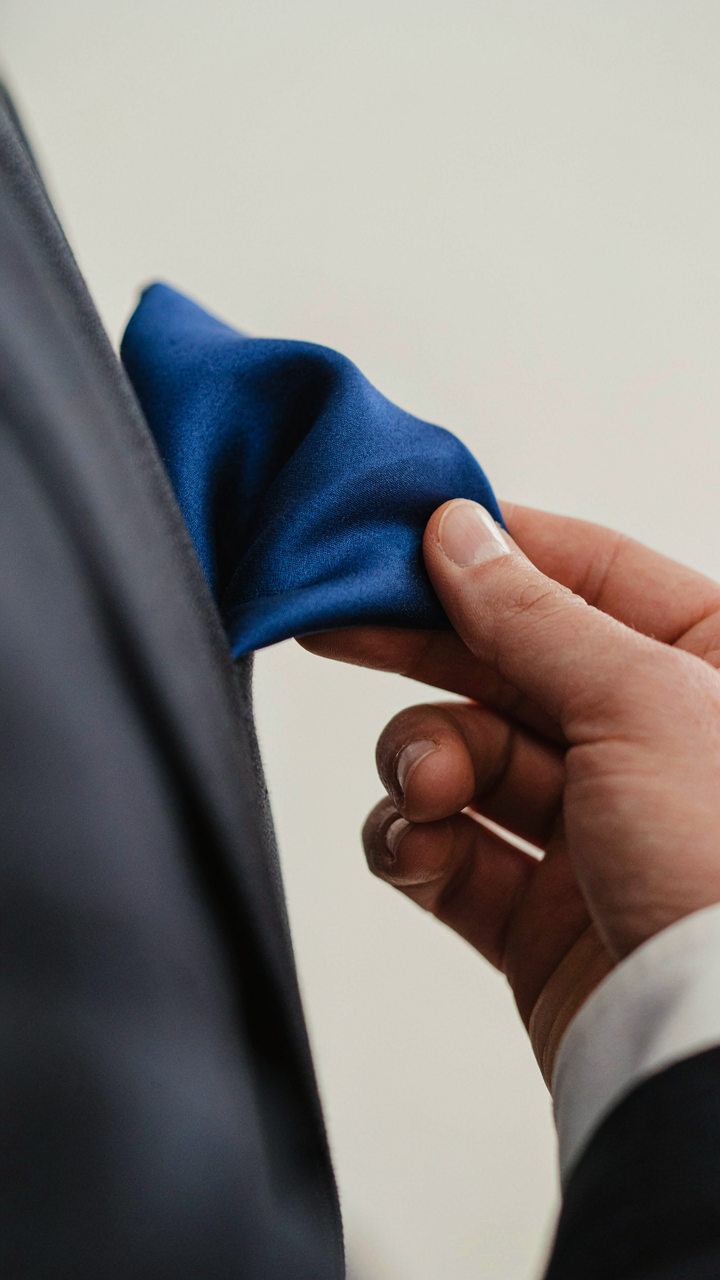
You want people to assume you spent more than you did. That’s the real calculus here, and fabric is the mechanism that controls perception without requiring actual spending. In economics, this is called signaling—the way a material broadcasts quality faster than price ever could. Cheap fabrics broadcast immediately. The right ones don’t.
- Silk: Catches light distinctly and drapes with weight. A silk pocket square reads luxury because the fiber itself moves differently than synthetics. Even budget silk holds shape longer than polyester.
- Linen: Natural texture signals intentionality. Linen wrinkles, but that wrinkle reads as “natural material” not “cheap.” Linen blends cut cost while preserving the signal.
- Cotton sateen: Smooth finish with a subtle sheen without being reflective. Sateen weave creates perceived depth that plain cotton lacks, costing marginally more but reading significantly better.
- Wool blend: Adds body and structure to cheaper fibers. A wool blend pocket square holds its fold, which is the primary visual cue that separates budget from bargain.
- Polyester microfiber: When engineered correctly, microfiber mimics silk’s hand feel and drape. Budget wedding suppliers use this deliberately because it photographs well and resists creasing during the event.

The mechanism here is simple: natural fibers and quality weaves resist wrinkling and hold intentional folds. Wrinkles in a pocket square broadcast neglect. A crisp fold broadcasts control. Pick fabric that maintains that fold through eight hours of wearing, handshakes, and photos.
Where Durability Actually Matters
Everyone tells you to buy pocket squares that last forever. They’re wrong. A pocket square worn once at a wedding doesn’t need to survive a decade. You’re optimizing for the wrong variable.
What matters is performance during the event. The fabric must hold its fold during photos, survive humidity without spotting, and not pill when brushed by suit jackets. A silk-polyester blend does this better than pure polyester. It’s also cheaper than pure silk. Durability past the wedding is waste. You’re not wearing this groomsmen pocket square monthly for five years. The real cost trap is buying overbuilt products designed for repeated wear when you need something engineered for a single eight-hour performance window. Linen-cotton blends excel here because they wrinkle predictably (which reads as intentional), resist sweat stains better than pure linen, and cost less than both. Performance trumps longevity. Choose the fabric that survives the specific day you need it to.
The “Square” Paradox: When Less Is Truly More

Why The Classic Shape Actually Limits You
You want the pocket square to look intentional, not like you’re trying too hard on a budget. Here’s the mechanism: the rigid square shape forces you into a binary choice—fold it formally or fold it casually—but both options telegraph that you’re thinking about it. Borrow a principle from information theory: constraint creates signal. A true budget move isn’t choosing the cheapest square. It’s choosing a shape that makes the fold decision irrelevant, so the fabric does the work instead of your technique.

The standard fold is the TV fold or the three-point. Both expose the full shape. This means cheap fabric reads cheap immediately. You’re fighting the material instead of using it. Silk blends hide threads and creases better than cotton at budget prices. The real savings comes from selecting a shape that doesn’t demand perfection in drape or precision in folding. Shape choice directly determines how forgiving the fabric can be.
The Angle Play And Asymmetry Option
Rectangular or diamond-cut pocket squares aren’t trendy or edgy—they’re mechanically superior on a budget. The asymmetry shifts visual attention away from the fabric’s surface quality and toward the composition. A rectangular piece folded at an angle creates line and intention. Asymmetrical shapes also allow you to tuck more fabric into the pocket, which means you’re hiding the cheap interior folds where texture deteriorates first.
Triangular folds or asymmetrical points give you control over where the viewer’s eye lands. This is why military dress uniforms use specific fold angles—they control the visual field. Apply that logic: position the best part of the fabric forward, tuck the weak parts into the pocket. You’re no longer trying to sell the entire square. You’re selling one clean edge and a confident angle. Buy rectangles or diamonds. Fold at forty-five degrees. Practice the tuck twice before the wedding.
Pocket Square Folds: The Art Of Deliberate Imperfection

How Fabric Holds Shape Under Stress
You care about this because a messy fold makes you look careless, and you’re spending money to look intentional. Here’s what actually happens: pocket square folds operate on the same tension and drape principles that structural engineers use in architecture. The fabric’s weight, weave density, and thread count determine how long a fold holds its form before gravity and body heat collapse it. Cotton blends hold creases longer than pure silk. Linen springs back aggressively. Budget squares use lower thread counts, which means they lose shape faster and demand folds that work with fabric weakness, not against it.

The mechanism is simple. Tighter folds concentrate stress on fewer fabric layers, creating visible creases that hold. Looser folds distribute weight across more surface area, which looks softer but fails under heat and movement. For budget squares, you exploit this by choosing folds that use the fabric’s natural stiffness. A three-point fold on a budget cotton blend stays locked for four hours. The same fold on cheap rayon collapses in ninety minutes. Match the fold to the material’s actual properties, and you stop fighting the square.
The Power Of Structured Simplicity
The advice to “experiment and find your style” wastes your time. Most groomsmen fold poorly because they add unnecessary complexity. The two-point pocket square fold, also called the TV fold, uses only two visible corners. It requires minimal precision, works on any fabric weight, and budget materials handle it best because the fold concentrates fabric at the pocket’s center where weight naturally settles. Expensive squares forgive lazy folds through sheer material quality. Budget squares don’t. They force discipline.
The one-inch rule controls the mechanism. Your folded square should protrude one inch from the jacket pocket, no more. This measurement determines fold depth and how many layers sit at the top. Too shallow and the fold collapses into the pocket. Too deep and the square looks bloated. Practice folding at exactly one inch, crease it with your thumb, and insert it straight down into the pocket without adjusting. Repetition builds muscle memory. Your hands learn the angle and pressure needed before the wedding day arrives.
Pocket Square Styles: Breaking The Monotony Protocol

The Individual Groomsman Choice
You want permission to stand out without looking like you’re trying too hard. Here’s the mechanism: a pocket square functions as a signal amplifier. In design systems, signal-to-noise ratio determines whether a message lands or gets lost. One groomsman in a contrasting pocket square reads as intentional. All groomsmen in matching squares reads as uniform. The single contrast creates visual hierarchy without chaos.

Most wedding advice says match everything for cohesion. That’s incomplete. A budget wedding pocket square becomes a tool for selective differentiation when you understand that matching solves a different problem than distinction does. The groom’s square can anchor the look while groomsmen vary theirs by color family. This costs nothing extra and solves the real tension: looking coordinated without looking like you bought a package deal.
Sartorial Consistency Without Conformity
The common advice here is wrong: you don’t need all groomsmen in identical squares. You need a decision framework. Pick one constraint, not one style. That constraint could be pattern type (solids only), color range (warm tones), or material (cotton). Everyone works within that single rule. This prevents visual noise while letting individual pocket squares exist.
Budget pocket squares from retailers like Brooks Brothers Factory, Men’s Wearhouse clearance, or discount sellers like T.M. Lewin run five to fifteen dollars per unit. At that price point, buying seven different squares within your chosen constraint costs thirty to sixty dollars total versus matching sets at eighty to one hundred twenty. You gain flexibility and reduce the impression of uniform rental wear. The protocol: decide your constraint, source to it, and stop overthinking the rest.
How To Fold A Pocket Square: Beyond The Basic Instructions

The Three Point Hold Versus Everything Else
You want to look like you know what you’re doing without actually spending time learning. The real mechanism here is contrast: the fold’s geometry breaks up the flat plane of your suit jacket. Think of it like load distribution in structural engineering, where you’re strategically placing visual weight. Most groomsmen default to the flat square because it’s simple. That’s exactly why you shouldn’t. A three-point fold takes ninety seconds and costs nothing extra.

The three-point hold works because your eye tracks the peaks. Fold the square into thirds, then angle two corners up while one stays centered. Budget pocket squares in cotton blends hold this shape for hours without creasing out. Polyester blends hold it even longer but trap humidity. Test your fold the morning of the wedding, not the night before, because fabric memory shifts with humidity and handling.
The Suit Cut Determines Your Fold Strategy
Your jacket’s pocket opening size isn’t arbitrary, and folding the same way for every suit wastes the one cheap asset you control. In tailoring, proportions govern perception, and pocket depth creates either visual extension or visual compression. A slim-cut jacket with a shallow pocket demands a smaller, tighter fold. An oversized groomsmen’s jacket with a deep pocket can handle a fuller fold that sits proud.
Measure your actual pocket depth before buying or folding. A budget square at two inches squared fits any pocket. A four-inch square forces you into a tight French fold on slim cuts and looks cramped. On standard-cut suits, that same square sits perfectly with a two or three-point fold that shows texture. Always fold after dressing in the full suit so you can see the proportion live.
Boutonniere Wedding Harmony: The Unspoken Connection
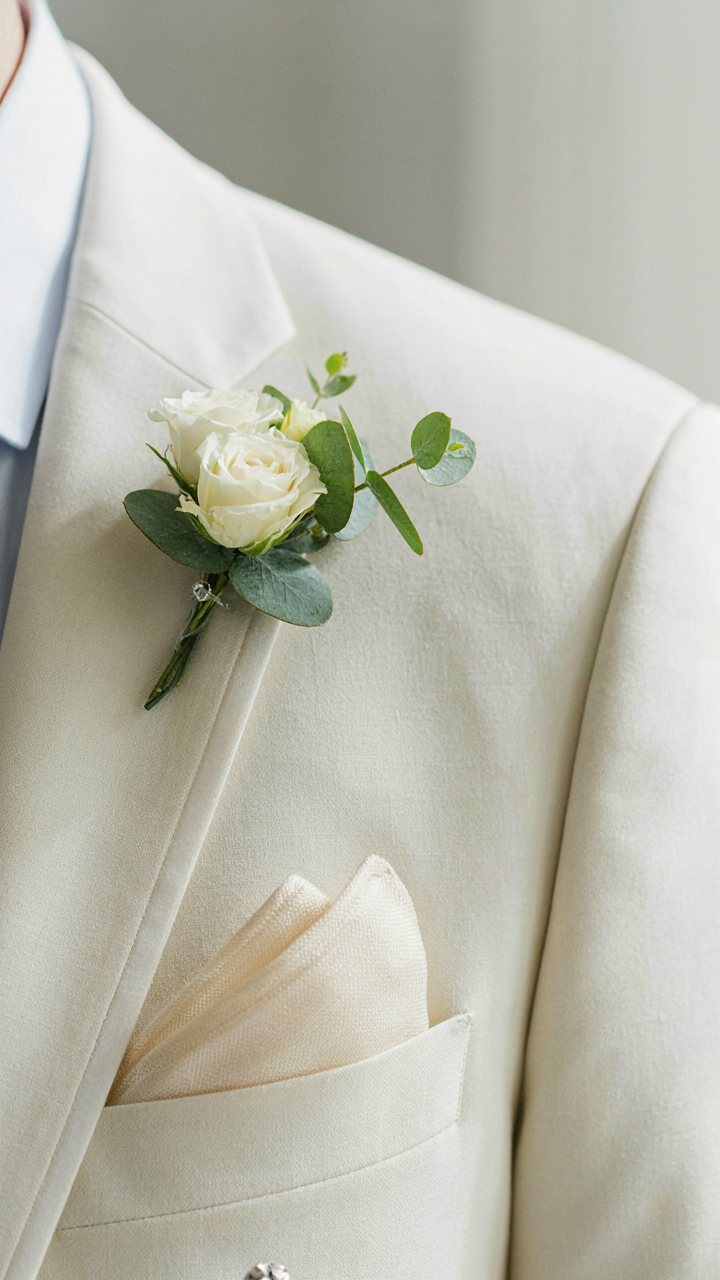
Match The Pocket Square To Floral Scale
You’re worried the pocket square will look cheap next to the boutonniere, so you’re overthinking the pairing. The real mechanism is scale: a boutonniere occupies roughly two square inches on the lapel, while a pocket square occupies four to six. The pocket square dominates the visual weight simply by area. Budget pocket squares fail when they try to compete with the boutonniere’s texture and depth instead of anchoring it. Use a solid or tightly woven pattern on the pocket square, and let the boutonniere’s complexity do the work. The pocket square should recede, not announce itself.

Boutonniere design hasn’t changed materially in a century. A small cluster of flowers or greenery, pinned to the lapel. The pocket square sits eight inches away on the chest. Pairing them means understanding that the eye moves from pocket square to boutonniere as a sequence, not as simultaneous elements. Choose a pocket square in a color that exists somewhere in the boutonniere’s palette—not identical, but harmonious. Cotton blends or linen work better than silk for this because they hold shape without looking overstyled, and they cost half as much.
Tonal Cohesion Over Pattern Matching
The common advice is to match the pocket square pattern to the boutonniere. That’s wrong and expensive. Most budget pocket squares in patterned fabrics look overwrought next to fresh florals because the printed pattern competes for attention instead of supporting it. The real strategy is tonal cohesion—matching the depth and temperature of color, not the specifics. A cream or champagne pocket square works with nearly any boutonniere because it recesses into the background while maintaining visual connection.
Tonal cohesion comes from design theory, not fashion magazines. In visual hierarchy, neutral or desaturated colors sit lower in weight than bright or saturated ones. Your boutonniere is bright and natural. Your pocket square should be muted or neutral to avoid visual cacophony. If the boutonniere is white or blush roses with eucalyptus, choose a cream or soft gray pocket square. If it’s burgundy with greenery, a taupe or light gray pocket square keeps the eye on the flowers, not the pocket. This approach costs less because you’re not hunting for an exact match.
The DIY Imperative: Pocket Square Sewing Pattern Secrets

Simple Patterns For Maximum Return
You want to feel like you solved the problem yourself instead of admitting you just didn’t want to spend money. That’s fine. The mechanism that makes DIY pocket squares work is constraint. A pocket square is geometrically simple—just a square of fabric folded into a triangle. No sleeves, no darts, no waistband adjustments. You can produce a functional result with a pattern that takes thirty minutes to execute, which means your ROI on learning time stays positive.

Most DIY guides online tell you to find complex patterns that look impressive. Wrong. A folded square needs zero pattern complexity. Cut a piece of fabric to size (typically 16 to 18 inches for a standard pocket square), hem the edges with a simple running stitch or machine stitch, and you’re done. The visual impact comes from fabric choice and fold technique, not construction difficulty. Beginners succeed here because the forgiveness margin is wider than any other garment category.
Where To Source Fabric Without Overpaying
First paragraph goes here with the list following immediately after.
- Deadstock Fabric Retailers: Websites and warehouses sell overstock from garment manufacturers at 40 to 70 percent below retail. Search for “deadstock silk” or “clearance suiting fabric” to find bulk quantities in quality materials.
- Quilting Cotton Wholesalers: Bulk cotton yardage costs under two dollars per yard when purchased in 10-yard increments. Not formal, but functional for casual wedding settings and significantly cheaper than silk alternatives.
- Textile Mill Outlet Stores: Physical locations in manufacturing regions sell directly to consumers. If you’re near a textile hub, mill outlets offer first-quality fabric at wholesale prices with no middleman markup.
- Estate Sales And Fabric Liquidation: Upscale estates often include bolt ends of luxury fabric. Linen, wool, and silk remnants sell for pennies because sellers want inventory cleared, not profit maximized.
- Natural Fiber Closeouts: Linen and cotton seasonal overstock from apparel brands gets liquidated in bulk lots. Minimum order quantities are higher but per-unit cost drops below one dollar when buying in volume.
The economics here are straightforward. Retail fabric runs eight to fifteen dollars per yard for quality material. Bulk sourcing cuts that to one to three dollars per yard. A single pocket square uses less than a quarter yard. At scale, making twelve pocket squares for groomsmen costs thirty to forty dollars in materials instead of two hundred. The leverage comes from purchasing power, not labor time.
The Real Obstacle Isn’t Your Budget; It’s Your Unexamined Belief That More Expense Equals More Elegance
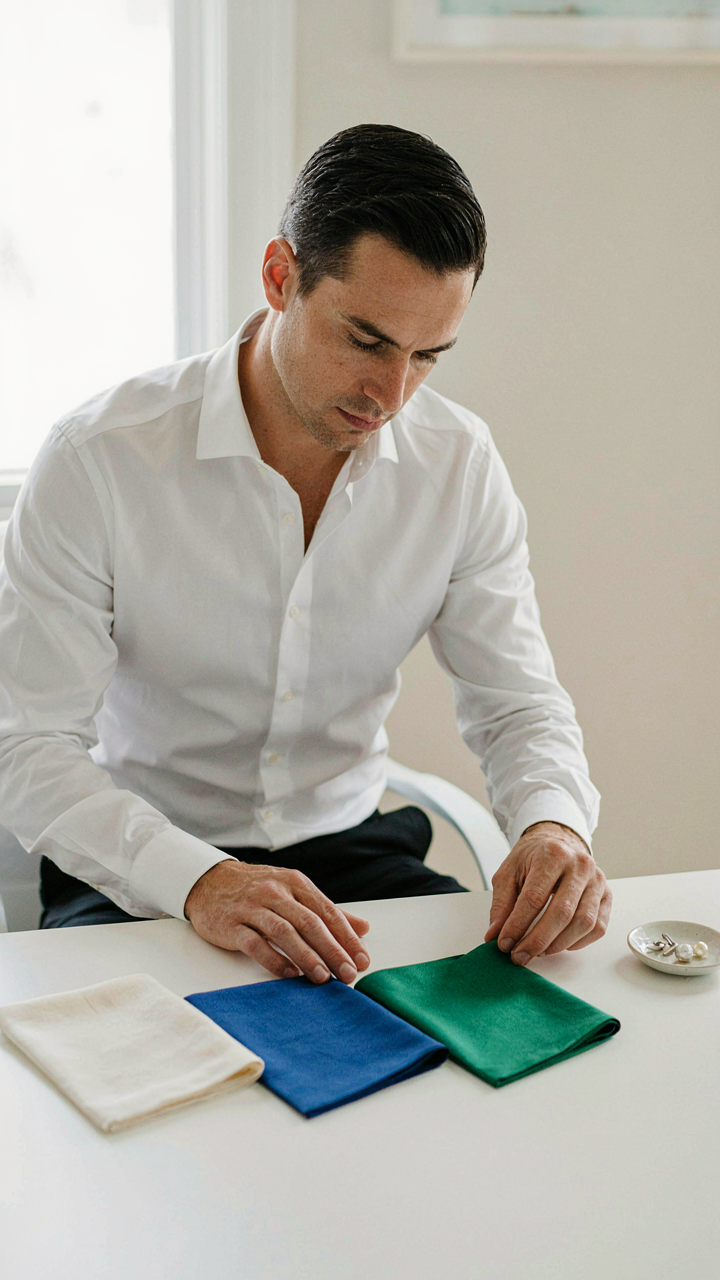
You’ve spent the last hour hunting for pocket squares online because you think spending more proves you care about the details. You’re wrong. The groomsmen standing next to you won’t remember the price tag. They’ll remember if you looked intentional or lazy. A five dollar linen square from the right vendor beats a fifty dollar synthetic one from the wrong one. Stop conflating cost with taste. Open a browser tab right now and spend fifteen minutes on three fabric suppliers you’ve never heard of. Buy the budget option that makes you feel like you made a real choice. That’s elegance.