The “Scarcity As Strategy” Protocol: Redefining Your Wedding Reception Timeline

Budget Dictates Creativity, Not Compromise
You’re afraid you’ll look cheap. That’s the real fear underneath every budget wedding timeline question. But here’s the mechanism: scarcity forces specificity. In economics, scarcity drives value perception. Apply this to your reception timeline and you stop trying to fill six hours with mediocre content. You build two hours of undeniable moments instead. Guests remember intensity, not duration. A tight, intentional timeline reads as curated, not broke.
Most couples pad their timelines to hide budget gaps. They stretch cocktail hour to ninety minutes. They add filler entertainment. They hope nobody notices the budget. This is backwards. A compressed timeline demands you eliminate waste and amplify what matters. Your constraints become your design system. You’re not working with less money. You’re working with less time, which forces better decisions about where money goes.
Where Your Impact Actually Lands
Focal points aren’t decorations. They’re moments where guests’ attention concentrates and decisions about the whole event get made. Most timelines treat the reception as one long event. Wrong framing. Your reception is five or six distinct focal points separated by transition time. The entrance. The first dance. Dinner. Toasts. Dancing. Each one needs forty to sixty minutes of oxygen around it, and nothing else matters during that window.
Budget timelines fail because they try to distribute resources evenly across six hours. That’s the mistake. Concentrate your resources into focal points and leave the rest bare. Let people talk during cocktail. Keep dinner simple. Skip the elaborate cake cutting ceremony if it’s not your focal point. When you edit ruthlessly, the remaining moments hit harder and your budget stretches further because you’re spending on what guests actually experience, not what fills time.
Deconstructing The Reception Timeline: What Truly Matters Hourly
The Non Negotiable Anchor Points
You’re reading this because you’re afraid you’ll waste money on moments nobody remembers. That’s the real fear. Here’s the mechanism: your budget reception only has three or four hours of actual guest attention. Everything else is logistics. The non-negotiables are the moments where guests shift their behavior: arrival, food service, toasts, dancing start, and departure. These five points anchor your timeline because they’re the inflection points where energy either builds or dies. Everything between them is negotiable.

The common advice says to pack your timeline with events: games, slideshows, outfit changes, cake cutting theatrics. Wrong. Each added event burns 15 to 30 minutes of guest focus and budget resources you don’t have. Instead, map your hour-by-hour blocks around these five anchors. Your job is to remove the filler that doesn’t earn its time cost. If a tradition doesn’t create a measurable shift in guest energy or engagement, it’s overhead masquerading as meaning. A focused timeline with 20 minutes of breathing room outperforms a packed one with six separate “moments” fighting for attention.
Eliminate The Hidden Time Thieves
The common timeline advice ignores setup overhead. Most planners treat food service, table transitions, and technical setup as invisible or already solved. They’re not. Cocktail hour eats 45 to 60 minutes minimum if you’re doing it right, and most budget receptions skip it entirely to save an hour of venue rental. That creates a compressed block where 80 guests funnel through a dinner line simultaneously. The real optimization isn’t adding events; it’s frontloading constraints that eat time silently.
Your hour-by-hour timeline should identify exactly where you lose 10 to 15 minutes to transition friction. This is the economics principle of slack: every system needs buffer zones or it collapses. Assign 10 minutes between dinner service and toasts. Assign 15 minutes between last dance and final goodbyes. Most budget couples don’t, then panic when the timeline runs 20 minutes late. Build those buffers directly into your hourly grid as placeholders, not afterthoughts. This prevents the cascade where one delayed moment derails the entire sequence.
The 3 Act Structure: Crafting Your Budget Reception’s Narrative Arc
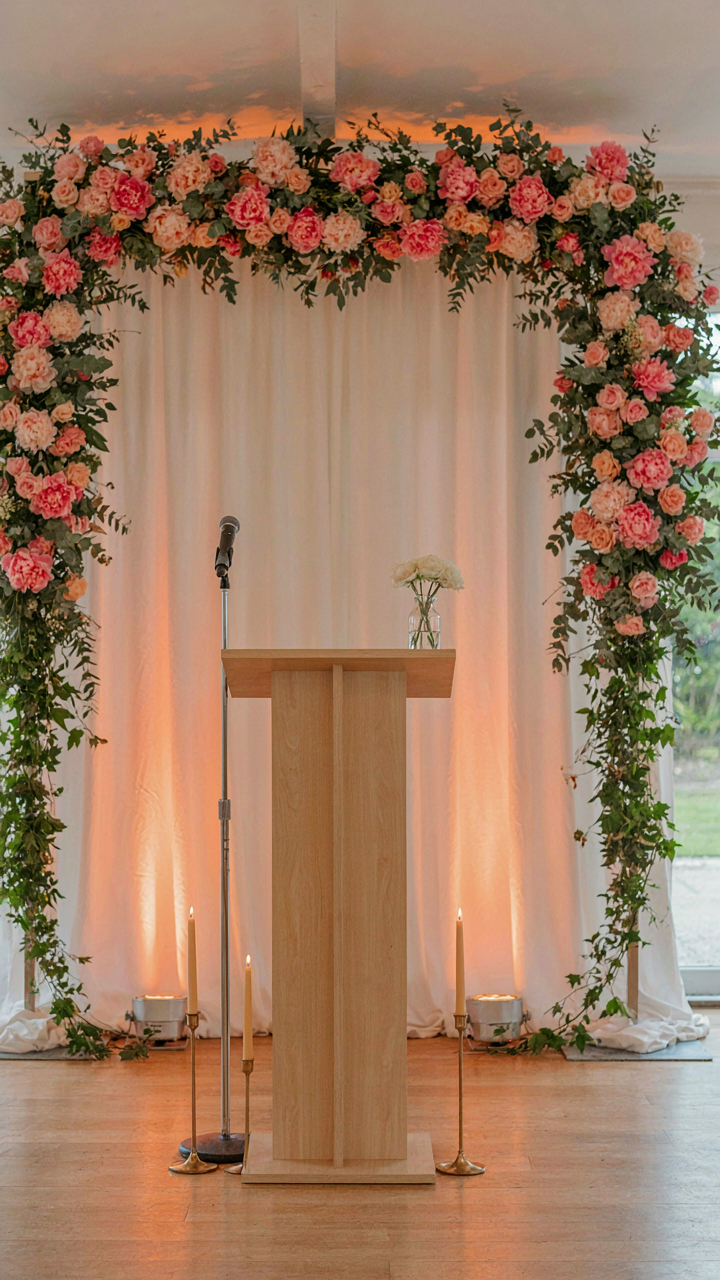
Exposition Confrontation Resolution
You want your wedding to feel expensive without the bill to match. Here’s the mechanism: screenwriting’s three act structure maps directly onto budget reception timelines. Exposition sets the scene and orients guests. Confrontation builds energy through eating, toasting, and dancing. Resolution winds down and sends people home satisfied. Each act serves a function. You’re not throwing a party, you’re directing one.

The first act runs 60 to 90 minutes after doors open. Guests arrive, find their seats, eat the first course. Energy is low and polite. You control the pace with food timing and music volume. No speeches yet. Let people settle. The confrontation act peaks at hour two, when toasts land, the main course finishes, and dancing starts. This is where your money works hardest because guests perceive activity as value. The final act compresses into 45 minutes: dessert, last dance, farewells. People leave with the final experience fresh in memory.
Pacing Flow Through Narrative Tension
Tension in filmmaking comes from expectation meeting obstacle or surprise. Apply this to your timeline directly. The common advice says “keep things moving” or “don’t bore guests.” That’s vague and useless. Real pacing works because you control what guests expect at each hour, then deliver or delay it strategically.
Hour one sets low expectations. Cocktails, mingling, first bite. Hour two explodes with activity. Speeches, dancing, cake. Guests brace for entertainment. Hour three releases that tension by slowing down. Soft music, conversation, goodbyes. If you reverse this, your reception feels wrong and rushed, regardless of budget. The timeline becomes a mechanism for managing attention, not just a schedule. Structure your vendor arrivals, cue your playlist progression, and time your toasts around this arc. The hourly breakdown isn’t decoration. It’s the difference between a reception that lands and one that dissipates.
The “Opportunity Cost” Calculation: Maximizing Your Budget Wedding Schedule

Where Your Money Actually Goes
You’re reading this because you want to prove you didn’t waste money on a wedding. Here’s what actually matters: every dollar and every minute has a competing use. This isn’t sentiment—it’s scarcity. You have a fixed budget and a fixed timeline. Economics calls this opportunity cost: what you give up to get something else. In a budget reception timeline, every hour slot you fill with low-impact activity is an hour you can’t use for high-impact moments.

Most couples treat their timeline like a checklist. They book cocktail hour because that’s what happens, then dinner because that’s next, then dancing because the night isn’t over. They’re spending money on elapsed time, not on the moments guests actually remember. The real cost isn’t the catering for that second hour—it’s the absence of something your guests would talk about instead.
Invest In Moments That Stick
The common advice says “spread events throughout the night to keep energy up.” That’s incomplete. You keep energy up by frontloading impact, not by distributing mediocrity across time. Invest your budget where the guest actually does something or experiences something distinct. A 45-minute cocktail hour with no activity creates a memory vacuum. A 20-minute cocktail hour with a specific, unusual element creates a story.
Your timeline has roughly 4 to 5 major hourly blocks to work with in a typical reception. Allocate budget and time to blocks that produce a sensory or emotional trigger: the first hour (arrival and impact), the meal (extended interaction), one distinct moment (first dance, toasts, surprise element), and wind-down. Skip the filler slots. Cut the timeline tighter than feels comfortable. Let one activity own its time completely rather than stretching five mediocre activities across the night. This approach costs less and lands harder.
Reception Order Of Events: The Anti Schedule Template

Build Slack Into The Frame, Not Around It
You want a timeline because you’re afraid something will fall apart without one. That’s valid. But the mechanism everyone misses: rigid schedules don’t prevent chaos, they accelerate it. Borrow from operations management, which uses buffer stock to absorb demand shock. Your reception needs slack time built into the structure itself, not squeezed into gaps. A 5 PM cocktail hour that stretches to 5:45 PM doesn’t derail anything if dinner is scheduled for 6 PM with a 15-minute buffer built in.

The common advice is to pack events back to back and hope vendors execute on time. That’s how you watch 200 people stand around while a late ceremony pushes everything into a cascade of failure. Instead, design your timeline around realistic vendor behavior: food takes longer to plate than estimated, speeches run over, guests take time moving between spaces. Build these delays into your frame. Your timeline isn’t a prediction of what will happen. It’s a structure that absorbs what actually happens.
Clarify Vendor Responsibilities In Writing
Your photographer needs to know when they stop shooting ceremony and start shooting reception. Your caterer needs to know when plating begins, not just when service should end. Your DJ needs to know the exact moment cocktail hour transitions to dinner, which signals when music energy shifts. Write these moments down and share them three weeks before the wedding.
- Ceremony To Cocktail Transition: Specify exact time the last guest leaves ceremony space and DJ begins cocktail playlist. This prevents the awkward silence between two locations.
- Dinner Plating Window: State when kitchen begins plating and the hard stop time for appetizers. Vendors coordinate their own workflow within this frame, not around your micromanagement.
- Toasts And Dancing Start: Lock in the precise moment toasts begin and dancing resumes. This lets the DJ and catering staff plan music transitions and kitchen reset timing.
- Cake Cutting And Departure Time: Name the cake cut time and your final departure time. Vendors know how much time exists between these two events to execute cleanly.
- Bar Service Hours: Clarify when the bar opens and closes. This prevents caterers from over-prepping or stopping service too early.
Vendors adapt better when they have boundaries, not because they’re stubborn but because adaptation requires decision making. Tight constraints force prioritization. Vague timelines force constant back and forth. Your job is to communicate the frame clearly once, then trust the professionals to operate within it. On reception day, your only job is to track actual time against planned time and alert vendors to major drift before it becomes a problem.
The “Pareto Principle” In Your Wedding Day Timeline Ideas

Identify Your Critical Few Events
You want permission to skip the stuff nobody will remember so you can stop feeling guilty about cutting corners. The mechanism is simple: economics calls this the Pareto distribution—in your reception timeline, 20% of events create 80% of the emotional weight. The ceremony moment, the first dance, the toast, cutting the cake. Those four anchors carry your entire day. Everything else is filler competing for attention and budget.

Most couples schedule fifteen micro-events (cocktail hour games, table visits, receiving lines, special dances for cousins) then wonder why the timeline feels bloated and the energy dies between moments. You’re running a reception, not filling time slots. Identify which events your guests actually perceive as milestones, not obligations. The rest becomes negotiable.
Strip Out Everything That Doesn’t Move The Needle
The common advice says “include something for everyone.” That’s wrong. A bloated timeline exhausts your vendors, creates dead air for guests, and burns through your budget on coordination that adds zero value. Cut the trivial many ruthlessly: the bouquet toss, the garter removal, the formal table visit sequence where you stand at each table for thirty seconds while your food gets cold.
Your reception timeline should have clean white space between major events, not a packed schedule that reads like a corporate retreat agenda. This isn’t about being cold—it’s about letting each moment breathe so people actually feel it. Strip the schedule down to what moves the energy forward, then execute those moments flawlessly instead of spreading yourself thin across fifteen forgettable transitions.
Synchronicity, Not Control: Orchestrating Your Wedding Reception Schedule
The Ensemble Method
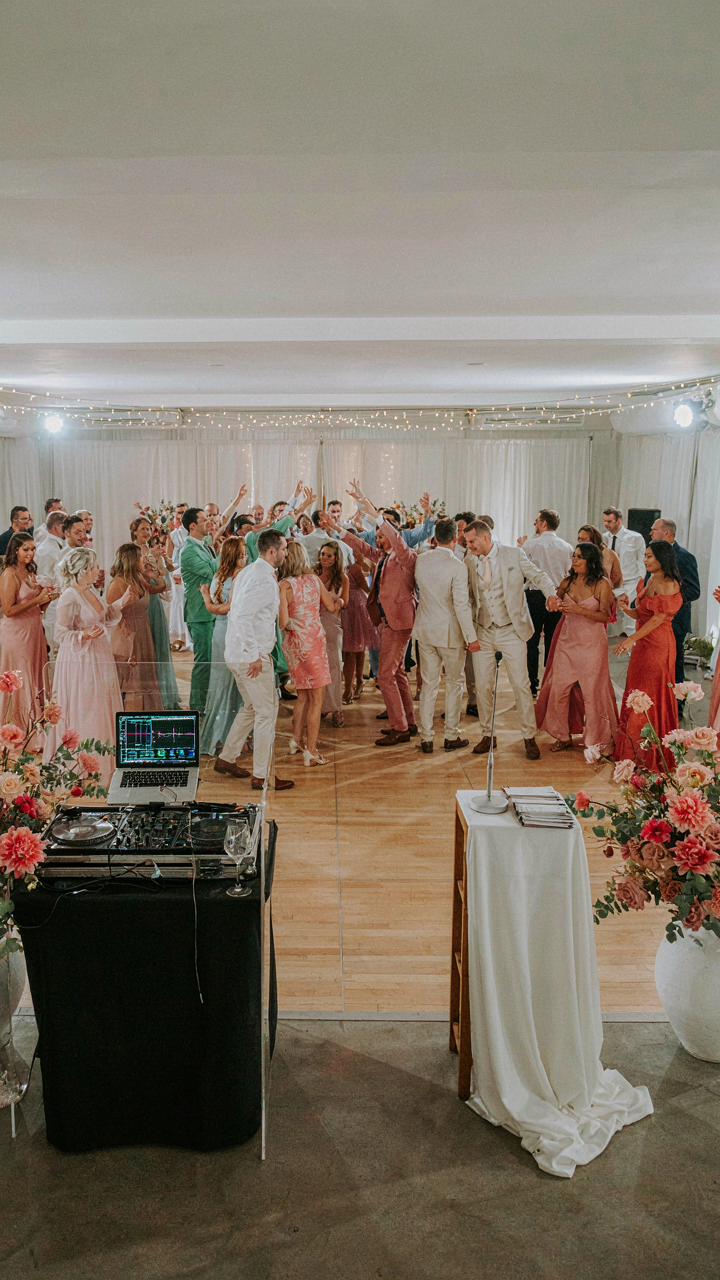
You want a timeline because you’re terrified of dead air and silence making your guests think you wasted their money. Here’s the mechanism: a jazz ensemble doesn’t work because a bandleader micromanages every note. It works because musicians understand the structure, know their role within it, and respond to the other players in real time. Your reception timeline operates the same way. You build a skeleton of transitions, not a script of rigid minute-markers. The skeleton gives your vendors, family, and staff permission to move fluidly without asking permission constantly.

Most couples create timelines that break the moment one element runs five minutes behind. Instead, build buffers into your transition points, not your events. A forty-five-minute dinner doesn’t need a hard stop at 7:15 PM. It needs a clear signal to your MC or DJ that when plates clear, the next cue begins regardless of clock time. This is how budget receptions stay on track without a wedding coordinator barking updates every ten minutes. Your timeline becomes a language, not a prison sentence.
Signals Over Schedules
Stop thinking about clock times as commands. Think about them as checkpoint cues. When you tell your caterer “dinner at 7 PM,” they hear a rigid deadline. When you tell them “dinner starts once cocktails naturally break” and show them three environmental cues (fewer people standing, plates cleared from bar, MC positioned), they adapt intelligently. The difference between a $3,000 and $15,000 wedding day is often just this: wealthy couples hire coordinators who translate clock time into observable signals. You can do this yourself by naming the actual trigger for each transition.
Build your hourly timeline as a sequence of signal-based handoffs between your vendors. Reception doors open. Guests flow to tables naturally. MC takes stage once 80% of guests sit. These aren’t times; they’re conditions. Write them down with a one-sentence trigger for each person responsible. Your DJ needs to know “start dinner music when caterer signals servers are pouring drinks,” not “play dinner music from 7:05 to 8:00 PM.” This removes ambiguity and makes your budget timeline actually executable on the day.
Post Ceremony Pitfalls: Avoiding The Costly Wedding Schedule Delays
Eliminate Transition Bottlenecks Before They Start
You’re worried about looking disorganized. The real problem is that ceremony-to-reception transitions kill your timeline because nobody owns the specific handoff moment. Think of it like supply chain logistics: every minute guests wait between ceremony and reception is dead time you’re still paying for—venue rental, catering staff standing idle, bar running without revenue. The bottleneck isn’t the ceremony ending; it’s the gap where no one has a defined role.

Map out exactly who moves what and when. Assign one person to manage chair stacking, one to direct guest flow to cocktail hour or directly to tables, one to cue the catering team. Write times on a printed card each vendor sees before the ceremony starts. Most couples skip this step and wonder why their four-hour budget window somehow stretched to five hours of paid labor. That gap costs money fast.
Stagger Arrivals To Control Venue Capacity And Staff Load
Guest flow is an engineering problem, not a social one. Stagger arrivals by inviting cocktail-hour guests at a different time than reception guests. A 2 PM ceremony doesn’t mean everyone shows up at 2:15 PM. Use your invitation details to segment: immediate family and wedding party to ceremony plus cocktail hour, general guests to cocktail hour only or directly to dinner service thirty minutes later.
This move cuts peak demand on bathrooms, bars, and catering stations. Your staff handles smaller groups in sequence instead of managing a crowd surge. You pay less in overtime because you’ve compressed service into predictable waves rather than one chaotic rush. Brief your invitation coordinator on this timing split before sending RSVPs so the messaging is consistent and guests don’t arrive confused.
The Unconventional Wedding Reception Timeline Template: Design For Delight, Not Debt

What Actually Matters To Your Guests
You’re worried people will judge you for a short reception or a tight schedule. Here’s the mechanism: guests don’t measure your wedding by duration or tradition. They measure it by whether they felt forgotten or entertained. Attention scarcity, borrowed from economics, means every minute you allocate has a return value. A three-hour reception with intent beats a five-hour reception where guests wait through dead time between speeches and dancing.

The timeline that wins isn’t the longest one. It’s the one that removes friction between moments guests actually want. Cut the cocktail hour if your bar isn’t set up. Cut the formal line if people hate standing still. Cut speeches if they’re longer than three minutes. Your guests came for connection and celebration, not for ceremony theater.
Strip The Revenue Plays Disguised As Tradition
Most advice on reception timelines serves the vendor, not your budget. The industry pushes four-hour minimums because it justifies higher hourly rates and staffing costs. It pushes staggered timings (cocktail, dinner, dancing) because each phase requires a separate vendor setup. None of this serves you.
Build your timeline backward from what you’re actually paying for. If you’ve rented the space for four hours, map your events into those four hours deliberately. Don’t add a cocktail hour just because “that’s what people do.” Don’t split dinner and dancing if you’re paying for one caterer. Stack your highest-energy moments in the middle two hours when guest attention peaks, then end before the venue charges overtime.
The Real Obstacle Isn’t Your Budget, It’s Your Fear Of Defying Expectations

You’re not struggling with a budget timeline because you lack information. You’re struggling because you’re terrified of what people will think when you skip the five-course dinner or compress cocktail hour. That fear costs you more than any vendor ever will. Open your guest list right now. Cross off three people you invited out of obligation, not love. Watch how suddenly your timeline becomes flexible, your budget breathes, and your wedding stops feeling like a performance. Your guests don’t remember the schedule anyway, they remember how you made them feel.