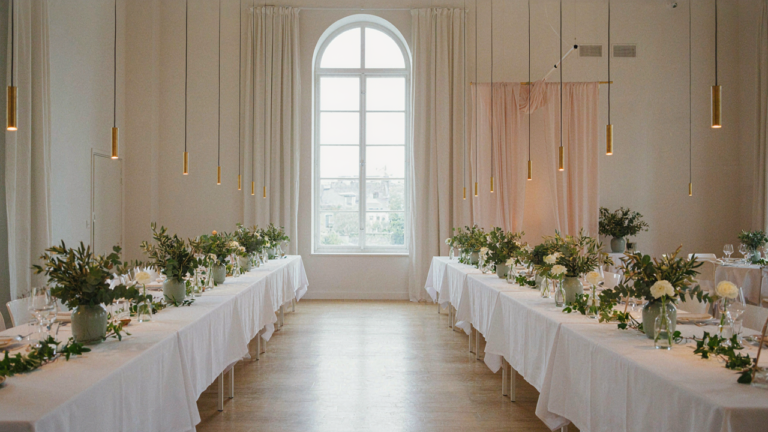
The Desert Wedding Aesthetic: Beyond Pinterest Boards
What The Desert Actually Looks Like
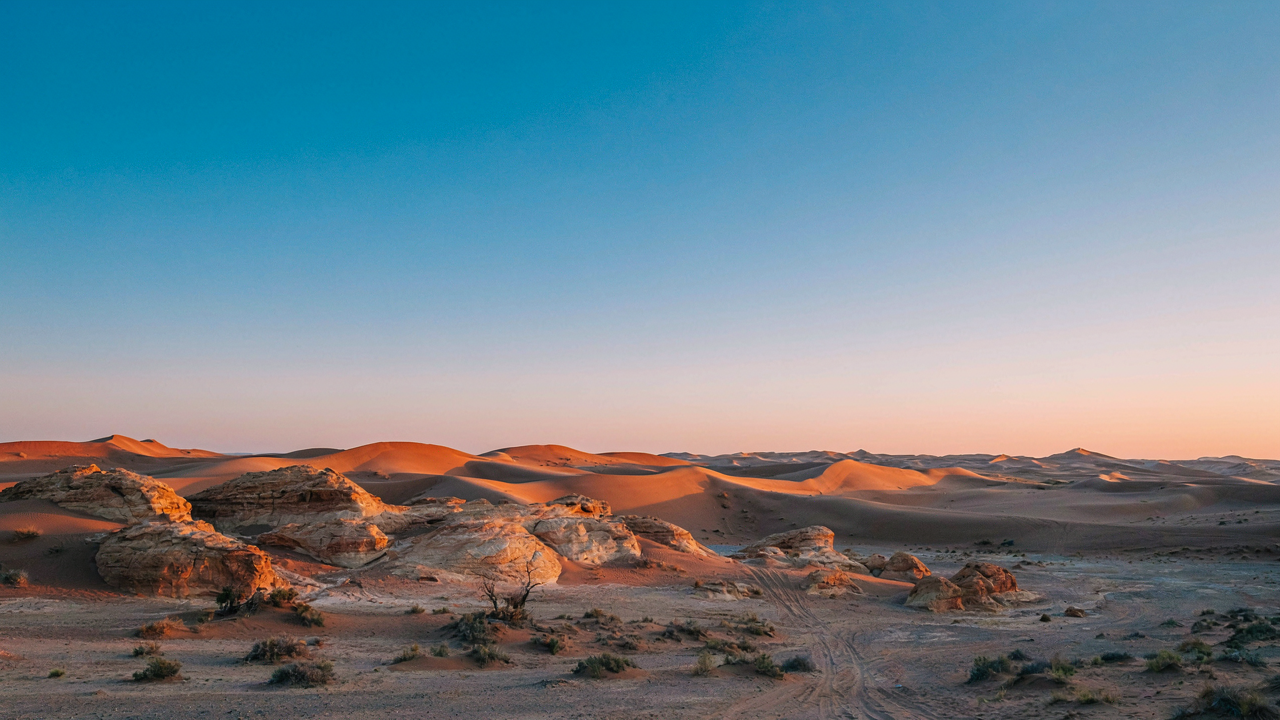
You want the aesthetic without looking like you tried too hard. That’s the real problem here. The mechanism is simple: the desert aesthetic works because it’s defined by subtraction, not addition. Natural light, sparse vegetation, exposed earth, and minimal color palette. The Sonoran Desert uses ochre and rust. The Mojave uses pale tan and gray. The Chihuahuan uses deep red soil. Pick your actual location first. Then build from what’s already there instead of importing Pinterest images that belong nowhere near your venue.
Most desert weddings fail because planners treat the landscape as a blank canvas needing rescue. It doesn’t. The desert’s power comes from its resistance to decoration. Sand dunes don’t need uplighting. Scrub brush doesn’t need garland. Rock formations don’t need staging. Your job is to work with what exists, not against it. Photograph your venue at different times of day. Notice where shadows fall. See where the eye naturally travels. That becomes your design framework.
Bohemian Means Poor, Not Broke
The word “bohemian” comes from a 19th-century European movement where artists lived outside mainstream society by necessity, not by aesthetic choice. They couldn’t afford conventional things, so they made do with what they had. Modern wedding marketing inverted this: bohemian now means expensive textiles, imported artisan goods, and curated vintage finds. That’s not bohemian. That’s consumerism wearing bohemian’s clothes.
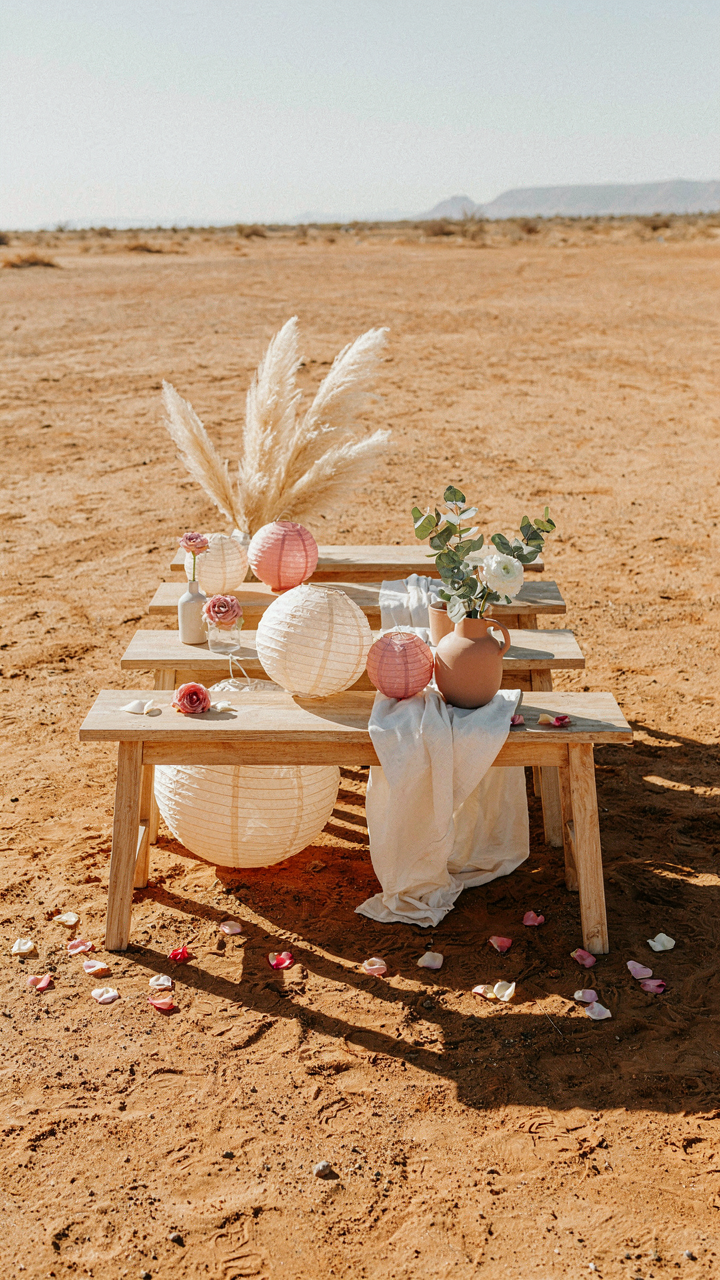
Real bohemian desert weddings use what the location provides and what guests can reasonably bring. Wooden benches instead of rented chairs. Paper lanterns made weeks before instead of event-rental brass. Potluck food displayed family-style. Handmade signage. Borrowed textiles from attendees’ homes. The constraint forces creativity and produces authenticity. When you can’t buy your way out of a design problem, you actually solve it. That’s the mechanism that makes bohemian work on a budget: limitation breeds distinctiveness, not the other way around.
Site Selection: Your Desert Chic Wedding Blueprint
Natural Landscape As Your Actual Venue
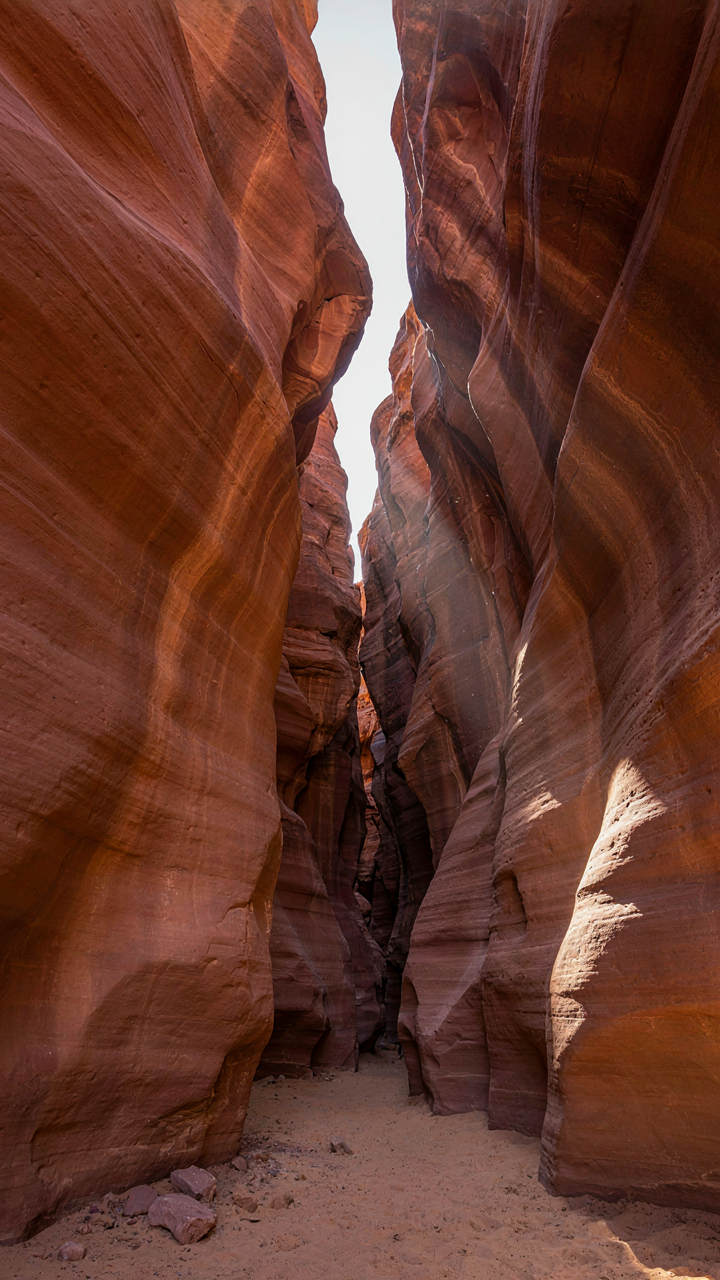
You want the location to do the work for you so you don’t have to rent expensive decor. Here’s the mechanism: bohemian desert aesthetics borrow from landscape architecture’s principle of “borrowed scenery”—using existing terrain features as your visual foundation rather than fighting against them. Raw desert already provides texture, color, and scale. Sand dunes, rock formations, and sparse vegetation become your backdrop without markup. The bohemian movement itself rejected manufactured environments; it was a reaction against industrial aesthetics. Your venue should reflect that principle literally.
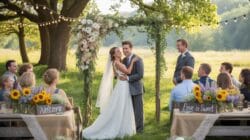
Location determines your labor and material cost before you sign anything. A slot canyon with natural walls eliminates the need for backdrop rentals. Alkali flats provide bleached earth tones that match bohemian color palettes. Desert scrub offers visual interest without landscaping work. Scout locations in late afternoon when light angles show what you actually get, not what you hope for. Most couples waste budget on decor to compensate for bland venues. Reverse that. Pick a location so strong it requires minimal addition.
Find Permits And Avoid Venue Markup
The common advice here is wrong: most people assume they need a designated wedding venue. You don’t. Raw land is cheaper and permits are straightforward if you follow the process. Contact your county’s land management office or Bureau of Land Management directly. Many desert areas allow events on public land with a simple permit application and insurance certificate. Private landowners often rent acreage at 40 to 60 percent below wedding venue pricing because they’re not in the wedding business.
Venue companies markup raw space 300 to 500 percent by adding amenities, staffing, and liability packaging. Cut them out. Rent directly from land trusts, ranches, or state parks that manage desert acreage. Get written permission before planning anything. Insurance is your actual cost, not venue rental. A general liability policy for your event runs 200 to 400 dollars. File your permit 60 to 90 days before your date. Confirm utilities and water access before you commit to a location.
The Resourceful Decor Protocol: Desert Theme Wedding Decor
Local Found Elements Beat Retail Entirely
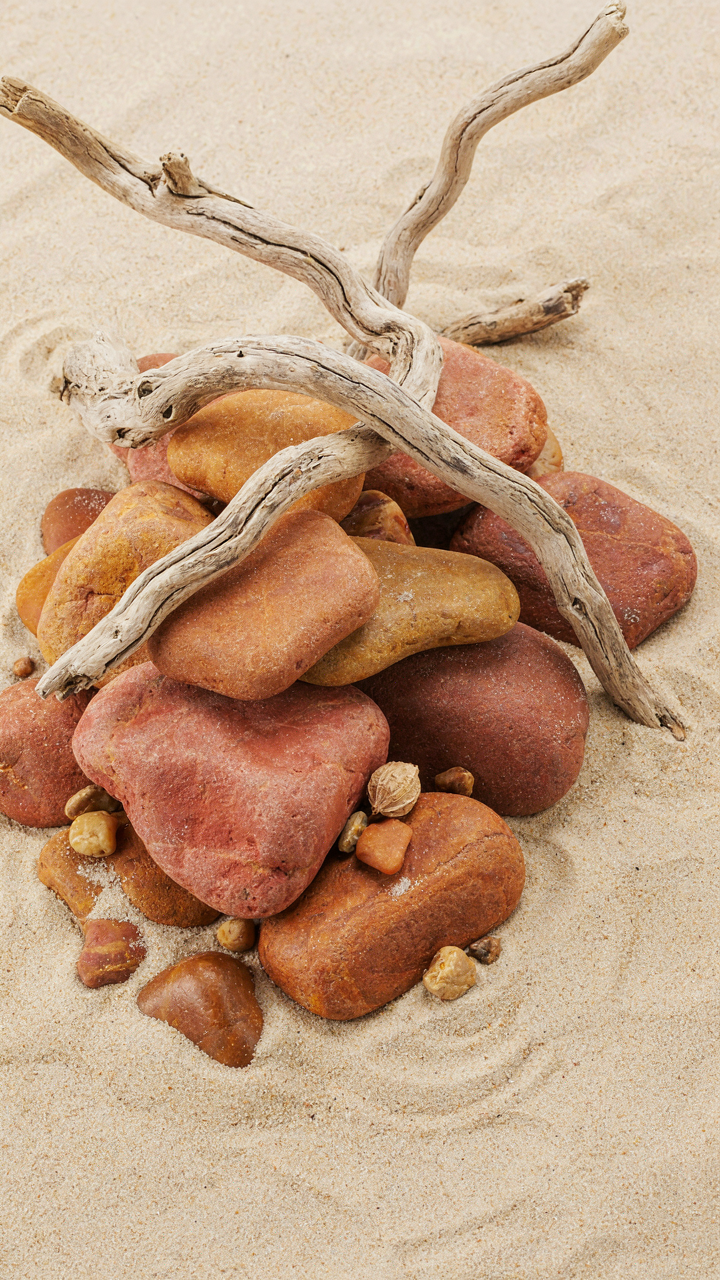
You want to look intentional without looking broke. The real mechanism is this: retail bohemian decor is mass-produced, homogenized, and signals the opposite of what you’re trying to communicate. Local and found elements work because they’re contextual. A piece of driftwood from the actual desert you’re getting married in tells a story retail never can. You stop competing with Pinterest and start competing with authenticity.
- Rocks and Stones: Collect from the wedding site itself or nearby washes. Sort by color and size for arrangement flexibility. Transport in bulk before the event day to reduce logistics stress and costs.
- Dead Wood and Branches: Source fallen timber from desert areas, riverbeds, or storm damage. Strip bark if needed for cleaner displays. Use for table runners, archway frames, or hanging installations without treatment.
- Native Plants and Succulents: Propagate from cuttings weeks before. Arrange in grouped clusters rather than scattered singles. Replant after the event or gift to guests as favors with minimal waste.
- Sand and Soil Variations: Layer different desert sand colors in glass vessels or directly on tables. Mix with rocks for visual texture. Source from landscape suppliers in bulk at a fraction of floral shop markups.
- Reclaimed Metal and Rusted Pieces: Scout farm salvage yards, estate sales, and online marketplaces. Rust and patina reinforce bohemian authenticity. Clean minimally to preserve character without creating safety hazards.
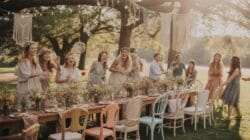
The budget advantage compounds because you control the supply chain directly. You’re not paying a florist markup on someone else’s gathering. Transportation and time become your only costs, and both scale down when you work in batches and plan staging before the wedding day arrives.
Natural Selection Dictates What Actually Works
Evolutionary biology teaches us that survival depends on fitness to environment, not decoration. Apply this to your wedding: the decor that survives the desert and doesn’t require constant intervention is the decor that belongs there. You won’t see tropical flowers thriving in sand without artificial climate control. But native low-profile plants, weathered wood, and minerals actually live in that space.
This means abandoning the instinct to fill every gap with something. Empty space in a desert is accurate. Sparse arrangement is not a budget constraint masquerading as a design choice. It’s the actual physics of the environment. A few well-placed stones cast shadows that define the space better than a wall of draped fabric fighting the wind. The decor that lasts through the event without constant fussing is the decor aligned with how the desert actually functions. Your job is amplification, not contradiction.
The Desert Color Palette Wedding: Pigment, Not Paint
Where Desert Light Actually Comes From
You want this section because you’re afraid your wedding will look cheap if the colors don’t match some imagined “boho aesthetic” you saw on Pinterest. Here’s the mechanism: desert color palettes work because they’re extracted from what actually exists there, not invented. The Sonoran, Mojave, and Chihuahuan deserts produce specific hues based on mineral composition, sand grain size, and how light refracts at different times of day. This is geology, not decoration. When you pull color directly from those sources, the palette coheres without effort because it reflects real environmental constraints.

Most couples reverse-engineer this wrong. They pick a color they like, then hunt for decorations to match it. Instead, source three to five dominant hues from actual desert locations you admire. Photograph the landscape at dawn, midday, and dusk. Screenshot the images. Use a color picker tool to extract hex codes. This gives you a palette grounded in physics, not trend forecasting. The colors will feel intentional because they are.
Raw Materials Over Manufactured Finish
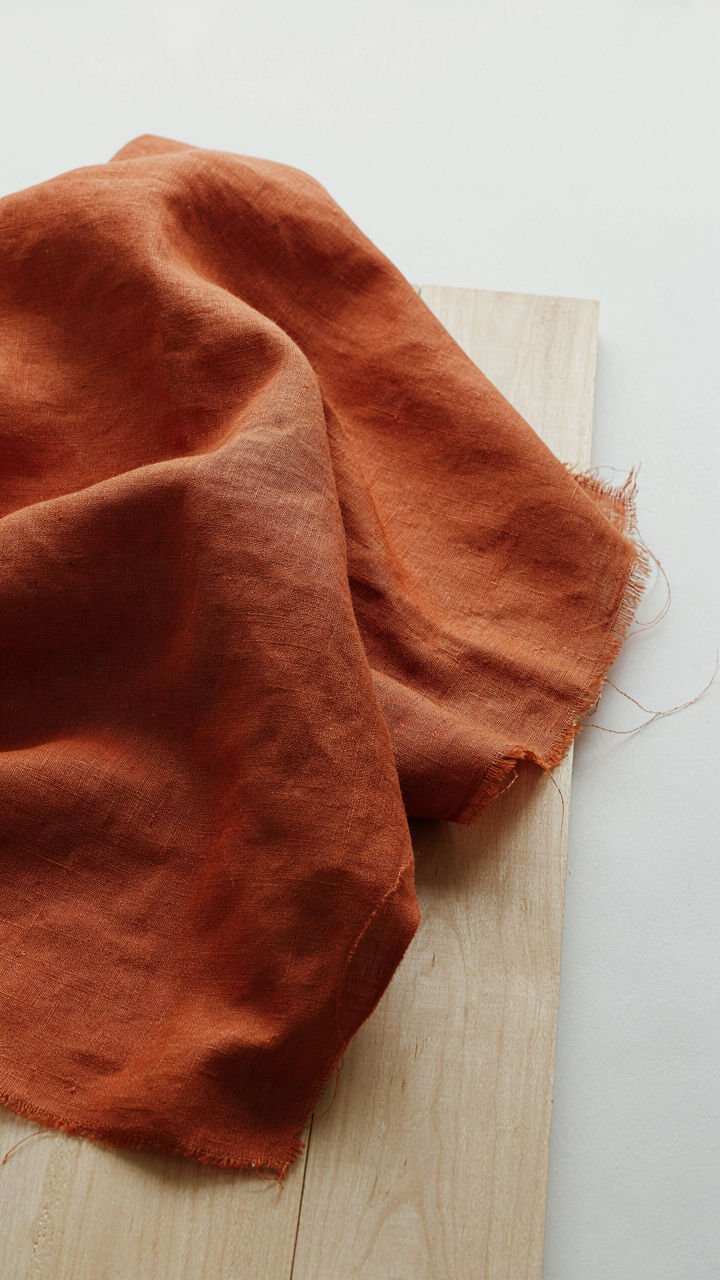
Every boho desert wedding guide says “use natural materials.” That’s incomplete. The real move is integrating materials that already contain the pigment you need, then letting their texture do the work instead of painting over them. Unbleached linen, raw wood, terracotta, adobe brick, and air-dried palm all carry built-in color. You’re not choosing between “natural” and “artificial”—you’re choosing between materials where the color is structural versus surface-level.
Bleached muslin reads flat and corporate. Raw linen reads intentional because the weave itself creates depth and shadow variation. Stained wood accepts light differently than painted wood. Adobe has mineral undertones that printed paper cannot replicate. Buy materials in their unfinished state and let their surface grain and fiber structure create visual interest. This approach costs less than painting custom colors and photographs infinitely better because the camera captures actual texture instead of a flat wash.
Boho Wedding Inspiration: Less Is More Principle
Curate Essential Elements Only
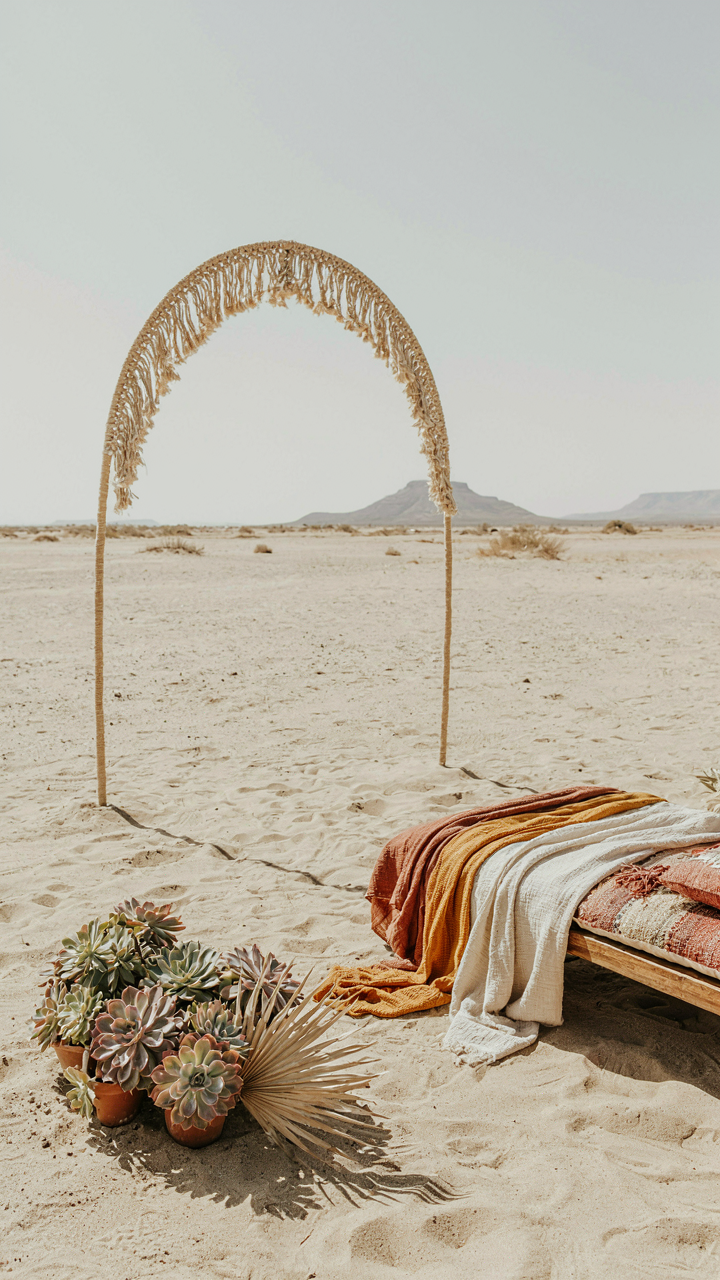
You want people to think you’ve done more with less. That’s the real fear underneath this section. The mechanism is simple: bohemian design emerged from the 1960s counterculture as a rejection of consumerist excess, yet modern weddings invert that by drowning guests in stuff. You strip back because constraint forces intention. Every piece you include now carries weight instead of disappearing into noise.
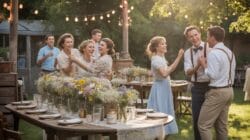
Start by identifying the three elements that define your specific vision: maybe it’s macramé, succulents, and earth-tone textiles. Not five. Not eight. Three. Everything else becomes filler that eats budget and attention. Desert bohemian weddings actually benefit from emptiness—the landscape already provides scale and drama. You’re not competing with it. You’re working with it. Remove one decoration per area until removing another one hurts the design.
Experience Beats Overwhelming Decor
Common advice says pack more into every corner. That’s backwards. A guest remembers the moment they felt something, not the count of hanging tapestries they walked past. Bohemian desert weddings profit from negative space the way music profits from silence. The quiet moments between songs make the songs hit harder.
Build your budget around what guests actually interact with: the ground they walk on, the music they hear, the food they eat, the fire they gather around. These cost less than floor-to-ceiling installations and create the actual memory. Arrange your ceremony space so three focal points exist instead of thirty competing details. This protocol works: identify your ceremony focal point, then one feature for the reception entrance, then one for the dance floor. Everything serves those three anchors.
Vendor Selection: The Value Driven Desert Boho Wedding

Skill And Shared Vision Over Price
You’re worried about getting screwed. That’s the real thing here. You think lower price means lower risk, but it actually inverts it. Economics teaches us about comparative advantage—the principle that one party gains more efficiency in one area than another. In desert boho weddings, your photographer has comparative advantage in capturing light on sand and textiles. Your florist has it in sourcing dried botanicals that don’t wilt in heat. Buy that advantage. Pay for it.
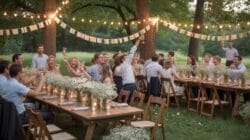
Cheap vendors who don’t specialize in desert settings will solve problems the wrong way. They’ll use fresh flowers that die by sunset. They’ll light the ceremony like an indoor event. They’ll miss the actual aesthetic you hired them for. A vendor who’s shot five desert boho weddings knows the angle of golden hour in that specific location. They’ve problem-solved around dust, heat, and scale. That knowledge costs more upfront because you’re not paying for their time—you’re paying for their failures already made so you don’t repeat them.
Clear Scope Eliminates Negotiation Friction
Everyone negotiates wrong on weddings because they negotiate on price first. That’s backwards. You define scope so tightly that price becomes obvious. Tell your vendor exactly what you need: “Four hours of photography, 600 edited images, two shooters, a first look session, and a two-minute highlight reel.” Not “we want good photos.” Not “we want it to feel bohemian.” Specificity kills ambiguity, and ambiguity is where vendors pad estimates and cut corners later.
Once scope is locked, price negotiation moves from “can you do it cheaper” to “can you do this scope for X budget.” That’s a yes or no question. If they say no, you either increase budget or reduce scope. If they say yes, you have a contract that protects both of you because expectations are written down. Start scope conversations by asking vendors what they typically deliver, then edit from there. Never let a vendor pitch you features. You pitch requirements, they confirm feasibility.
DIY Vs. DI Why Bother: Practical Desert Wedding Ideas
The Math Behind Making It Yourself
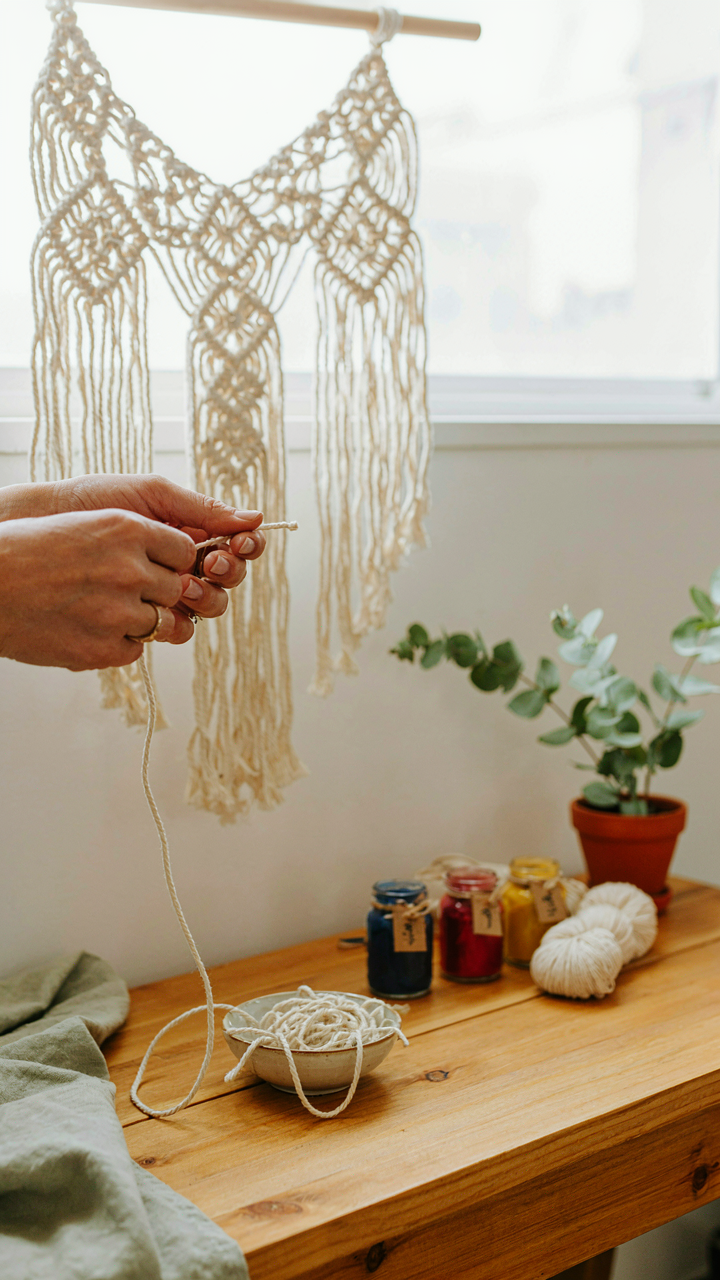
You want to DIY because you think it saves money. It doesn’t always. The real mechanism here borrows from economics: opportunity cost. Your time has value whether you assign it or not. A bohemian desert wedding theme demands hand-dyed linens, macramé installations, and sourced vintage pieces. If you spend sixty hours on these, you’ve either sacrificed income or sleep.
Calculate the actual cost: materials plus your hourly rate, then compare to hiring it done. Most people skip this math and end up broke and exhausted. The decision isn’t about passion for crafting. It’s about whether the output justifies the input.
- Hand-dyed table runners: Budget forty to eighty dollars in dye and fabric per runner, plus eight to twelve hours labor per color variation you want to achieve.
- Macramé wall hangings: Plant-based jute costs fifteen to thirty dollars per piece, but knotting a six-foot installation takes four to six hours if you’re skilled, longer if learning.
- Vintage furniture sourcing: Hours hunting estate sales, auctions, and online marketplaces add up fast; factor in shipping costs and refinishing time before the event.
- Floral arrangements and dried botanicals: Desert florals like pampas grass and sagebrush seem cheap per stem but assembling centerpieces for forty guests requires bulk purchasing and day-of labor.
- Invitations and stationery: Hand-lettering, printing, or block-printing each piece at scale demands materials, trial runs, and precision that compounds your time investment significantly.
The bohemian desert aesthetic relies on collected, intentional details. Rushing these details or overextending yourself undermines the entire vibe. Know your limits before you commit.
Know What You Actually Own
Stop outsourcing tasks you’re already equipped to handle. The bohemian desert wedding theme thrives on curation, not production. If you have design sensibility, delegate logistics. If you’re organized, handle timelines. If you’re skilled with plants, build the installation yourself.
The mistake is treating every task as equally important. They’re not. Your core competency determines where you add value. Everything else drains your reserves and dilutes your focus. Ruthless delegation means you hire for execution on tasks outside your wheelhouse, freeing you to refine what matters most to your vision.
Guest Experience: The Intimate Boho Theme
Create Touchpoints That Signal Intentionality
You want guests to feel like they stumbled into something rare, not attended an event. That requires deliberate design at every interaction point, starting before they arrive. The mechanism is simple: scarcity of attention creates perceived value. When guests notice you’ve considered details most planners skip, they internalize the whole experience as premium, regardless of budget.
Pre-arrival communication sets the tone immediately. Send a physical postcard or email with specific instructions on what to wear, what to expect, and why the desert matters to your vision. Greet arrivals at a marked entry point with cold water in glass bottles, a hand stamp with henna-inspired ink, or a simple sage bundle. These aren’t luxuries. They’re signals that this gathering operates under different rules than standard weddings.
Comfort Without Losing The Aesthetic
Most budget boho advice says to sacrifice comfort for look. That’s wrong and it tanks the entire experience. Guests who are sunburned, dehydrated, or sitting on hard ground for hours don’t care about aesthetic authenticity. They remember suffering. Comfort and aesthetic work together when you solve for the real variables: temperature, seating, lighting, and access.
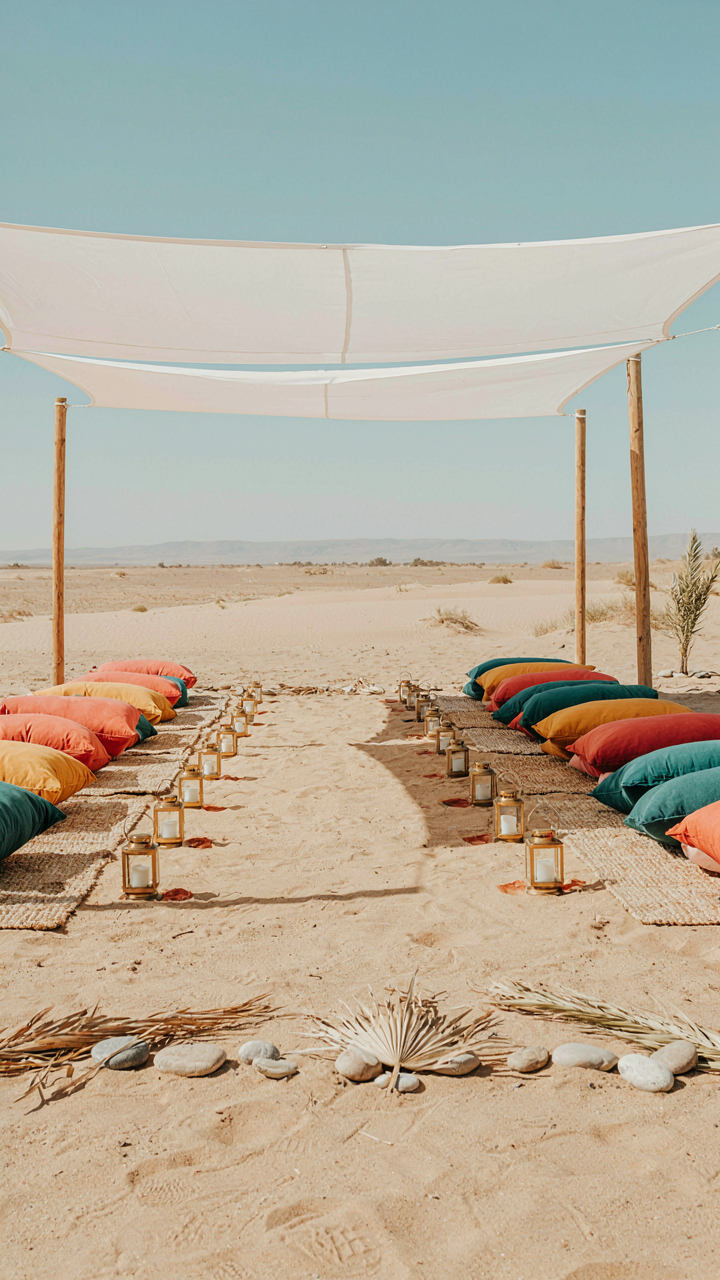
Provide shade structures using simple white canvas or natural fabric stretched across metal frames. Position low seating on rugs and cushions rather than chairs, which actually costs less and looks more intentional. Set up a water station with fresh fruit and electrolyte options at two strategic points. After sunset, string Edison bulbs or place lanterns along pathways so guests navigate safely. These decisions honor both the bohemian desert aesthetic and basic human physiology.
Post Wedding: Sustaining Your Desert Wedding Theme
Leave No Trace, Leave No Regret
You want to feel like your wedding mattered beyond the Instagram posts—like it didn’t just extract value from the desert and vanish. The mechanism is simple: a bohemian desert wedding generates physical waste that conflicts with the aesthetic you paid for. Plan removal before the event, not after. Assign one person to photograph the site before setup and after breakdown. This creates accountability and prevents the slow realization that you’ve left behind tarps, stakes, and forgotten décor.

Desert ecosystems recover slowly. Sand patterns shift across years, not months. Native plants die from foot traffic and soil compaction. The bohemian philosophy—rooted in rejecting excess and embracing nature—gets inverted when you leave degradation behind. Use marked pathways. Collect every stake, string, and cloth scrap. This isn’t virtue signaling. It’s the only logical conclusion to an event built on valuing the land enough to host your wedding there.
Repurpose What You Built
The standard advice says “save your décor for future events.” That’s lazy and often untrue—most pieces won’t fit your next context and end up in storage for years before the trash. Instead, plan secondary uses before you buy. Wooden pallets used for ceremony backdrops become raised garden beds or outdoor furniture for your home. Fabric draping transitions to throw blankets, wall hangings, or quilting material. Metal stands and arches get repurposed as plant structures or outdoor sculptures.
Inventory everything during breakdown. Document condition and material. Reach out to other couples, event planners, or rental cooperatives in your region before the wedding ends. Selling or gifting used décor immediately prevents the psychological weight of ownership without purpose. Many bohemian desert weddings use rented items anyway—verify what you own versus what you’re liable for, and prioritize keeping only pieces that serve a function in your actual life, not your fantasy version of future entertaining.
The Real Obstacle Isn’t Your Budget; It’s Your Addiction To External Validation
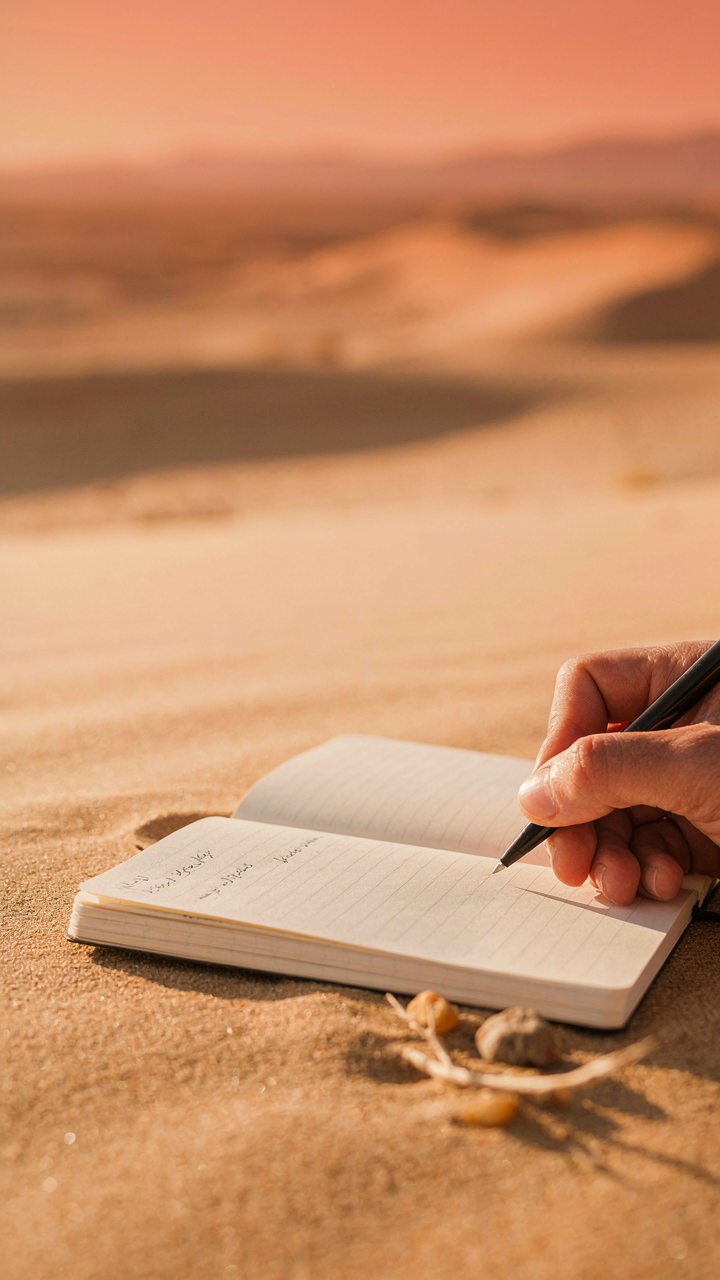
You’ll spend months scrolling Pinterest, comparing your bohemian desert wedding theme to someone else’s Instagram feed, and convince yourself you need more money. The truth? You’re terrified your guests will judge you. Stop asking what others think and start asking what actually moves you. Today, write down three elements of your vision that have nothing to do with impressing anyone. Build from there. Your bohemian desert wedding doesn’t need their approval to be real.