The Urban Canvas: Reclaiming Neglected Rooftop Ceremony Spaces

Scout Where Others Don’t Look
You want this to feel exclusive without paying exclusive prices. The mechanism is simple: most couples search the same five venues because they show up first in Google. Rooftop venues exist everywhere in urban areas—office buildings, parking structures, hotels, warehouses, apartment complexes—but only a fraction are marketed to weddings. Property managers don’t think “wedding venue” by default. You do the work they haven’t done yet.
Start with Google Maps. Zoom into your city. Identify rooftops visually by their architecture and surrounding views. Call the building management directly, not the sales team. Ask one question: “Do you allow private events on your rooftop?” Most say yes. Most have never formalized pricing because they’ve never been asked. This is where negotiation lives—in the gap between what they’ve charged before and what they might charge now.
Negotiate The Slot Nobody Wants
Off-peak hours exist for a reason: nobody fights for them. Hotels charge less for Tuesday weddings than Saturday. Building owners prefer events outside their tenant hours. This creates leverage. The real play isn’t finding the cheapest venue—it’s finding the venue that needs revenue during their slow window and matching that with your ceremony timing.
Call venues and propose specific off-peak slots: Friday afternoon, Sunday morning, Wednesday evening. Quote your budget range upfront. Most will counter lower than their standard rate because they’d rather fill the space than keep it empty. A rooftop that costs 3,000 on a Saturday might rent for 1,200 on a Thursday. You’re not getting a discount—you’re paying the actual market price for that time slot.
Minimalist Aesthetics: Beyond The Balloon Arch Rooftop Wedding

What The Rooftop Already Gives You
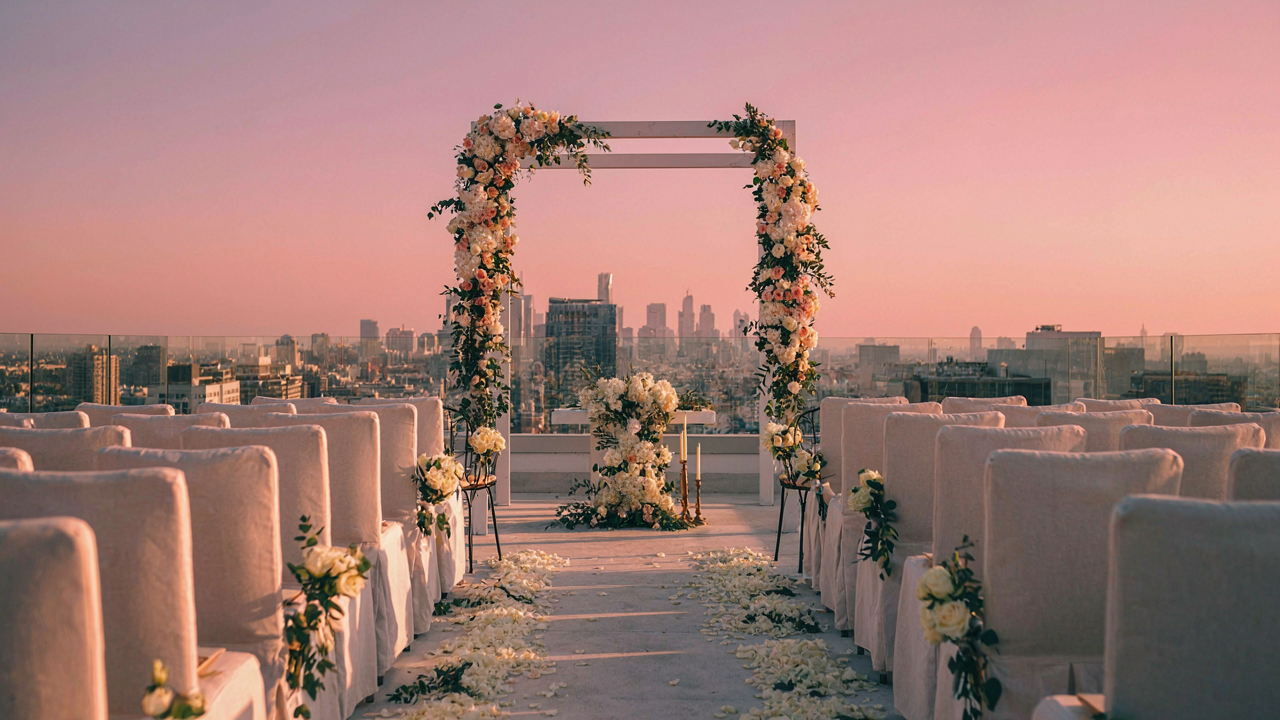
You want minimalism because you think it looks expensive and refined, but the real reason is simpler: you’re broke and need the space to do the work for you. A rooftop already has what matters. The sight lines extend past your ceremony. The sky moves. The structure itself—the edge, the texture of the roof surface, the geometry of the building—functions as your backdrop without costing you anything. Don’t fight what’s already there. Most rooftop ceremonies fail because couples import wedding theater onto a venue that doesn’t need it.

The mechanism from landscape architecture applies here: negative space. In that field, emptiness shapes perception as much as objects do. On a rooftop, what you remove matters more than what you add. Strip down to the actual necessities: seating for guests, standing room for the couple, a clear sightline to the ceremony. Let the architectural bones speak. You’re not decorating a blank canvas. You’re curating what the venue already exposes.
Golden Hour Placement And Shadow Timing
Lighting determines whether your rooftop reads as intentional or bare. This isn’t about uplighting or string lights—those are Band-Aids for bad timing. The sun’s position at your ceremony start time either works for you or destroys the whole aesthetic. Schedule your ceremony for the last 90 minutes before sunset. The angle of the light at that time creates definition and depth without equipment. Guests sit facing west (or your optimal direction). The couple stands with the sky as background, not squinting into the sun.
Pre-ceremony site visits need a specific task: stand at the exact ceremony time on the exact date you’re marrying and watch where shadows fall. Shadows from railings, HVAC equipment, or the building itself can block half the couple or the officiant’s face. Position the ceremony spot where the rooftop structure casts shadows on the perimeter, not center. Adjust the ceremony time by 15 minutes if it fixes a shadow problem. Light does more work than any decoration ever could.
The Resourceful Network Protocol For A Balcony Wedding

Call In The Favors You’ve Already Earned
You want this cheap because you’re afraid spending money signals you don’t matter. That’s backwards. The mechanism is simple: people who matter to you already want to help. Economics calls this the barter economy, and your rooftop ceremony is the perfect asset to trade on. You have skills, connections, and relationships that cost vendors money to acquire. Stop pretending those are worthless.

Your photographer friend shoots weekends anyway. Your caterer cousin has equipment sitting idle between jobs. Your florist neighbor buys bulk inventory and needs creative outlets. These people benefit from the work itself, not the money. Propose a trade that moves their needle, not yours. Offer something that costs you time but costs them cash. That’s the actual currency in play.
Build Only What Requires Your Hand
The advice to DIY everything is lazy. Most DIY projects waste hours for marginal savings. Focus instead on what demands your specific touch or vision. Rooftop ceremonies have sight lines and wind patterns only you understand on that day. You know the angle of light at 6 PM on your building. You know which guests need shade versus which need visibility.
DIY the ceremony staging, the guest flow, the timing cues. Buy the flowers, rent the chairs, pay for catering. The leverage isn’t in cutting costs across the board. It’s in spending money where professionals move faster and spending sweat where only you can make the call. Your vendor contacts handle execution. You handle the experience architecture. That separation keeps the day moving instead of trapped in Pinterest anxiety.
Experience Design: Curating A Memorable Small Rooftop Wedding Ceremony

Intimacy As The Actual Product
You want people to feel like they witnessed something exclusive, not like you ran out of money. The mechanism here is scarcity. In design language, we call this constraint-driven excellence. A rooftop ceremony with 25 people creates natural intimacy that 200 guests cannot replicate, no matter the budget. The small footprint forces proximity. Guests sit close enough to hear vows without amplification. They see facial expressions. This is the product you’re selling, not the backdrop.

The opposite of intimate is forgettable. Most ceremonies blur together because they prioritize scale over presence. You accomplish memorability by removing distractions and eliminating the gap between guest and couple. On a rooftop, you have weather, a city view, and immediate sightlines. Use these. Skip the elaborate processional. Have guests already seated when you arrive. Eliminate dead time. Every minute of ceremony design should create a moment someone recalls five years later, not spacing out during a generic speech.
Participation Replaces Passive Attendance
Generic advice says let guests watch passively while you perform. Wrong. Passive attendees forget faster and feel less connected to the outcome. Instead, build moments where guests make decisions or contribute directly. This isn’t about gimmicks. It’s about shifting them from audience to stakeholders.
Ask your officiant to invite specific guests to read passages, hold rings, or light candles. Have guests physically move the ceremony props themselves instead of watching staff arrange everything. If you’re doing vow exchanges, let close friends and family stand in a circle around you rather than sitting in rows. These moves require no additional budget and transform how people remember the day.
The Catering Alchemy: Smart Food & Drink For Your Terrace Wedding

Skip The Catering Company Markup
You’re afraid of looking cheap, so you default to the one vendor who makes that fear go away. That’s the mechanism. A catering company charges you 40-60% markup on food costs alone, then adds service fees and minimums that don’t exist elsewhere. They trade your anxiety for your money.

Food trucks and potluck formats break this equation. A taco truck charges per person with zero hidden costs. You know the price upfront. Potluck divides labor and expense across your guests, but only works if you control the menu structure—assign specific dishes, not categories, so you don’t end up with five desserts and no protein. A rooftop’s constraints actually help here. Limited space forces you to make intentional choices instead of padding the spread.
One Drink, Done Well
Build your bar like a military supply chain operates: limit SKUs to what you can actually manage. This isn’t minimalism. It’s logistics. A signature cocktail plus beer plus one wine varietal means one person can run the whole operation. You eliminate waste, over-pouring, and the mental overhead of stocking twelve options.
Choose the signature drink based on your rooftop’s climate and time of day. A cold aperitif works for afternoon ceremonies. A spirit-forward cocktail for evening. Make it in batches beforehand, stored in a cooler, so service becomes pouring, not mixing. This single protocol cuts your bartending cost from $1500 to $200 in supplies plus one friend who knows how to pour.
Photography & Documentation: Capturing The Fall Rooftop Wedding Narrative

Hiring Student Photographers For Portfolio Trades
You want professional photos without the professional price tag. That’s the real reason you’re reading this. Here’s what actually works: student photographers need portfolio pieces more than they need money. Portfolio building in photography follows the same scarcity principle as any creative field. Early-stage photographers have unlimited time and zero leverage, so they trade labor for proof of competence. Find them through local art schools, photography forums, or Instagram hashtags tied to your city. Negotiate explicitly: they shoot your rooftop wedding in exchange for full digital rights to use images in their portfolio.

The mechanism is transaction clarity. Don’t frame it as a discount or favor. State the trade plainly: they get portfolio work, you get documented coverage at reduced cost. Rooftop light at golden hour and fall colors create strong portfolio material. Vet their work first. Look for technical control of exposure and composition in varying light, not just aesthetic taste. Have them sign a simple agreement covering timing, deliverables, and timeline for edits. This prevents scope creep and misaligned expectations.
Mobilizing Guests As Secondary Documentarians
The common advice says “ask guests to take photos.” That’s lazy and wastes a real resource. What you actually need is a directed documentation strategy that captures moments your hired photographer will miss by definition of being one person. Create a specific shot list and assign it to three to four guests who own decent cameras or phones with manual controls. Brief them fifteen minutes before the ceremony begins. Show them the angles you need: details of the rooftop space, the processional from a different vantage point, reactions during vows, detail shots of food or flowers.
This works because you’re using game theory applied to guest participation. You’ve lowered the friction to contributing meaningfully by removing ambiguity. Guests know exactly what role they play instead of just snapping random moments. Collect these files immediately after the event while contact information is fresh. Designate one person as the point of collection. Frame it as collaborative storytelling, not gap-filling. The resulting mix of professional and guest perspectives creates narrative depth that a single photographer cannot achieve alone, especially in the bounded space of a rooftop where sight lines are limited and multiple angles matter.
Legalities & Logistics: Navigating The Rooftop Terrace Wedding Bureaucracy

The Permit Question Nobody Wants To Answer
You’re hoping the permit requirement is overblown so you can skip it and save money. It isn’t. The rooftop is public-facing real estate, and your city has liability exposure the moment you gather people on it. That’s the actual mechanism: the permit exists to transfer risk from the building owner to you, and to document that transfer.

Your building management will demand proof you have permission before they unlock the roof. Most cities require permits for events over 20 people. Contact your local Department of Buildings or Events office now. Some jurisdictions want applications 30 to 60 days out. Noise ordinances vary wildly by neighborhood, but expect restrictions starting around 10 PM. Liability insurance is non-negotiable if the building has a mortgage, which it does. Your event insurer covers bodily injury and property damage for the day itself, not structural issues. Submit these documents together, not piecemeal.
When Weather Shuts Everything Down
Rain doesn’t cancel rooftop weddings if you plan the escape route first. This is basic operations thinking: you identify failure points before they fail. Your contingency isn’t a backup date. It’s a covered space, a timeline, and a trigger that forces the decision.
Rent or build a tent that covers the ceremony zone only, not the whole roof, to keep costs down. Set a weather decision point: usually 24 hours before. Check your local forecast and your backup indoor venue’s availability. If wind exceeds 20 mph or rain starts two hours before, move indoors. Brief your vendors on this trigger now, not the morning of. Your photographer, caterer, and coordinator each need to know exactly when and how the pivot happens. No ambiguity prevents scrambling.
The Cognitive Bias Correction For Your Rooftop Ceremony

What You’re Actually Paying For
You’re drawn to this section because you’re afraid you’ll look cheap. Economics calls this opportunity cost: every dollar spent on rooftop decor is a dollar not spent elsewhere, yet most people never calculate what they’re actually trading away. The mechanism is simple. You have a fixed budget. Each choice eliminates another choice. A rented arch costs money. Upgraded lighting costs money. Catering upgrades cost money. Most couples add features to rooftop ceremonies without asking what they’re sacrificing to afford them.

The real cost isn’t the money spent. It’s what you stop doing because you spent it. If you allocate $2,000 to floral arrangements for a forty-person rooftop wedding, you’ve decided not to spend it on a videographer, or a better meal, or a rehearsal dinner that actually matters. People optimize for visible status signals instead of tracking their actual trade-offs. Before you book anything for your rooftop, list what you’re not doing to afford it. That number determines if the choice was worth making.
Status Theater Versus Real Memory
The common advice says your wedding should reflect your personality. That’s incomplete. Status signaling and genuine connection operate on different frequencies. You optimize for one, you lose the other. A rooftop ceremony creates physical distance between you and your guests. Higher elevation, narrower space, noise from surrounding buildings. Yet couples often add expensive theatrical elements like projection mapping, elaborate sound systems, or designer furniture because the setting itself feels incomplete.
What actually matters to guests is conversation, food they enjoy, and the ability to see you clearly. The rooftop becomes a constraint you compensate for, not an asset you leverage. Skip the theater. Use the elevation as your backdrop. Keep guest count intimate so people can actually hear each other. Feed them well. The memory your guests keep isn’t about the arch or the lighting rig. It’s about whether they felt included or positioned as an audience to your display.
Post Ceremony Pivot: The Anti Afterparty

Dinner With The People Who Actually Matter
You’re worried that skipping the traditional reception makes your wedding feel incomplete or cheap. That’s not the real problem. The mechanism is this: most couples mistake attendance volume for validation. A rooftop ceremony with thirty people doesn’t need a hundred-person afterparty to justify itself. It needs intentional time with the humans you chose to witness the vows.

Skip the venue rental for a second location. Take your wedding party and immediate family to a restaurant within walking distance or a short drive. Order a private room or a reserved table. Feed people real food, not passed appetizers. The constraint forces conversation instead of mingling theater. You pay less, your guests eat better, and the actual intimacy you built during the ceremony continues instead of dissolving.
Real Contact Beats Obligation Mail
The common afterwedding advice says send thank you cards within two weeks and call it done. That’s a checkbox, not a relationship. Psychology calls this the recency effect: people remember the last interaction most vividly. Your last interaction shouldn’t be a formality.
Within five days, text or call three to five people from the ceremony individually. Not a group message. Ask them what moment stuck with them. Reference something specific they said or did. Do this for a quarter of your guests over the next month. You’ll spend three hours total and create actual memory anchors instead of transactional gratitude. The people who matter most will feel the difference because you made follow up a protocol, not an afterthought.
The Real Obstacle Isn’t Your Budget; It’s Your Imagination Constrained By Societal Expectations

You don’t need permission to get married on a rooftop with fifty people instead of five hundred. You don’t need a planner to validate your choices. Stop asking for approval and start building what actually matters to you. Today, write down three things the wedding industry tells you to do, then delete them. What remains is your real wedding. The only expensive mistake you can make is designing someone else’s dream.