The Unseen Advantage Of A Rainy Wedding Day

When The Spectacle Collapses
You want to hear that rain makes weddings magical because you’re afraid you wasted money if the weather ruins your vision. The mechanism is simpler: rain kills the production problem. When you can’t execute the outdoor ceremony you planned, the decision gets made for you. You stop performing for Instagram and start actually getting married. The shift from production to presence happens because the alternative is panic, and panic forces clarity.
Couples who plan elaborate outdoor setups spend months obsessing over aesthetics: lighting angles, backdrop positioning, guest comfort zones. Rain erases this. You move indoors or under a tent. The ceremony happens in half the space. Relatives stand closer. The photographer adapts or doesn’t. What matters is that nobody’s watching a production anymore, they’re watching two people commit to each other in an inconvenient situation. Constraints strip away the performance.
Proximity Enforces Real Conversation
Think of rain as a crowding mechanism borrowed from spatial design. Architects know that proximity increases interaction depth. A rainy wedding compresses people into tighter quarters. Guests can’t scatter across a lawn finding the shade they want. They cluster. They talk to people they didn’t plan to talk to. They sit next to someone’s aunt instead of standing alone checking their phone.
The common advice says rain creates “cozy intimacy” like it’s accidental. It’s not. Forced proximity is a structural choice made by weather. Guests experience what researchers in environmental psychology call reduced social distance. They engage more deeply with fewer escape routes. You don’t get the sprawling garden party energy, but you get actual connection. The reception becomes a room where people attend to each other instead of circulating like they’re working a networking event. That difference compounds across the entire day.
Rainy Wedding Aesthetic: Beyond The Predictable

Dramatic Lighting And Moodier Photos
You want people to think your wedding looked intentional, not like you got unlucky. Here’s the mechanism: overcast skies eliminate harsh shadows and diffuse light evenly across faces and details. In photography, this is borrowed from studio lighting theory, where diffusion is the tool that separates amateur shots from professional ones. Rain creates natural diffusion for free.

Wet surfaces reflect available light and add depth to images. Puddles become compositional elements. Skin tones read cleaner without the blown-out highlights that direct sun creates. The real advantage isn’t mood—it’s technical. Your photographer captures richer detail in fabric, expressions, and backgrounds because the light cooperates instead of fighting them. This is why professional studios use softboxes. Rain gives you the same output without the equipment.
Texture And Material Contrast
Forget the tired advice about rain being romantic. Rain exposes design choices. Velvet absorbs moisture and darkens, creating visual weight. Satin reflects what little light exists, adding shimmer to movement. Linen wrinkles on purpose now instead of by accident. These aren’t problems to solve—they’re the actual content of your wedding’s visual story.
Ceremony details become tactile and specific. Wet wood shows grain. Leather gains character. Fabric weights matter because rain makes them visible. When you stop fighting the weather and start layering materials that respond to it, your aesthetic moves from generic to deliberate. The mechanism is simple: constraint forces specificity. Rain removes the option to rely on perfect conditions, so your choices become the thing people remember.
The “Adapt Or Die” Protocol: Planning For A Rainy Outdoor Wedding

Contingency Plans Beat Crossed Fingers
You’re afraid of looking stupid if your outdoor wedding falls apart in the rain. That’s the real reason you’re reading this. The mechanism is simple: most couples treat rain as an exception instead of a variable in their equation. They plan one scenario and hope. That’s not a plan. It’s denial wearing a tuxedo.

A real contingency protocol works like a military supply chain. You identify decision points before they arrive. Where will guests stand if it pours? What triggers the shift? When do you make the call? Couples who loved their rainy weddings didn’t embrace the rain after it happened. They made decisions about it beforehand. They chose specific locations with natural cover or portable solutions. They assigned roles so someone owned each decision. No ambiguity means no panic.
Essential Gear Separates Comfort From Chaos
- Tent coverage or marquee rental: Provide shelter for ceremony and reception areas. Account for wind load ratings and proper anchoring in wet soil conditions.
- Umbrellas in bulk: Source 15-20 high-quality umbrellas for ceremony entrance, exit, and guest movement between areas. Black or wedding-colored umbrellas maintain aesthetic consistency.
- Heaters or infrared lamps: Wet conditions drop perceived temperature fast. Propane or electric heaters in covered areas maintain guest comfort and prevent shivering in photos.
- Elevated flooring or boardwalks: Rent temporary decking or heavy-duty plywood to prevent muddy ceremony sites and transition areas. Protects guest footwear and dress hems.
- Lighting upgrades: Rain dims natural light significantly. Add uplighting, string lights, or strategic spotlighting to compensate for reduced daylight and create intentional ambiance.
- Ground drainage plan: Scout your venue beforehand for natural water pooling. Have tarps or sand ready to redirect standing water away from key areas.
Gear isn’t optional when you’ve chosen an outdoor wedding in a climate that produces rain. You either rent equipment based on weather probability or you watch your guests stand in puddles. The couple who loved their rainy wedding didn’t get lucky. They made phone calls to rental companies three months out and confirmed everything existed before the forecast even mattered.
Wedding Photos Rain: Capturing The Unscripted Magic

When The Light Works Against You
You want proof that rain doesn’t ruin a wedding. You’re afraid you’ll look back at soggy photos and regret the whole day. The real mechanism: most photographers treat rain as a lighting problem instead of a contrast tool. Rain creates directional scatter. It kills harsh shadows and flattens midtones. A professional doesn’t fight this. They expose for the wet surfaces, which now reflect available light like a natural softbox. The couple becomes the subject against muted backgrounds instead of competing with blown-out sky.
Rain forces intentionality into framing. Without golden hour drama, the photographer has to compose tighter, use foreground elements, and rely on gesture over landscape. This eliminates filler shots. You get fewer images overall but higher utility per frame. The couple’s expressions read clearer against neutral tones. Emotion doesn’t compete with scenic backdrop.
Moments Happen When Plans Break
The standard advice says candid moments emerge naturally. Wrong. Candid moments emerge when structure collapses and people stop performing for the ideal they imagined. Rain is that collapse. It removes the ceremonial polish everyone prepared for and replaces it with actual behavior. The bride running for cover. The groom laughing at the muddy aisle. The grandmother holding the train up like a flag. These aren’t staged. They’re what happens when logistics force you to improvise.

A photographer with rain experience knows to stay close during transitions instead of retreating. The real moments cluster in the gaps between plans—the walk to the car, the wait under the tent, the pivot to plan B. These gaps exist in every wedding. Rain just makes them unavoidable and therefore longer and richer. Document the moment someone decides to stop fighting the weather and actually enjoy the day. That frame pays more than any posed family shot.
The Cognitive Reframing Method: Embracing The Inevitable

Control What You Can Control
You’re reading this because you want permission to believe rain won’t ruin your wedding, and that permission matters because you’ve already sunk emotional capital into a date. Here’s the mechanism: Stoic philosophy separates outcomes into two bins—what you control and what you don’t. Rain falls in the second bin. Your guests’ experience, your timeline, your vendor coordination, your mental state—those live in the first bin. The couple in this real story didn’t fight the weather. They identified exactly what they could move, what they could protect, and what they could reframe within their actual power.
Weather systems aren’t the problem to solve. Your response architecture is. They rented a tent not as a backup plan but as a deliberate infrastructure choice. They moved the ceremony thirty minutes earlier to avoid the heaviest downpour window. They adjusted lighting fixtures to compensate for the gray sky. None of these required the rain to stop. All of them required a decision to build around constraints instead of pretending constraints don’t exist. That shift in planning reduces panic because you’re no longer betting on luck.
Finding Certainty In What Breaks
Most wedding advice says embrace imperfection and find beauty in flaws, which is corporate speak for I don’t have an actual framework. Psychological resilience isn’t about loving the broken thing—it’s about extracting the specific value locked inside the disruption before it compounds. This couple’s rain created unexpected moments: guests clustered closer, conversation density increased, the photographer captured genuine expressions instead of squinting faces. These aren’t consolation prizes. They’re measurable shifts in the social dynamic that wouldn’t have occurred under clear skies.

The mechanism is straightforward. When external conditions force deviation from the planned script, people either contract inward or recalibrate their expectations downward to match reality. The couple that plans for rain doesn’t experience surprise—they experience execution. Their guests notice the difference. They see someone who designed the day to work, not someone managing failure. Document the specific moments that only rain made possible. Don’t call them silver linings. Call them the actual event design.
Wedding In Rain: The Logistical Upside

Venue Flexibility Unexpected Spaces
You’re worried rain means your vision collapses and you’re stuck with whatever backup plan you scrambled together last minute. The real mechanism: rain eliminates competition for indoor venues. When weather turns, couples panic and abandon outdoor bookings, freeing up indoor spaces that were already reserved but suddenly available for renegotiation or creative hybrid setups.
Most couples treat rain as a binary problem: outside works or it doesn’t. Wrong. Rain creates negotiation leverage. Indoor venues suddenly have openings because other events shifted dates. Hotels with ballrooms become flexible on timing and pricing. The couple that sees rain as a venue opportunity, not a disaster, secures better indoor locations at the last moment because desperation hasn’t set in yet. Your planner calls at 6am, explains the situation to three venues, and one of them offers their premium room at standard rate because they’d rather fill it than leave it empty.
Vendor Collaboration Creative Solutions
Borrowing from systems design, rain forces a constraint that eliminates waste in vendor workflows. When florists, caterers, and lighting teams can’t execute their default setup, they stop performing muscle memory and start solving. That’s where better ideas live.

The common advice says hire vendors who “can handle anything.” Useless. What you actually need: vendors who’ve built protocols for contingency work, not vendors who claim they’re infinitely flexible. A florist who’s redesigned arrangements for indoor constraints five times has real solutions, not apologies. Same with catering teams that’ve transitioned from outdoor buffet to passed hors d’oeuvres under a tent. When you hire for constraint-solving experience, not just experience, rain stops being an exception and becomes part of their normal toolkit. Your photographer adjusts lighting angles, your caterer shifts plating strategy, your coordinator moves timelines. All pre-planned. All executed clean.
Rain Wedding Day: Guests’ Unforgettable Experience

When Strangers Become Conspirators
You want proof that your wedding won’t fall apart if the weather doesn’t cooperate. The real mechanism here is tribal bonding through shared adversity. In sociology, this is called “collective efficacy”—when a group faces an external threat together, they bond faster than they do under ideal conditions. Rain isn’t a problem to solve. It’s a catalyst that transforms passive attendees into active participants in something that feels earned rather than staged.
Rain forces guests to make decisions together. They huddle under shared umbrellas. They laugh at ruined hair and makeup. They help strangers navigate wet grass. This isn’t nostalgia or romance. It’s a documented pattern: people who survive minor friction together report stronger social bonds afterward than people who experience seamless events. The couple that had a rainy day wedding real story didn’t avoid the rain. They let it do the work for them.
The Physics Of Proximity And Warmth
Forget the advice about “creating ambiance with candlelight.” That misses the point entirely. The real mechanism is temperature regulation and spatial compression. In environmental psychology, proximity + slight discomfort = increased intimacy. When guests are physically close because they’re sheltering from rain, their nervous systems register safety through proximity rather than distance.

A tent wedding in rain forces people into a smaller footprint. Guests sit closer than they planned. They share blankets. They stand near the heater. Conversation density increases because physical barriers compress the social space. The couple who hosted a rainy day wedding real story didn’t add more decorations to feel “cozy.” They let the rain shrink the room, which did the work automatically. After the ceremony, have guests move directly indoors rather than lingering in transition spaces. This prevents the energy from dispersing before connection takes root.
The Resilience Dividend: Why Imperfection Wins
When Constraints Force Real Decisions
You’re reading this because you want permission to stop obsessing over control. Here’s the mechanism from evolutionary biology: organisms that adapt to unpredictable environments survive. Those that demand certainty don’t. Rain on your wedding day is a stressor that filters out the performative guests and forces you to commit to what actually matters. The couple who pivots their ceremony indoors or under cover hasn’t failed. They’ve activated a survival trait that weak planning never builds.
Evolutionary pressure shaped human resilience through exposure to chaos, not elimination of it. The couple that plans a rainy day wedding real story doesn’t get there through wishful thinking. They inventory real options beforehand, communicate clearly, and execute the decision on the day. That’s not luck. That’s adaptation.
Systems That Gain From Disorder
Most wedding advice tells you to minimize risk. That’s backward. Nassim Taleb’s framework of antifragile systems reveals the actual mechanism: some things benefit from stress rather than breaking under it. A rainy day wedding real story reveals which relationships hold and which collapse when comfort disappears. The guest list thins. The vendor team either executes or vanishes. The couple either stays locked on their definition of the day or fragments under pressure.

The antifragile wedding doesn’t fight the rain. It redesigns around it before the day arrives, building optionality into the venue, timing, and logistics. Rain then becomes information, not sabotage. The couple executes a predetermined path and discovers something the perfect-weather wedding never will: what they actually value doesn’t require perfect conditions. That clarity compounds across a marriage.
Rain Wedding Photos: The Visual Story Of True Love

Umbrellas, Reflections, And Wet Light
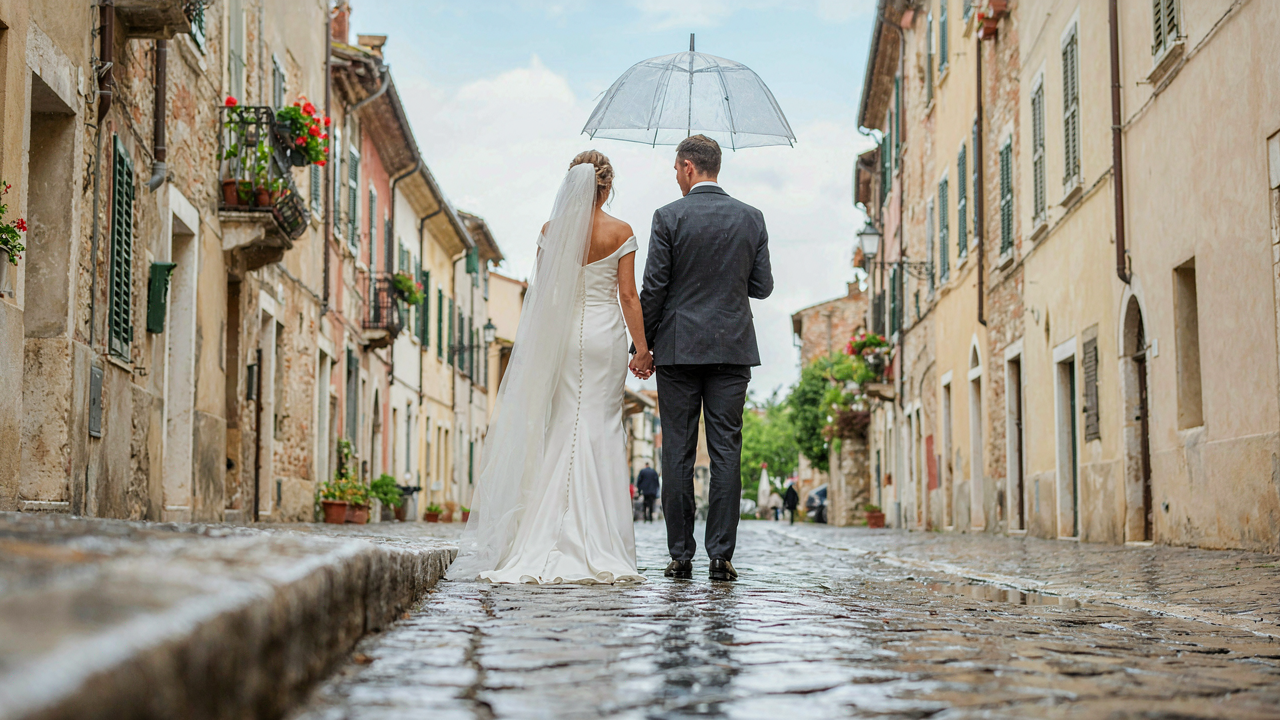
You want these photos because you’re terrified your wedding won’t look like the Pinterest version. Here’s what actually happens: rain creates contrast. In photography, contrast is signal. Dry weddings blend into beige sameness. A wet ceremony creates visual separation between subjects and environment. The umbrella becomes a compositional anchor, not decoration. Reflections in puddles give you a second image plane without staging it. Misty air diffuses harsh light that normally flattens skin tone and detail.
The mechanism is optical physics. Moisture in air acts as a natural diffuser, scattering light wavelengths evenly across the scene. Your photographer doesn’t need to rent strobes or reflectors. The weather does the work. Black umbrellas pop against gray skies. White dresses hold detail in overcast light instead of blowing out. Couples who resist rain photos miss the only lighting condition where overexposure isn’t a risk. The shot exists because of water in the air, not in spite of it.
Raw Moments, No Performance Required
Most wedding photography advice tells you to smile bigger and look more in love. That’s lazy guidance. Rain strips away the performance because guests are uncomfortable, logistics fail, and the couple stops thinking about the camera. Authentic expressions emerge when people stop posing. A couple laughing under a collapsed umbrella registers as relief, not vanity. Tears during vows read as genuine emotion, not theatrical display.

A photographer trained to capture rain weddings knows the real work happens in the gaps. Between formal shots, during the scramble to move inside, while the couple shelters together. These unguarded moments reveal actual relationship texture. The couple’s coordination under stress, how they handle a blown plan, whether they pivot to humor or blame. Your photographer positions for these instants, not away from them. Document the moment your partner makes you laugh during the worst weather decision you’ve made together.
Beyond The Forecast: Cultivating An Unshakeable Mindset

Where Your Power Actually Lives
You want this section because you’re afraid a rainy day wedding means failure. Here’s the mechanism: you don’t control weather. You control whether you treat weather as a problem or a parameter. Locus of control in psychology separates people who blame circumstances from people who decide what circumstances mean. The rain at your wedding isn’t a setback. It’s the setup you’re working with. Everyone gets a setup. Most people waste energy fighting theirs instead of building from it.
The couples who loved their rainy day weddings didn’t have better weather. They had a different response system. They stopped treating the forecast as a threat and started treating it as information. This shift happens in one place: before the day arrives. You decide now whether rain means disaster or just means you’re getting married in rain. That decision locks in. It determines every choice you make on the actual day, from how you cue your vendors to what you tell your guests to how you move through the timeline.
The Story You Tell Owns The Day
Everyone expects a perfect day narrative. That expectation is a trap. Most advice tells you to “stay positive” or “make the best of it,” which is weak and obvious. The real move is harder: own the rain as your actual story, not as a deviation from someone else’s story. Your wedding isn’t a copy of Pinterest. It’s yours. Rain doesn’t ruin that. Fighting the rain does.
This is where narrative control becomes operational control. You communicate to your team and guests that this is intentional. Not in a fake way, but factually. Rain changes light, sound, and how people move. You work with those changes, not against them. You adjust timing by minutes, not hours. You position people differently under cover. You let the day be what it is and photograph it that way. The couples with real rainy day wedding stories didn’t salvage a bad situation. They executed a different wedding better because they expected different conditions and planned accordingly.
The Only Thing Holding Back Your Epic Rainy Day Wedding Is Your Rigid Expectation Of Perfection

You’re terrified of rain because you’ve been sold a fantasy. The couple in this story didn’t love their rainy day wedding because they surrendered to mediocrity. They loved it because they stopped fighting reality and started designing around it. Your move is simple: call your photographer today and ask how they shoot in rain. That conversation kills the fantasy and births the actual wedding you’ll remember. Stop planning the wedding Instagram promised you and start planning the one your life deserves.