The Unseen Public Park Wedding Advantage: Why “Cheap” Is A Lie

What The Wedding Industry Actually Sells You
You care about this because you’re terrified you’ll look poor, not because you want a good party. The wedding industry doesn’t sell events—it sells fear of judgment masked as tradition. Venues, planners, and vendors profit by convincing you that spending money equals respect. A public park wedding dismantles this lie immediately because it forces you to build value through design and execution instead of price tags. The mechanism is simple: constraint removes the vendor markup trap entirely.
The average couple pays 40 to 60 percent of their budget just for access to a controlled venue and the permission to exist there. That’s not a service—that’s extraction. Public parks eliminate this layer completely. You get the same outdoor space, same light, same ground, zero landlord premium. What remains is only what matters: your actual wedding. This shift changes everything about how you think, spend, and build.
Design Leverage In Unrestricted Space
Think like an architect, not a consumer. In architecture, constraint is a design tool that forces innovation—removing unlimited budget forces you to see what actually creates impact. Public parks offer the reverse constraint: unlimited creative control with zero venue fees. Most couples mistake this freedom for savings alone; that’s incomplete. You gain the ability to layer design elements that work because they’re chosen, not because they came bundled with catering.
A controlled venue dictates lighting, table placement, music volume, and decoration rules. A public park gives you the power to design these systems yourself. You decide where light falls, how guests move, what surfaces matter. This is why public park weddings often feel more intentional than expensive venues—they have to be. Your design choices become visible instead of buried under someone else’s infrastructure. Start by identifying the three focal points where guests naturally look: the ceremony spot, the transition zone, and the gathering area. Design backwards from those three spaces only.
The 3 Phase Park Permit Protocol: Your First Strategic Move

Securing Your Park Reservation And Understanding Local Rules
You’re worried about losing your date to someone else or discovering mid-planning that your vision is illegal. Here’s the mechanism: parks operate on a first-come, first-served reservation system with hard capacity limits. You don’t negotiate with parks like you negotiate with venues. You comply or you don’t get the space.

Contact your city parks department directly, not through their website. Call. Get a human. Ask three things: the specific permit application deadline, whether they require liability insurance, and what activities they restrict. Most parks prohibit amplified sound, open flames, and alcohol without explicit written permission. Document every answer in writing via email follow-up. Your reservation locks in only after you submit the completed application and they approve it, typically 2-4 weeks prior to your event date.
Fees, Insurance, And The Paperwork That Protects Your Budget
The standard park permit fee runs $75 to $300 depending on your city and park tier. What eats your budget isn’t the permit fee itself, it’s the liability insurance requirement most parks now demand. General liability insurance for a single event costs $200 to $400 and covers injuries or property damage claims. Skip this and the park cancels your permit 48 hours before your wedding. Insurance is non-negotiable infrastructure, not optional expense.
Request the full permit application packet immediately after your initial call. You’ll need: proof of identity, your event date and time, number of guests, a site map showing where ceremony and reception occur, and your insurance certificate. Some parks require proof you’ve hired a caterer or confirmed parking arrangements. Submit everything together in one packet to prevent delays. The park either approves or requests modifications within their stated review period, typically 10-14 days.
Outdoor Park Wedding Aesthetics: Design By Constraints

Let Nature Do The Work
You want your wedding to look expensive without spending money. That’s the real calculation here. The mechanism is constraint-based design: when you remove the ability to buy your way out of a problem, you’re forced to see what’s actually there. Parks already have visual infrastructure. Trees, water features, elevation changes, existing structures. Most weddings bury this under rented linens and centerpieces. You won’t. Instead, you identify what the park already provides and amplify it.

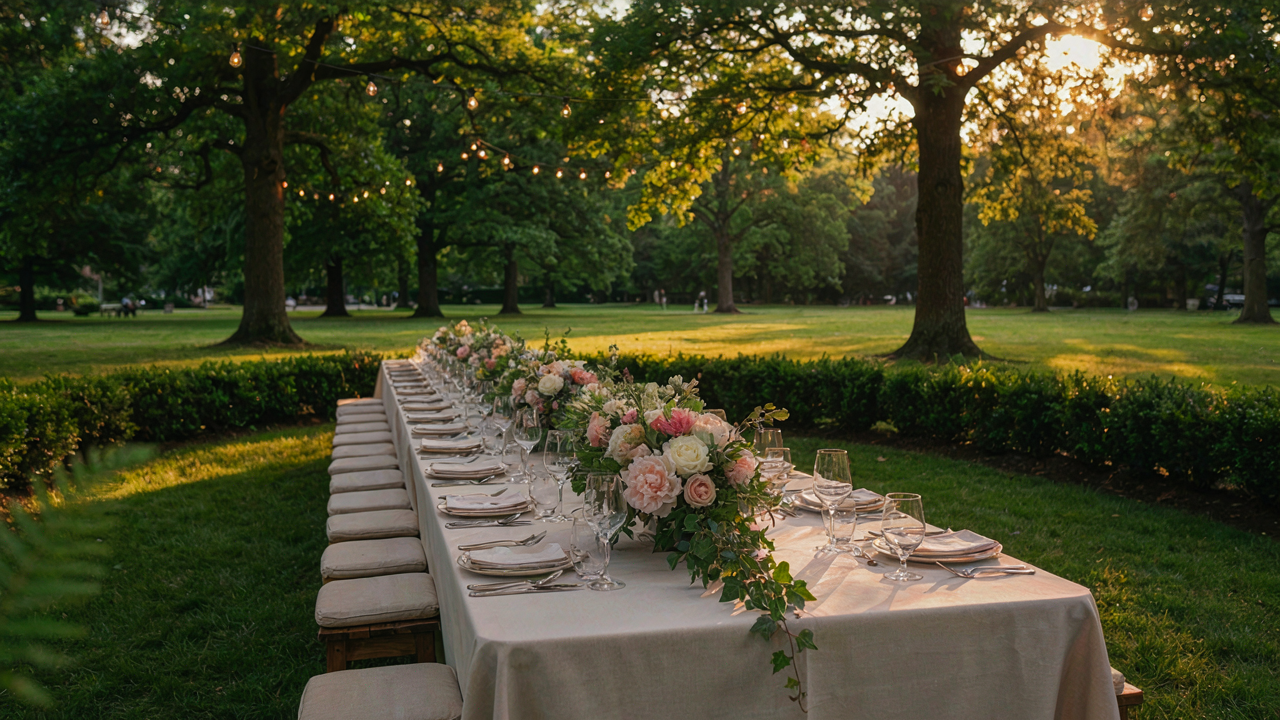
This isn’t minimalism as an aesthetic choice. It’s minimalism as a budget necessity that accidentally produces better results. The common advice says “let nature be your backdrop.” That’s incomplete. Nature needs editing. You choose a park section with specific visual bones: a treeline that frames the ceremony, a clearing with natural sightlines, existing shade that eliminates the need for a rental tent. Then you add only what interrupts the view. Flowers in clustered bunches near the altar, not scattered across surfaces. Fabric draped on existing structures, not floating installations. The constraint forces clarity.
Photography Angles Before Decoration
Good photography doesn’t require elaborate staging. It requires angles. A 200-dollar bouquet photographed against a blurred treeline reads as luxury. The same bouquet against a gray rental backdrop reads as cheap. Park weddings win because you’re working with depth and natural bokeh instead of fighting against flat rental backgrounds. Scout your park location during the same time of day as your ceremony. Identify where light hits. Find angles that isolate the couple from crowds and background clutter.
Most couples decorate first, then hope the photographer finds good frames. Reverse this. Walk the space with your photographer two weeks before. Mark which trees create natural framing. Note where late afternoon light creates rim lighting on faces. Identify the clearing that gives you sky instead of neighboring buildings as background. Then place your ceremony furniture in those spots. Place flowers where they don’t block sightlines but appear in frame. The decoration becomes a footnote to the location, not the location a stage for decoration. This protocol prevents you from buying decoration you don’t need and ensures every image holds its own weight.
The Logistics Of Lean: Applying Military Strategy To Your Park Reception Ideas

Setup And Teardown Efficiency
You want this section because you’re afraid of looking disorganized on your wedding day. The real mechanism is this: military strategy calls it “tempo”—the speed at which you move relative to your opponent. In a park wedding under 5500, your opponent is time itself, and your guests’ patience is the finite resource you’re managing.
Break your setup into stations, not tasks. Station one handles tables and chairs. Station two handles food and beverage placement. Station three handles decorations. Assign one person per station. This prevents bottlenecking, the moment when multiple people need the same resource at the same time. You move through setup 40 percent faster when roles don’t overlap.
Teardown wins or loses your deposit refund. Most couples waste money here because they lack a reverse sequence. Setup backwards. If decorations go up last, they come down first. Tables and chairs that arrived earliest leave latest. This order prevents resetting the same area twice. Most parks require you out by sunset. A 90-minute teardown done wrong becomes a 150-minute scramble.
Weather And Parkgoers: Contingency Without Panic
The common advice says “have a backup plan.” That’s useless because it doesn’t specify the mechanism. Real contingency planning means you identify which specific elements fail under which specific conditions, then you pre-position the solution before the condition hits.
Rain affects three things: food exposure, seating comfort, and foot traffic patterns. Buy cheap clear plastic sheeting before the wedding. Position it near your food table on setup day, not during the storm. Wet grass means guests cluster near paved areas. Pre-stage extra chairs near walkways and parking. This sounds small, but it prevents guests from standing in mud for two hours and then complaining about your venue choice.
Parkgoers create friction you can’t eliminate, only redirect. Some parks stay open during events. Other parkgoers will cut through your reception area. Don’t fight this. Instead, create a clear boundary with rope or signs at setup, positioned 20 feet wider than your actual reception space. Humans follow visual cues better than invisible property lines. The boundary prevents accidental encroachment without requiring you to police strangers during your own wedding.

Culinary Hacking: Feeding Your Guests Without The Catering Cartel

The Food You Control Yourself
You want catering because it signals you have money and taste. The mechanism is simpler: caterers markup food 200 to 400 percent. They charge for labor, logistics, and the brand tax of looking professional. You eliminate that tax by doing the work yourself or redistributing it across your guest list through a structured potluck model.
The potluck framework borrows from economics—specifically, the principle of comparative advantage. Each person contributes what they cook best, not what the couple needs most. You assign categories, not dishes. This prevents six pasta salads and zero protein. Assign roles by strength: your best cook handles the main, your organized friend coordinates timing, your detail-oriented relative manages quantities.
- Main dish assignment: Choose one trusted cook to handle protein for 30 to 40 people. Provide protein cost upfront if budget is tight. They execute one thing perfectly instead of you sweating four things mediocrely.
- Vegetable and starch slots: Assign two to three people specific categories, not specific dishes. One does vegetables, one handles starches. They choose the execution. Quantity matters more than novelty.
- Dessert and appetizers: These are status dishes people volunteer for. Ask for three to four volunteers and let them compete on execution, not cost.
- Sides and condiments: Assign these to people with lower cooking confidence. Bread, cheese, dips, and spreads require no skill and carry social weight.
- Backup coordinator: Assign one person the single job of texting contributors two days before with portion reminders and arrival times. This prevents no-shows and undersized portions.
The key is assignment, not request. People ignore open-ended potluck asks. They respond to specific roles. You control quality through specificity, not through paying someone else to control it. Provide a shared shopping list, a timing document, and one person responsible for following up.
Beverages And The Serving Apparatus
Beverage costs crater once you stop paying bars to pour. Most couples spend $8 to $15 per person on bar service. You spend $2 to $3 per person buying bulk beer, wine, and non-alcoholic options yourself, plus ice and cups. The serving apparatus is the real variable: self-service stations eliminate the labor cost entirely.

Build two beverage stations instead of hiring a bartender. One station handles alcoholic drinks: beer, wine, and one simple mixed drink in a dispenser. One station handles water, lemonade, and iced tea in pitchers. Guests serve themselves. You control portion size through the container size, not through rationing. Place stations on opposite sides of the park to distribute traffic. Set up each station 90 minutes before the ceremony and restock during the reception instead of hiring someone to do it. Train one friend on setup so it takes 20 minutes instead of an hour.
Music And Mirth: Entertainment That Doesn’t Break The Bank

Build Your Playlist Before The Day
You’re worried people will judge you for not hiring a DJ. That’s the real issue. Here’s the mechanism: a curated playlist on a Bluetooth speaker costs you zero dollars and forces your guests to actually talk to each other instead of dancing in isolation. Economics calls this a constraint that produces better outcomes. Download a portable speaker under 100 dollars—a used UE Boom or Anker Soundcore handles outdoor volume without distortion. Test it in the park location beforehand. Sound travels differently outdoors than indoors. Place speakers strategically so they don’t blast one side of the wedding.
Create your playlist in three phases: cocktail hour ambient music at lower volume, dinner tracks that encourage conversation, and uptempo songs for the final two hours. Use Spotify or Apple Music. Build it weeks ahead and test it during planning. The speaker charges via USB or battery. Bring a power bank as backup. One person manages volume and song transitions from a phone or laptop—assign this to someone who isn’t giving toasts or serving food. This eliminates the awkward silence problem without hiring staff.
Low Friction Games That Guests Actually Play
The generic advice says “lawn games keep people entertained.” Wrong. Lawn games fail because they create winners and losers in front of strangers, and adults resent losing at cornhole to their cousin. The real mechanism is participation without stakes. Offer activities that generate social interaction, not competition. A photo booth setup with a tripod, phone holder, and printed props costs under 150 dollars and runs itself. People photograph themselves naturally. No scoreboard. No elimination.

Set up a sign-in book where guests write advice or memories instead of just signing a generic guest book. Provide colored markers. Place it on a small table near the entrance. This takes two minutes to set up and generates actual content you’ll read later. Card games on picnic blankets work because they’re low-pressure and people join mid-round. Bring a deck of cards and let groups self-organize. Polaroid-style instant printing from a smartphone app plus a small printer costs under 200 dollars total and guests take physical photos home. These mechanisms work because they require minimal coordination and let guests choose their own engagement level.
The Real Cost Of “Free”: Hidden Expenses To Avert

Permits And Park Fee Structures
You want to believe the park is free because it validates your budget math. It isn’t. Parks charge permit fees because they have to maintain infrastructure, enforce rules, and manage liability. Most public parks require event permits ranging from $50 to $300 depending on headcount and location. Some parks tier fees by day of week, time of year, or whether you’re a resident. You need the actual permit document before you book anything else. Contact the parks department directly, not the parks website. Website info lags months behind policy changes.
The permit fee isn’t your only exposure. Parking fees, trash removal surcharges, electricity hookup costs, and damage deposits all live in the fine print. Some parks require you to hire their approved vendors for setup and breakdown, locking you into inflated quotes. Ask specifically: Is there a mandatory vendor list? What’s the damage deposit? Does the permit include trash service or do I pay separately? Get answers in writing. One couple I know discovered a $400 “event coordinator fee” three weeks before their wedding because they didn’t read the full permit agreement.
Rentals And Insurance As Sunk Line Items
Think of insurance like a defensive perimeter in military strategy. You’re not building walls to celebrate safety, you’re building them to prevent a single breach from collapsing the whole operation. Most parks require liability insurance naming them as additional insured, typically $300 to $500 for a one-day event. That’s not optional. If you skip it, the park cancels your permit.

Rentals are where 5500 budgets die. Tables, chairs, and a tent for 75 people run $400 to $800 depending on quality and delivery distance. A basic sound system costs $150 to $300. Portable restrooms, if the park doesn’t have sufficient facilities, are $150 to $400 per unit. You cannot cut these items and have a functional wedding. The math forces a choice: fewer guests or lower food spend per person. Make that trade explicit now, not at the vendor call. Lock all rental quotes in writing with specific delivery and pickup times, because a missed pickup window costs extra fees.
Exit Strategy: Leaving No Trace And Maximizing Memories

The Cleanup Protocol That Protects Your Deposit
You care about this section because you’re terrified of losing your park permit refund or getting blacklisted from the venue. That fear is rational. Parks have hard rules about post-event conditions, and they enforce them. Treat cleanup like supply chain logistics: everything that enters the park must exit it. Designate one person as cleanup lead three weeks before the event. This person walks the park the day before, photographs every corner, and creates a specific checklist tied to those photos. During the event, position trash receptacles at two spots minimum. Assign cleanup crew members to zones. The mechanism is simple: distributed responsibility fails; centralized accountability succeeds. Post-event inspection happens within two hours of the last guest leaving. Your deposit depends on the park manager’s walk-through, not your perception of cleanliness. Confirm with the parks department exactly what “returned to original condition” means for your specific location. Some parks require grass raking. Others demand removal of all equipment stakes. Get this in writing.
The Reflection That Matters
Most couples do a post-wedding debrief and waste the data by never writing it down. The real value sits in capturing what you’d change operationally for a future event, not how you felt during the first dance. Within 48 hours, interview your three key vendors: photographer, caterer, and whoever managed logistics. Ask them three specific questions: What took longer than expected? What created bottlenecks? What would you change if you did this again? Document their answers in a shared document. This becomes your operational manual. Include timing breakdowns, vendor contact quality, budget variance explanations, and guest feedback patterns. Couples who spend under 5500 dollars without this documentation end up repeating expensive mistakes at future events. The mechanism is straightforward: reflection without documentation is just emotion; documentation without specific questions is just data noise. Store this document where you’ll actually find it again.
The Real Obstacle Isn’t Your Budget, It’s Your Adherence To Manufactured Expectations


You don’t need five grand to get married. You need permission to stop performing for people who won’t show up anyway. The couples who pull off real weddings under five thousand aren’t scrappy. They’re honest. They stopped asking what a wedding should look like and asked what their wedding needs to be. Pick one thing you actually care about today. Cut everything else. That single choice separates people who throw events from people who build memories.