Beyond Budget: The True Value Of A Wedding Potluck

Why Cost Savings Misses The Point
You’re reading this because you want permission to spend less money and still look like you did something meaningful. Here’s what actually happens: the budget constraint forces a design decision that changes how people show up. In economics, this is called a binding constraint, and it restructures incentives. A potluck wedding doesn’t save money because it’s cheap. It saves money because it transfers agency from the couple to the guests, and that transfer is what creates the real friction or flow.
Most wedding advice treats cost savings as the feature. It’s not. Cost savings is the exhaust. The mechanism is that when guests contribute food instead of attending a transaction, they become stakeholders in an outcome, not consumers of a service. The couple stops managing vendor timelines and starts managing community participation. This sounds softer than it is. It’s actually a structural shift from centralized control to distributed execution. That shift determines everything that happens next.
Real Investment Means Skin In The Game
When a guest brings a dish they chose, they’re not just attending a wedding. They’re staking their reputation on that contribution. They’re asking themselves: “Will this work? Will this fit? Will people actually eat it?” That’s not casual. That’s commitment. Ownership creates attention. Attention creates memory. People don’t remember the catered chicken breast from the hotel ballroom. They remember the neighbor’s lasagna that somehow became the wedding’s signature moment.
The couple who runs the potluck wedding sees this early. They stop being hosts performing hospitality and start being collaborators managing a system. The protocol is straightforward: assign dish categories early, confirm RSVPs with dish commitments weeks ahead, and have a backup plan for no shows. This isn’t cute. It’s operational. When execution tightens, people invest harder because they know their absence breaks the chain. That’s how a potluck wedding becomes something everyone talks about—not because it was novel, but because it was reliable.
The Participation Protocol: Designing Shared Ownership

How You Actually Get People To Show Up
You want this to work because you’re terrified of begging people to bring food and watching them bail or show up with store-bought dessert. Here’s the mechanism: people participate when they own a specific outcome, not when they receive a generic request. The difference between “bring something” and “we need someone to handle the vegetable situation and here’s why that matters” is the difference between a potluck that collapses and one that runs like logistics. You assign contributions strategically by identifying gaps first, then matching people to those gaps based on their actual capacity and interest, not guilt.

The couple who pulled this off didn’t send mass emails asking for volunteers. They mapped out what the meal actually required, then reached out to specific people with specific asks. One guest who mentioned cooking Indian food got asked to bring a main dish in that style. A friend known for being detail-oriented handled the drink coordination. Someone else who loved baking got the dessert role. Each person felt chosen, not conscripted. That’s the difference between a potluck that feels like a chore and one people remember.
Roles That Distribute Pressure, Not Create It
The common advice here is wrong: don’t ask for “help with the reception.” That’s a vague obligation that creates resentment. Instead, design discrete roles with clear ownership and decision authority. One person owns appetizers completely. Another owns the main course flow. A third owns cleanup systems. Each role has a boundary, not a burden.
The potluck that became a story gave people titles and autonomy within them. The “beverage director” didn’t just bring drinks; they decided quantities, temperatures, service order. The “plating coordinator” wasn’t fetching plates; they designed the actual flow of how people would eat. This transforms participation from being drafted into labor into being given a domain. The person executing the role feels like a stakeholder in the event’s success, not like they’re being used.
Family Style Wedding Dinner: The Distributed Kitchen Model

Know What Your Guests Actually Cook
You want people to think you’re resourceful, not broke. That’s the real fear here. But the mechanism is simpler: you’re not asking guests to contribute. You’re assigning them roles based on what they’ve already proven they’re competent at making. This is supply chain thinking applied to food. You identify each guest’s actual kitchen output, not their aspirations. Someone who makes mediocre pasta salad at every potluck doesn’t get assigned the appetizers. Someone known for solid casseroles does. The couple in this real wedding situation asked specific people to bring specific dishes weeks before the event, with written confirmation. No surprises. No lukewarm mystery casseroles.

The assignment happens before invitations go out, not after. You map your guest list against known competencies first, then build the menu around who can deliver. This eliminates the chaos of open-ended “bring whatever” requests. It also removes the social awkwardness of someone showing up with store-bought potato salad when you needed an entrée. The couple documented each guest’s commitment in a shared spreadsheet that everyone could see. Accountability moved the needle on follow-through. People showed up with what they promised because the commitment was visible.
Choreography Of Collection And Display
Logistics kills potluck weddings. Call it the coordination problem in catering. You need a staging timeline, not just a food list. The couple rented a kitchen at a nearby community center starting four hours before the ceremony. Guests with hot dishes arrived ninety minutes before dinner service, placed their contributions in labeled warming trays, and left. Cold dishes came two hours prior. Someone assigned specifically to this role tracked arrival times, checked temperatures on hot items, and repositioned dishes as needed for both temperature stability and visual flow on the serving table.
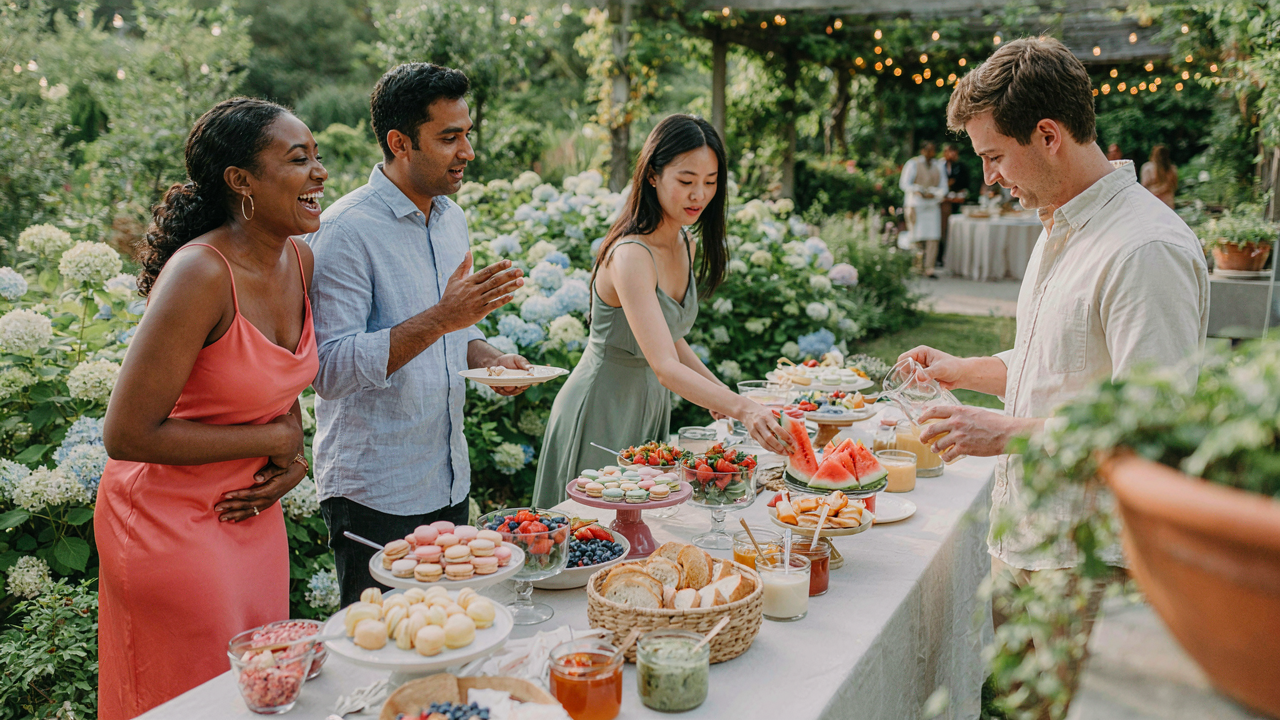
The serving setup mimicked restaurant-style plating stations rather than a chaotic buffet line. One table held appetizers and sides. A second held mains. A third held desserts. Staff (two hired servers, plus two friend volunteers) managed the flow so guests moved through in sequence instead of clustering at one bottleneck. The couple used white linen, simple place cards for each dish identifying the contributor, and consistent serving vessels instead of mismatched Tupperware. This single decision about presentation changed how guests perceived the meal. They saw a coordinated event, not a assembled collection of leftovers.
Outdoor Potluck: The Venue As A Catalyst For Connection

Spaces That Break Down Social Barriers
You want proof this works without feeling like you’re settling for less. The mechanism is proximity without formality. In architecture and urban design, this principle is called “permeable space”—zones that allow movement and spontaneous interaction instead of enforcing fixed seating roles. The couple who hosted the potluck wedding chose a sprawling backyard over a rented hall specifically because open land removes the hierarchy built into banquet tables. No head table. No assigned seats. No stage separating people.

This changes behavior at a fundamental level. When guests arrive at an open outdoor space, they self-organize around natural gathering points: the food table, the drink station, the shade under trees. Small conversations cluster and merge. Someone talks to the caterer’s assistant while waiting for a plate. Another guest joins because they’re standing nearby, not because they were seated together by a seating chart. The informal arrangement created more genuine mingling than any “icebreaker activity” ever could. Guests still reference specific conversations from that day because the setting allowed them to happen.
Natural Elements Replace Manufactured Decor
Don’t buy into the idea that “rustic” means cheaper. That’s not what happened here. Using existing trees, grass, and sunlight as the primary ambiance framework actually demands more intentional design work than renting decorations. It requires reading the land itself. The couple walked the property at different times of day to map where light hit the ground, where shade pools formed, where the eye naturally traveled. They positioned the food and seating areas to use what was already there instead of fighting it.
Trees provide structure, ceiling height, and natural gathering points that fabric tents cannot replicate. Sunlight creates visual variation throughout the day without a single string light. Grass eliminates the institutional feel of a concrete or vinyl dance floor. These elements cost nothing but force the couple and their guests to accept the space as it is, which paradoxically creates more memorable moments than curated perfection. The wedding photographer barely needed to add light. Nature handled that.
The “60 Person Wedding” Illusion: Intimacy At Scale

When Distributed Effort Replaces Centralized Control
You want to know if you can pull off something big without losing the personal touch—that’s the real fear. Most wedding advice says scale kills intimacy. That’s incomplete. What actually kills intimacy is centralized decision-making. Think of it like network topology: a star network has one point of failure and bottleneck. A mesh network distributes load across nodes. A potluck wedding shifts from star to mesh. Instead of the couple making every call, you embed decision-making into smaller contributor groups. Each person who brings food, sets up, or coordinates one element owns that piece. The couple becomes orchestrators, not architects of every detail.

This works because people invest in what they control. When someone commits to bringing a specific dish or handling a particular station, they show up differently than if they received a catered plate. They arrive early, they adjust on the fly, they talk to other contributors. The gathering stops being something the couple produces for guests and becomes something guests produce together. That shift in ownership structure is what makes sixty people feel intimate instead of sprawling.
The Subcrew Model Within One Event
Small groups create accountability that large groups destroy. Sociology already maps this: the Dunbar number suggests humans maintain stable social relationships around 150 people, but active collaboration breaks down hard around twelve. A potluck wedding under eighty people naturally splits into operating subgroups even without explicit structure. The food contributors form a crew. The setup people form another. The family logistics folks form a third. Each subgroup has roughly four to eight active members who coordinate among themselves. Those micro-groups generate the personal interactions that make an event feel small, even when total headcount suggests otherwise.
The couple makes one strategic decision per subgroup instead of sixty decisions across sixty people. They name a food coordinator, a setup lead, a timeline keeper. Each lead recruits their own team and handles their layer. Communication compresses from many-to-many chaos into a few key conversations. Guests experience the event as their subgroup’s collective effort, not as passive receivers at someone else’s production. That’s the mechanism that makes scale irrelevant to intimacy: you’ve simply replicated the conditions of a small gathering at a larger physical size.
Beyond Lunch Wedding: The Narrative Arc Of The Day

When The Timeline Actually Matters
You want to know if a potluck wedding can feel intentional instead of chaotic, which means you’re really asking if you can control perception without controlling every variable. The mechanism is narrative structure. Traditional weddings follow a fixed script because the venue, catering, and timeline lock into place. A potluck wedding has no such constraints, which makes timeline design the only lever that separates “memorable” from “confused guests standing around eating casserole at 4 PM.”

The couple who pulled this off didn’t fight against potluck’s loose nature. They weaponized it. They built an actual arc with setup, tension, and release. Arrival window opened at 2 PM but food service didn’t start until 3:30 PM, which gave them ninety minutes to run games, speeches, and a walk-through of the grounds. This wasn’t random padding. It forced the day into an experience rather than just a meal.
How Disruption Becomes Memory
The common advice says to “embrace spontaneity” or “let the day unfold naturally,” which is how you end up with eight potato salads and nobody knowing when to eat. What actually works is deliberate disruption inserted into a clear structure. Think of potluck weddings like information theory: too much structure breeds boredom, total chaos breeds confusion, but strategic surprise points within a known framework create engagement and stickiness.
This couple’s breakthrough came when they asked guests to bring dishes labeled only by cuisine type, then assigned tables by what each table’s food “wanted” as company. Someone’s Thai curry sat with the salads. Aunt Carol’s funeral casserole got paired with the bread and wine station. This wasn’t cute. It forced guests to move, to interact with unfamiliar people, and to see the potluck contributions as part of a designed system, not just random offerings. The disruption created the story everyone still repeats.
The Viral Feedback Loop: Why Everyone Still Talks About It

When Everyone Wins, Everyone Talks
You care about this section because you want proof that breaking the rules doesn’t tank your reputation—it builds it. Game theory calls this a positive-sum outcome: everyone leaves with more than they arrived with. In a traditional wedding, guests consume. In a potluck wedding, guests contribute. The math flips. When contribution replaces consumption, people become invested in the story itself, not just the event. They own it.

The couple who hosted the potluck wedding didn’t just save money—they engineered a system where talking about the event became the logical next step for attendees. Each guest brought a dish tied to something meaningful: a recipe from their family, a cultural dish, a favorite restaurant knockoff. This wasn’t generic. It meant the meal told a story only that group could tell. Guests didn’t attend a wedding. They participated in creating one.
How Authentic Delight Compounds
Genuine surprise propagates faster than forced spectacle because people trust it. The potluck wedding surprised guests in a specific way: it asked them for something, then made that asking feel valuable instead of cheap. This distinction matters tactically.
- Word-of-mouth from contributors: Guests who brought dishes retold the story as their own accomplishment, not the couple’s budget hack. Ownership drives repetition.
- Unexpected quality of execution: The couple didn’t skimp on atmosphere, music, or ceremony details. The constraint was financial, not creative. People noticed this gap and discussed it.
- Permission to deviate: Attendees felt licensed to tell others that weddings don’t require the standard template. The event became proof of concept, not an anomaly.
- Concrete proof of values alignment: Guests saw a couple making deliberate choices that matched what they claimed to value. No gap between words and action meant people trusted the narrative enough to repeat it.
- Shareable specificity: “They had a potluck wedding” is bland. “They asked everyone to bring a family recipe and served them on vintage plates they collected” is specific enough to retell and remember accurately.
The mechanism is simple: social proof works when people feel they’re sharing evidence of something true, not promoting a brand. The potluck wedding functioned as evidence. Every retelling was a data point confirming that weddings could work differently. The couple didn’t market the event—guests marketed it for them, because the event proved a belief they already held but hadn’t seen executed before.
Potluck Wedding Ideas: Operationalizing Authenticity

Assigning Roles Without Creating Resentment
You want permission to delegate without feeling cheap. The mechanism is specificity. Everyone shows up to a potluck wedding expecting vague goodwill. That fails immediately. The couples who pull this off treat delegation like a production schedule, not a favor request. Each person gets a role with clear deliverables, timing, and contingency. This removes the emotional labor of guessing.

The difference between a potluck that collapses and one that runs is whether people know exactly what happens if they don’t show up. Assign a specific dish to a specific person three months out. Get confirmation in writing. Name a backup person immediately. Tell both of them this is the plan. This isn’t cold. It’s respectful. People know where they stand and can plan accordingly.
Redundancy As The Only Real Safety Net
Supply chain language applies here: build buffer stock. The couples who execute potluck weddings well don’t pray the food arrives. They plan for the person who cancels three days before, the dish that spoils in transit, the recipe that flops. This means asking two people to bring the same category of item, or having backup sides ready to assemble quickly if something fails. You absorb the cost of redundancy upfront or you absorb the chaos on the day.
The second layer is setting expectations about timing and presentation. Food shows up at different temperatures in different states. Don’t pretend that doesn’t matter. Create a heating and holding system before the wedding. Designate someone to manage a timeline for when dishes arrive and when they go out. The couple doesn’t control this alone. One trusted person manages the kitchen operation like a catering coordinator would. This prevents the cold pasta, the abandoned casserole, the logistics nightmare disguised as spontaneity.
The Real Obstacle Isn’t Your Budget; It’s Your Addiction To Control

You don’t fear a potluck wedding because it costs less. You fear it because you can’t micromanage every detail into submission. The couples who pulled this off didn’t just save money. They surrendered the illusion that perfection lives in total control. Stop planning your wedding like you’re directing a film. Text five people today and ask what dish they’d bring. Watch what happens when you actually trust people instead of controlling them. Control is the expensive habit masquerading as responsibility.