Beyond The Red Carpet: Defining Your Vintage Hollywood Wedding Theme

Which Era Actually Matters
You want this to feel authentic because spending money on something fake—even if nobody else notices—kills the experience for you. The mechanism is simple: Hollywood’s visual identity changed dramatically across decades, and picking the wrong one wastes your budget on conflicting details. The 1920s had art deco geometry and dropped waistlines. The 1930s introduced streamline moderne and bias-cut gowns. The 1940s brought wartime utility mixed with glamour. The 1950s exploded into saturated color and structured silhouettes. Each era had different lighting, fabrics, and proportion rules. Conflating them costs money twice—once on wrong pieces, again on corrections.
Start by naming a single five-year window, not a decade. Pick a specific film or star from that window as your visual reference, then reverse-engineer what made that moment distinct. A 1934 Jean Harlow wedding looked nothing like a 1954 Grace Kelly wedding. The difference isn’t subtle taste—it’s materials, construction methods, and social context that shaped what was actually available and desirable. Your budget scales differently based on era because some details were expensive then and cheap now, while others flip the calculation. Narrow your choice first. Everything else follows from that decision.
The Consensus Gets The Details Wrong
Most wedding planners tell you to “mix vintage with modern” or “pick your favorite Hollywood moments.” This is lazy and expensive. Mixing eras creates visual noise that reads as confused, not eclectic, forcing you to buy more to cover the contradiction. Authentic period detail is cheaper because it requires fewer pieces to feel complete. A 1935 art deco table setting needs minimal decoration—the geometry does the work. A “vintage Hollywood mashup” needs constant supplementation because nothing coheres.
The real move is constraint-based design, borrowed from product engineering where fewer components means lower cost and higher impact. Commit to one era’s material palette: if it’s 1930s, you’re working with chrome, black lacquer, ivory, and gold leaf. If it’s 1950s, you’re layering blush, gold, and white with pastels. Your vendors find pieces faster. You reject wrong items immediately instead of second-guessing. Your guests recognize the intentionality, even unconsciously. The specificity signals investment, which actually costs less than generic approximation. Document your chosen era’s three defining visual rules before you book anything.
The “Silver Screen” Venue Acquisition Protocol

Unconventional Spaces Pack More Visual Punch
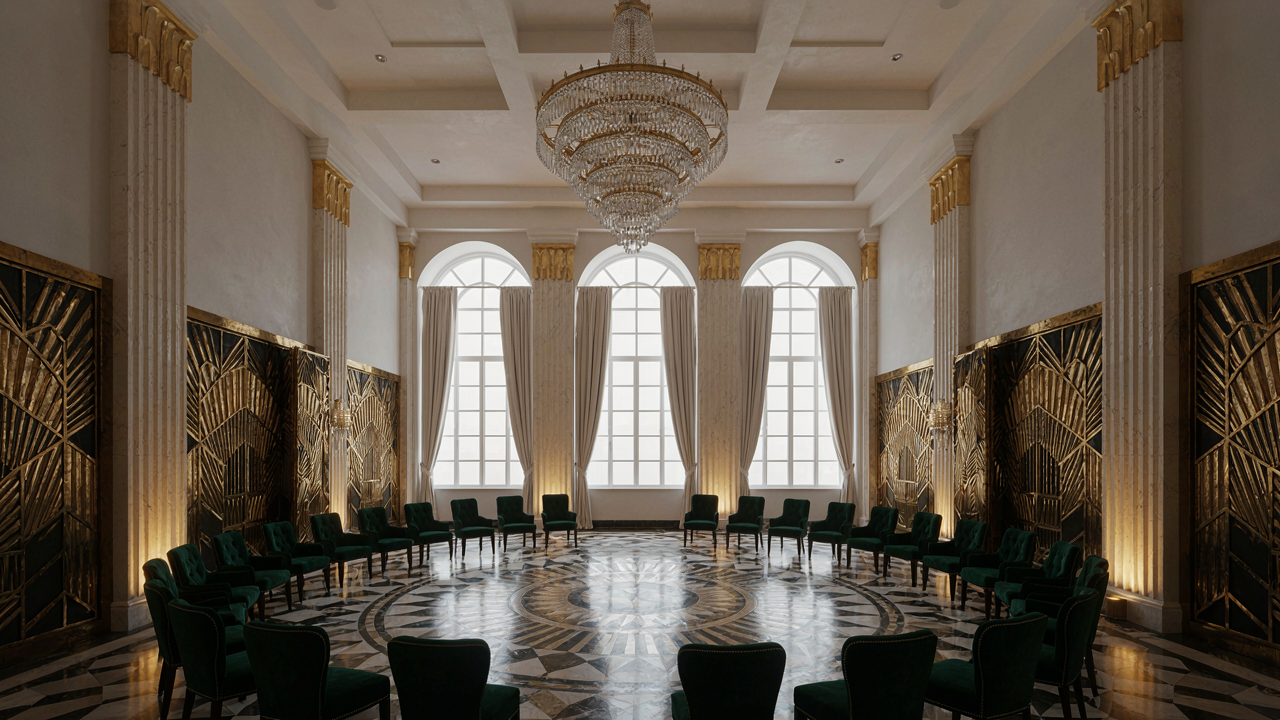
You want the venue to do the heavy lifting so you spend less on decoration. That’s the real game here. Old Hollywood doesn’t live in banquet halls. It lives in art deco buildings, defunct theaters, historical libraries, and industrial lofts with bones already intact. The mechanism is simple: borrowing from architecture, you’re seeking spaces with existing “load-bearing aesthetics” that require minimal intervention. A 1920s bank lobby already has marble, geometric detailing, and drama. You pay for the space, not the transformation.

Most couples ignore these venues because they’re not marketed as “wedding spaces.” Theaters between productions rent for fractions of typical venue rates because the owner sees it as unused revenue. Historical societies rent their buildings to offset maintenance costs. The aesthetic alignment is already there. Your labor shifts from decoration to curation. You select what to highlight and what to downplay, rather than building a facade from scratch.
Rates Drop When You Bypass The Middleman
Published packages are fiction designed for people who haven’t asked what’s actually negotiable. Venue coordinators build margins into package pricing because most couples won’t push back. Go directly to facility management, not the wedding coordinator. State your date, your headcount, and your timeline. Ask for the base rental only, stripped of catering markups, service charges, and package bundles. This conversation changes the number completely.
Leverage timing and day selection as your negotiating tool. Weekday rentals, Sunday ceremonies, and off-season dates (January through March) carry real discounts because venues want utilization, not premium pricing. A Friday night in February costs significantly less than a Saturday in June. When you name a specific low-demand date, you give the venue manager a reason to say yes to a lower rate. Document everything in writing. Get the final number in an email before you sign anything.
Costume Drama: Attire On A Classic Hollywood Wedding Theme Budget

Rent Or Reproduce: The Real Trade Off
You want to look like you stepped out of a 1940s film without spending like a studio did. Here’s what nobody admits: rental locks you into existing inventory, reproduction lets you control the narrative. Rentals work when standardized sizing and timing align with your date. Reproductions win when you need specific silhouettes, custom tailoring, or pieces that don’t exist in rental catalogs. The mechanism is scarcity. Rental houses own limited stock. Custom reproduction means you’re competing against time, not inventory limits.

Rental pricing typically ranges from $150 to $400 for a single gown or suit, depending on designer reissue and condition. Reproduction costs $300 to $800 upfront but gets reused, photographed, and stored indefinitely. Rentals save cash if you need one wearing. Reproductions save cash if you plan multiple events or want exact period accuracy. Evaluate your wedding date against rental house availability first. If they have your size and style in stock three months out, rent. If they don’t, or if you need 1930s draping they can’t source, commission a reproduction from a theater costumer or vintage reproduction specialist. Commit to your choice by month four of planning.
Accessories That Signal Without Costing
The real leverage sits in accessories, not garments. A $40 vintage brooch reads louder than a $200 reproduction dress because it’s specific, unexpected, and requires knowledge to place correctly. Economics calls this signaling: you’re communicating taste through constraint, not spend. Old Hollywood costumes worked this way on set. Studios dressed supporting actors in rented basics, then invested in jewelry, shoes, and hair pieces that appeared in close-ups.
Source accessories through estate sales, local antique dealers, and Etsy sellers who specialize in 1930s to 1950s reproduction. A paste brooch from the era costs $15 to $60 and photographs as authentically as a real one. Vintage shoes ($30 to $80) matter more than you think because modern shoe construction looks wrong in period footage and still photography. Hair accessories (combs, clips, headpieces) cost $20 to $50 and anchor the entire look. Accessorize with intention, not extravagance: three pieces maximum per person, each chosen for historical accuracy, not budget fill. Buy accessories first, build outfits around them.
The “Set Dressing” Blueprint: Decorating Your Old Hollywood Wedding

Lighting As The Atmosphere Weapon
You want people to feel transported, not just see decorations. That’s the real reason you care about this section—you’re buying status through mood, and mood is physics. In lighting design, we call it “color temperature,” and it’s the single variable that makes or breaks the illusion. Tungsten bulbs (warm, around 3200K) mimic the practical lights used on old film sets. Cool LED strips kill the era instantly. The mechanism is simple: old Hollywood didn’t have daylight-balanced lighting. It had amber, shadow, and contrast.

Rent or buy tungsten-based uplighting for key areas—corners, behind tables, against walls. Skip the common advice about “string lights everywhere.” Aim lights at surfaces, not at guests. That creates the theatrical depth that reads as old Hollywood, not backyard party. One uplight behind a column or against drapery costs less than a centerpiece and does ten times the work. Position lights to cast defined shadows. This single protocol—angled uplighting on architectural features—separates a themed wedding from a themed attempt.
Props You Build, Not Purchase
The wedding decor industry sells you garbage because you don’t know what you’re looking at. Rental companies stock plastic art deco pieces and generic “vintage” frames. Real old Hollywood relied on typographic elements, actual film reels, and architectural props like vintage telephone switchboards or studio lights. You can source these legitimately. Contact local theater departments, film schools, or estate liquidators for authentic pieces. Authenticity registers instantly because it has texture and weight that polyresin cannot fake.
Build your own prop library with three categories: signage, lighting equipment, and set pieces. Source wooden frames from thrift stores and refinish them. Print enlarged photographs of classic films or studio logos on kraft paper and mount them on wood. Borrow or rent actual vintage studio lights (they’re functional and photograph well). The cost difference between rental grade and authentic is negligible, but the impact separates your wedding from the template version. Your final step is placing props asymmetrically—never in perfect rows. Asymmetry signals design intent, not decoration checkbox.
The “Studio System” Catering Strategy

Menu Design Using Economic Principles
You want guests to think you spent more than you did. That’s the real calculation here. Economics calls this “price anchoring”—the first number you see becomes the reference point for everything else. Old Hollywood understood this instinctively. Studios controlled perception by limiting what appeared on screen, not by having unlimited resources.
Design your menu around three high-impact dishes instead of eight mediocre ones. Filet mignon with a simple red wine reduction reads expensive. Lobster tail with clarified butter reads expensive. Champagne-poached salmon reads expensive. You’re not feeding a crowd—you’re creating a curated experience. Execute three items flawlessly, and guests assume the entire operation was expensive. Cut the filler courses that nobody remembers.
The mechanism works because contrast makes the main dish land harder. Start with a single passed appetizer—not a table full of options. Serve one soup course. Present one entrée choice. End with one dessert. Your per-plate cost stays low, but the presentation creates the illusion of luxury through discipline, not abundance. This is how the studio system worked: controlled output, maximum impact.
Beverage Curation, Maximizing Perceived Value
Cocktails are the fastest way to signal affluence without spending it. Don’t offer a full bar—that’s chaotic and expensive. Offer two signature cocktails tied to Old Hollywood: a classic martini and a champagne cocktail. Both look expensive in the glass. Both are cheap to make at scale. The psychology: limited options feel intentional and refined, not restrictive.
Champagne matters more than wine selection here. One bottle of mid-tier champagne for toasts costs less than three wines for the table. It photographs better. It signals occasion. Your guests remember the champagne toast, not whether the Pinot Noir was acceptable. Skip the wine list entirely. Serve champagne, one red, one white, done. The constraint makes the celebration feel deliberate, not budget-constrained.
Control the pour and you control the perception. Use standard cocktail glassware—coupe glasses for cocktails, flutes for champagne, wine glasses for wine. The vessel itself communicates refinement. Train one person to make the two cocktails consistently. Batch your champagne cocktails in advance in a punch bowl format. Your cost per guest drops by 40 percent while the experience becomes more polished because nothing runs out, nothing looks improvised, and everything lands on cue.

Soundtrack To An Era: Music And Entertainment

Playlists Over Bands: The Real Math
You want a live band because you think it signals luxury. That’s the trap. The mechanism is simple: a four-piece jazz ensemble costs $1,500 to $3,000 for four hours. A curated playlist costs nothing after Spotify’s monthly fee you already pay. Old Hollywood didn’t need live music at every moment—it needed the right song at the right moment. Curated playlists give you that control.
The real advantage is editing power. You control tempo, volume, and transitions between dinner and dancing. A band takes requests, plays what they want, and fills silence with their own pacing. For a budget wedding, a high-quality speaker system ($200 to $400) and a disciplined playlist beats hiring musicians. You’re not cutting corners. You’re removing the middle man who doesn’t understand your vision.
Entertainment That Demands Participation
Passive music consumption is dead weight at a wedding. Old Hollywood understood spectacle—not as background decoration, but as moments that pulled people in. Think economics: the scarce resource at your wedding isn’t sound, it’s attention. You maximize attention by creating experiences people can’t ignore.
A photo booth styled as a 1940s studio setup costs $300 to $600 and creates content your guests generate themselves. A cocktail hour with a live caricature artist ($400 to $800) gives people something to do besides stand around. A structured timeline—dinner at 7, first dance at 8, games at 8:30—forces engagement. The mechanism works because you’ve removed the option to be passive. Build moments that require guests to participate or they’ll feel the friction of being left out.

Capturing The A List: Photography And Videography

Shoot The Scenes That Matter
You want proof you had a luxe wedding without dropping six figures on documentation. Here’s the mechanism: Old Hollywood weddings live on contrast between curated moments and dead time. Professionals shoot everything. You shoot only the frames that read as “expensive” to an observer. This isn’t about missing memories. It’s about directing finite resources toward the visuals that anchor the theme.
The common advice is to hire someone for eight hours and hope they capture the vibe. That’s wrong. You need a shot list built backward from what made 1940s studio photography distinct: dramatic lighting on faces, architectural geometry in the venue, props that signal wealth without showing price tags. Hire for four hours during golden hour and the ceremony. Assign a trusted guest with a decent camera to grab candids. You save 40-60% on labor while maintaining the visual language that reads as Old Hollywood.
- Golden hour portraits: Schedule shoots during sunset when light becomes directional and warm, mimicking studio lighting rigs from the Golden Age without equipment cost.
- Ceremony and first dance: These two sequences carry narrative weight and require technical skill. Allocate primary photographer time here.
- Detail shots of rentals and decor: Closeups of jewelry, glassware, linens, and floral arrangements prove investment happened. They’re static and easier to execute well.
- Guest candids during cocktail hour: Assign a secondary shooter or talented friend. Candids cost nothing if you brief them on framing and angles beforehand.
- Reception table moments and speeches: Capture genuine reactions rather than posed shots. These require presence but minimal technical demand.
Skip the highlight reel edit that costs extra. Request a simple timeline cut of ceremony and first dance. You already have your money’s worth in stills. The rest lives on phones and becomes shareable, which drives the perception of your event further than expensive post-production ever could.
Finding Talent That Understands The Aesthetic
Emerging photographers and film students know how to light for Old Hollywood because they study the source material obsessively. They don’t charge studio rates because they’re building portfolios. The trade is straightforward: you get lower cost and higher motivation for excellent work. They get images they can market as “luxury wedding” content.

Vet them on one metric only: Show you their work and ask specifically how they’d light a scene with vintage practicum lamps and no flash. If they hesitate or talk around the question, move on. If they talk about practical light placement and shadow direction, they understand the craft. Negotiate a package deal that includes raw files and limited editing. You handle the final color grade yourself using free tools like DaVinci Resolve, which lets you match the warm, desaturated tones of Technicolor without paying a colorist. Finalize your photographer contract by specifying shot list delivery within two weeks and raw file handover within four.
The “Contrarian Casting” For Your Old Hollywood Wedding Theme

Distributing Responsibilities Among Your Real Network
You want people to think you orchestrated this alone, and that fear is why you’ll waste money on vendors who don’t understand your vision. The mechanism is simple: delegation isn’t abdication. It’s giving specific people specific tasks because they’re actually better at those tasks than you are.
Your cousin who shoots photography as a side business doesn’t need a title to shoot your ceremony and cocktail hour. Your friend with design sensibility doesn’t need to be called a planner to source props and arrange the venue layout. The person who knows old film history better than anyone should curate your music and film clips. You pay these people what they ask, not what industry standards demand. The person handling logistics wins because they get paid for work they’d do anyway. You win because you spend less and get better results from people who actually care about the outcome.
Abandoning The Wedding Party Altogether
Standard wedding party hierarchy exists to solve a coordination problem that doesn’t exist in 2024. Instead of forcing five bridesmaids and five groomsmen into matching costumes, Old Hollywood weddings used a rotating cast of supporting players. Studio films didn’t employ redundancy. They employed efficiency.

Assign one person to handle the bride’s preparation and wardrobe. Assign one person to manage the groom’s side. Give someone else the job of managing timeline and vendor communication. Give another person the authority to solve problems on the day without asking permission. These roles shift based on actual competence, not loyalty or alphabetical order. The result costs less, moves faster, and produces a sharper execution because each person does one job well instead of five people doing one job poorly. Start by naming these roles before you name the people.
The Farewell Flicker: Exiting Your Hollywood Themed Wedding

What You Actually Owe After The Lights Fade
You’re worried the wedding ends and you’re left holding the financial bag. Here’s what actually happens: most couples blow their post-event budget on things that don’t matter because they never itemized what “after the wedding” actually costs. Rentals get returned within stated windows. Vendor payments finalize on contracted dates. The real drain is what you didn’t plan for: storage fees, alterations, shipping, thank-you printing, and the photographer’s final delivery timeline. Budget five to eight percent of your total wedding spend for post-event costs, then allocate it deliberately rather than discovering bills three months later.
The common mistake is treating the financial end as a single event instead of a process with distinct phases. Rental returns happen within days. Vendor final payments land within weeks. Guest thank-yous span months. Photography delivery timelines vary widely depending on your contract terms. Old Hollywood rentals specifically hold value, so return them on schedule to avoid daily overage charges that compound faster than most vendors disclose. Create a post-wedding timeline starting the day after your event with every deadline and cost clearly marked. Your vendor contracts already state these terms; you just need to extract them and sequence them.
Building Assets Instead Of Collecting Trash
Economics teaches depreciation: assets lose value the moment you acquire them. Fight this by treating Old Hollywood wedding elements as inheritable or sellable goods rather than single-use props. Vintage rentals, quality linens, and reproduction Art Deco pieces actually hold market value when you exit them correctly.
Sell the reusable elements within three months while the wedding is still culturally current in your circle. High-end fabrics, candelabras, and gold-toned furniture find buyers quickly through wedding resale platforms and local Facebook groups. Donation paths matter too: pieces that don’t sell become tax deductions if you document their condition and fair market value at donation. The mechanism is simple: liquidate fast, document everything, capture whatever recovery value exists before cultural relevance fades and the items become storage liabilities instead of assets.
The Real Obstacle Isn’t Your Budget; It’s Your Imagination’s Limits

Most people plan cheap weddings because they assume cheap means compromising. You don’t compromise. You remix. Stop scrolling Pinterest for expensive inspiration and start stealing from thrift stores, garage sales, and your grandmother’s attic instead. The Old Hollywood aesthetic lives in restraint and shadows, not in spending. Your next move: spend two hours tomorrow finding five free or dirt-cheap items that scream vintage glamour, then build your entire vision around those anchors. Constraints don’t limit creativity; they force it.