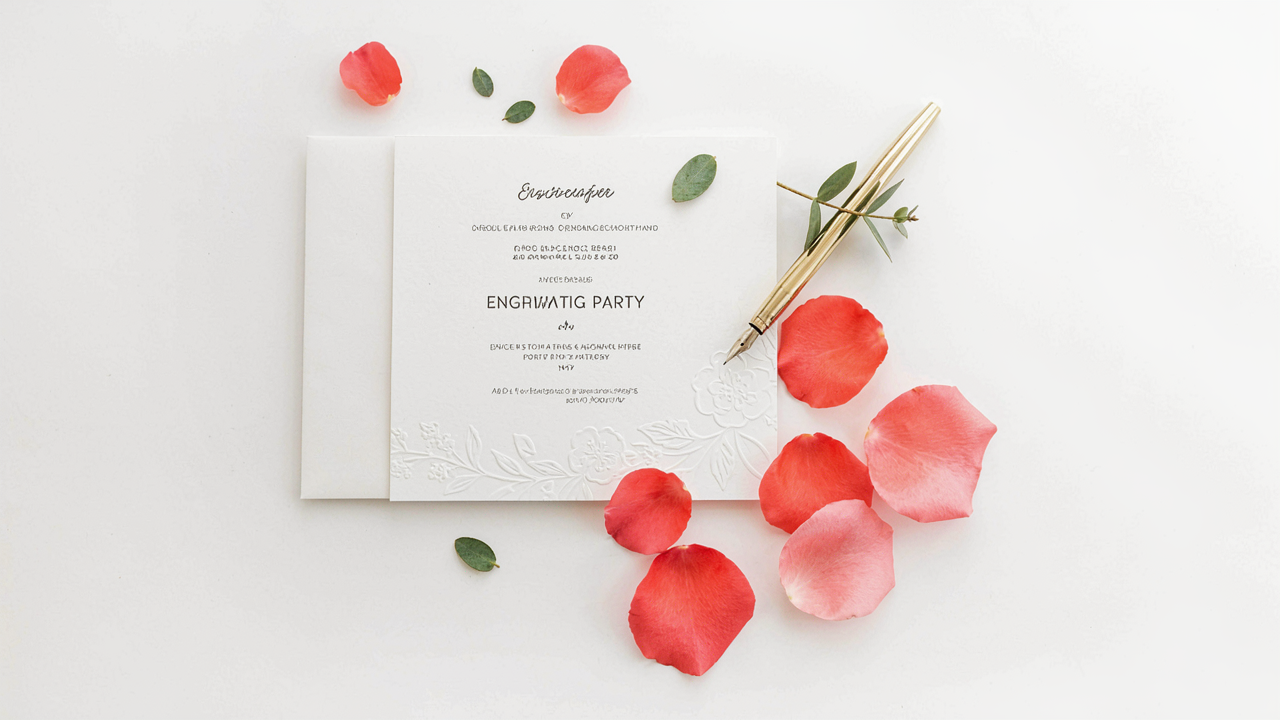
The Invitation As A Social Contract: Beyond Basic Engagement Invitations

State The Rules First
You want people to feel special, but what you really need is for them to know exactly what you expect. Most engagement invitations fail because they assume everyone understands the unwritten code. They don’t. Treat your invitation like contract language: specify the date, time, location, dress code, whether plus-ones are allowed, and what the event actually is. Ambiguity creates resentment. Clarity creates alignment. Write as if you’re a project manager briefing a team because that’s functionally what you’re doing.
The mechanism here mirrors contract law. You establish mutual understanding upfront to prevent disputes later. Include RSVP deadlines, parking information, dietary restrictions needed by a specific date, and whether children are invited. People will ask these questions anyway. Answer them before they ask. This eliminates decision fatigue for your guests and removes the back-and-forth friction that turns a simple invitation into a logistical headache.
Signal Without Announcing
Exclusivity works through scarcity and proximity, not proclamation. You convey who belongs by naming who you’re inviting and making attendance slightly inconvenient for the wrong people. A Saturday at 2 p.m. draws family. A Friday at 8 p.m. filters. A venue across town eliminates casual attendees. Never write “exclusive gathering” or “intimate celebration.” That sounds desperate. Instead, control the variables: time, location, and formality level communicate the boundary naturally.
The invitation wording itself should reflect the tone of who’s invited. Formal language attracts formal relationships. Casual language attracts casual ones. If you invite the entire extended family plus coworkers, your wording should be straightforward and accessible. If you’re inviting thirty close friends, the tone can be more personal and specific. The level of detail and intimacy in your wording becomes a filter itself. People self-select based on whether they recognize themselves in the invitation’s voice.
The Filter Protocol: Strategic Engagement Party Invite Wording

Language That Signals Who Should Actually Come
You want people to come who belong there, and you’re afraid of ending up with a bloated guest list full of obligation-based attendees. The mechanism is simple: word choice functions as a gate. Specific language in your invitation either opens or closes access without requiring you to send separate rejections. This isn’t rude—it’s honest. People read between lines naturally. Your job is to make those lines legible.

Start with venue details and time as your primary filter. A casual “backyard gathering, 4 PM Saturday” attracts a different crowd than “cocktail reception, evening attire requested.” The specificity of the setting and dress code does the filtering for you. Include sentence structure that assumes a particular type of participation. “Join us for an intimate celebration” signals smaller and more personal than “We’d love to see you at our party.” Word choice like “intimate,” “close family and friends,” or “limited guest list” stops people from inviting plus-ones and prevents the mental math that leads to “I’ll bring my coworker too.”
Making Gift Intentions Unmistakable
Generic advice says to include a line about gifts, but most couples hedge the language so badly it creates confusion instead of clarity. “Gifts are optional” tells people nothing—half will ignore it anyway. The real move is stating your actual stance without softening language that contradicts it. If you want no gifts, say “Your presence is our only gift.” If you want gifts, name a registry. If you want neither gifts nor money, say that. The mechanism works because ambiguous wording creates decision paralysis in guests, and they default to whatever their social circle does, which defeats your purpose.
Avoid phrases like “in lieu of,” “if you wish,” or “should you desire.” These undercut your message. Replace them with direct statements. “We have a registry at [store]” is clearer than “We’ve created a registry should anyone want to contribute.” If you’re collecting funds for a honeymoon or specific cause, name it outright and provide the method. People respect clarity over politeness—it actually reduces awkwardness because nobody has to guess what you want or feel judged for their choice.
The “Scarcity Principle” In Engagement Party Invite Ideas

Attendance As A Privileged Opportunity
You want people to feel like they’re getting something rare, not just filling a seat at another party. Economics calls this artificial scarcity, and it works because exclusion triggers status anxiety in the person being excluded. Your invitation wording doesn’t just announce an event, it signals that attendance matters because spots are limited or the moment is unrepeatable.

The mechanism is straightforward: replace generic language with language that positions the gathering as exceptional access. Instead of “You’re invited to our engagement party,” write something that emphasizes the singular nature of the moment. “We’re celebrating with our closest circle” or “Join us for this once-in-a-life milestone” reframes the invitation from obligation to privilege. People show up differently when they believe they were specifically chosen, not mass-invited.
Early Bird RSVP Creates Urgency
Deadlines don’t work unless you make exclusivity expire. The common advice to “just set an RSVP date” misses the real lever, which is tying that deadline to a concrete benefit or consequence that runs out. Your wording needs to make clear that early responders get something others don’t, or that spots genuinely close.
State the mechanism plainly in your invitation: “RSVPs by [date] secure your spot at the dinner reservation” or “We’re capping this at 40 people, first responses confirmed first.” This isn’t about politeness, it’s about removing the ambiguity that lets people procrastinate. When they know the cutoff triggers real consequences, they respond faster and with more conviction than they would to a vague deadline.
Decoding Guest Archetypes: Crafting Unique Engagement Invitations

The Real Reason You’re Segmenting Your Guest List
You want to avoid the social friction of a one-size-fits-all invitation. Here’s the mechanism: different guest groups operate under different social contracts with you, and your invitation language must acknowledge that contract or it reads tone-deaf. Borrowed from game theory, you’re managing “information asymmetry”—what each guest type knows about their role differs, so your wording must calibrate expectations differently for each group. The couple’s inner circle expects intimacy. Colleagues expect professionalism. Extended family expects tradition. Misalign the tone and the guest either declines or shows up resentful.

Your invitation wording becomes a signal about which mental frame the recipient should activate. A childhood friend gets casual language that confirms you’re still the same people. A boss gets formal language that confirms this is a professional milestone, not a demand on their personal time. Corporate contacts get clarity on what their attendance means for the relationship. The segmentation isn’t about being manipulative—it’s about respecting the actual relationship. Write one invitation for all these groups and half your guests will feel the distance.
Handling The Unstated Objections Before They Arrive
The common advice says to “make it easy to RSVP.” That’s incomplete. You need to name and defuse the objection nobody voices but everyone feels. Your aunt doesn’t skip your engagement party because RSVPing is hard—she skips because she’s unsure if it’s a gift-giving event, a boozy celebration she’s too old for, or an obligation disguised as an invitation. Your invitation wording must address this friction before she decides not to come.
The mechanism is preemptive framing. Include one line that answers the question the guest is too polite to ask. If it’s an afternoon garden event with light refreshments, say so—this tells the older relatives it’s structured and appropriate. If it’s casual and you don’t expect gifts, state that explicitly. If it’s a partner’s family you’ve never met, acknowledge the slightly awkward nature with a line like “Come celebrate with us and meet the whole crew.” This removes the mental tax of guessing. The guest who knows what to expect and why they belong shows up present instead of anxious.
The Art Deco Engagement Party Invite Effect: Aesthetics As Subtext

When Design Contradicts Your Words
You want people to think you have taste. That’s the real reason you’re reading this section. The mechanism is simple: your written invitation tone dies the moment your visual design contradicts it. Art Deco aesthetics—geometric patterns, metallic accents, symmetrical layouts from the 1920s design movement—work because they reinforce formality and precision. If your wording says “casual backyard gathering” but your card uses gold leaf and sharp angles, guests feel the conflict and trust neither message.

Design either validates your words or it undermines them. Most people choose fonts and colors last, treating them as decoration. That’s backward. Your visual language should land before anyone reads a single word. When the aesthetic matches the tone you’re writing in, the invitation feels intentional rather than assembled. Guests perceive confidence, not confusion.
Alignment Between Message And Visual Treatment
Most advice tells you to “pick colors that match your personality.” Useless. What matters is whether your design choices reinforce the formality level and urgency of your event. A black-tie engagement party invitation printed on cream cardstock with sans-serif type signals different expectations than the same wording on textured paper with script lettering. The visual weight carries more information than people admit.
Test your alignment by covering the text and asking: does this design alone tell the right story? If your design reads as casual but you’re hosting a formal dinner, the mismatch creates friction. Guests show up in the wrong clothes. They arrive with wrong assumptions about timing, dress code, gift expectations. Your design must visually support every claim your words make about the event’s tone and scale.
The Micro Economy Of Engagement Party Invitation

Controlling Guest List Flow
You care about this because an out-of-control guest list signals you have no authority over your own event. Here’s the mechanism: engagement parties operate on scarcity economics. Limited space, limited budget, limited time. Your invitation wording either creates artificial scarcity or accidentally broadcasts unlimited seats. “We’d love to have you” reads differently than “We’re hosting an intimate gathering for 25 close friends.” The second one enforces demand through clarity.

Most people write invitations without acknowledging they’re making a supply decision. They treat the wording as decoration when it actually functions as a rationing tool. Your invitation wording controls who feels welcome to ask if they can bring a plus-one. It controls whether distant acquaintances assume they’re included. Specify your actual capacity early. “We’re keeping this small, 30 guests total” stops bleeding. “Join us for an engagement celebration” invites everyone mentally in your contact list to show up.
Resource Allocation And Guest Experience
Your real resource bottleneck isn’t money or space—it’s coordination burden. Every additional guest multiplies the logistics you must manage. Economics teaches us that scarcity forces trade-offs. In engagement party invitations, you’re trading off guest count against experience quality. You either host more people with a surface level event or fewer people with actual engagement and memory.
Your invitation wording should telegraph what resources you’ve allocated toward the experience:
- Venue limitation wording: “Due to space, we’ve limited this to 40 guests” tells people they’re in a curated group, not a default invite list.
- Time-bound format: “Join us for cocktails, 6-8pm” prevents the all-day obligation creep that tanks host energy by hour four.
- Activity clarity: “We’re doing a casual dinner” or “appetizers and toasts only” shows you’ve made intentional resource choices instead of defaulting to open-ended hosting.
- RSVP deadline with reason: “Please confirm by October 15th—we’re finalizing catering” demonstrates that attendance numbers directly impact what you can deliver.
- Guest role definition: “Casual dress, no plus-ones” removes ambiguity that forces you to make uncomfortable calls later.
State your constraints plainly in the invitation itself. This sounds restrictive but it’s the opposite. Clear boundaries let guests relax because they know exactly what to expect and what’s expected of them. Your wording either pre-solves conflicts or creates them. Write for the experience you can actually execute, not the fantasy version.
Engagement Invitation Ideas: Mastering The Subtext

Who’s Hosting Signals Everything
You care about this because the host’s name on the invitation carries social weight you can’t manufacture through prose alone. In economics, we call this signaling—the act of revealing information that costs money or credibility to fake. On an engagement invitation, the host’s identity is your signal. If your parents host, you’re anchored to family stability. If close friends host, you signal intimate social capital. If the couple self-hosts, you signal independence. The wording barely matters next to who’s listed at the top. Pick hosts strategically because their name does the selling you can’t do with clever language.

The mechanism is straightforward: guests evaluate the event’s legitimacy and their own social position before they even read the date and time. A formal host name paired with formal wording reinforces each other. A casual host name paired with casual wording reinforces each other. Mismatch creates confusion, which kills attendance. Your job is to align the host identity with the tone of your words so the entire invitation reads as one coherent statement about who you are and who belongs in the room.
Say Less, Own More
Everyone’s been told to make invitations warm and personal, but that’s advice from people who don’t understand how attention works. Conciseness signals confidence. It also forces the reader to fill in gaps with their own meaning, which makes them feel invested in the event before they arrive. The best engagement invitations strip away justification. They state facts. They don’t explain why the party matters or why the recipient should care. That’s insecurity dressed as enthusiasm.
The power of omission is that it respects the reader’s intelligence and time. A two-sentence invitation outperforms a paragraph because people assume if you bothered to write it, it’s worth their attention. Cut every phrase that describes your feelings, the couple’s love, or why this moment is special. Your job is logistics and tone, not emotional narrative. List the date, time, location, RSVP method, and dress code if relevant. Everything else is noise that weakens the signal.
The Unspoken Language Of Engagement Party Invitations Ideas

What You Don’t Say Matters More
You care about this because you’re afraid of looking cheap or desperate through your words. Here’s the mechanism: silence operates like negative space in design. What you omit from an invitation creates psychological weight. A blank line where people expect information triggers curiosity. A missing detail forces the reader to fill the gap themselves, which makes them more invested in showing up. Every word you remove increases perceived exclusivity.

Most invitations fail because they over-explain. They pack the card with apologies, justifications, and nervous language that signals low confidence. The inverse works: constraints breed desire. When you strip an invitation to essentials only, you communicate that your event doesn’t need selling. The mechanism is scarcity signaling through deliberate minimalism. People attend what feels hard to access, not what feels desperate to fill seats.
The Precision Of Strategic Omission
Vagueness isn’t confusion. It’s control. In economics, information asymmetry creates market advantage because one party knows what the other doesn’t. Apply this to invitations: let guests wonder about exact logistics while you’re crystal clear on one element they can’t ignore. If you’re deliberately vague about the agenda but crystal clear about the dress code, you’ve shifted their focus. They stop asking “what will we do” and start asking “what should I wear.” You’ve designed their thought pattern.
The real skill is knowing which details to bury and which to highlight. Most couples treat invitations like checklists, hitting every box equally. Wrong approach. Bury the time in smaller font. Punch the location. Make the date impossible to miss. What you emphasize through typography, repetition, and placement isn’t accidental. It’s instruction. The invitation becomes a filter that sorts for people who care about what you care about, not just anyone with an open evening.
The Real Obstacle Isn’t Finding The Right Words; It’s Admitting You Desire Control Over Your Narrative

Most couples default to generic invitation templates because originality feels risky. But that’s cowardice dressed as convention. Your invitation sets the tone for your entire celebration. Write something that reflects who you actually are, not who you think you should be. Stop asking what sounds right. Ask what feels true. Open a blank document right now and write one sentence that only you could write, then build from there. Your guests didn’t show up for a Hallmark card.