The Rehearsal Brunch Fallacy: Why Dinner Is A Trap

Where Dinner Costs Actually Hide
You want to feel like you’re throwing a proper event without looking cheap. That’s the real tension here, and dinner is the trap that exploits it. Most people quote dinner rehearsal costs at face value: entree price times headcount. That’s incomplete math. Dinner pricing conceals labor multiplication. Evening service requires more staff per table, longer table turns, premium beverage markups, and venue rental fees that scale with hours occupied. A six-hour dinner burns money on idle time between courses.
Brunch operates on different economics. The meal itself runs two to three hours maximum. Venues price brunch lower because turnover is faster and day-shift staff cost less than evening service. Alcohol consumption per person drops significantly at brunch, which obliterates the beverage markup that destroys dinner budgets. Venues have zero incentive to hold your group longer, so they staff to move people through efficiently. This isn’t sentiment. This is how restaurant economics actually function.
The Structural Advantage Brunch Owns
Brunch sits at a unique inflection point in restaurant operations: it exists in the margin between breakfast demand and lunch rush. Think of this through queueing theory, the mathematical field that governs how systems handle flow and wait times. Dinner creates bottleneck constraints because every table follows the same temporal sequence. Brunch eliminates that constraint. Guests arrive across a two-hour window naturally. The kitchen doesn’t face simultaneous orders for thirty entrees. Preparation spreads across time. Fewer fires, lower stress, lower waste.
The cost structure advantage compounds backward through planning. Brunch venues have simpler menus because brunch customers expect repetition. Eggs. Toast. Pastries. Fruit. This means lower food cost per plate, less staff training required, and predictable sourcing. You’re not negotiating custom plating or complex preparations. Dinner demands perceived sophistication, which means custom requests, protein variety, and kitchen labor that scales nonlinearly with headcount. Brunch menus are utilitarian by design. That utilitarianism is what makes them budget-defensible. Your job is to book the venue, set a two-hour window, and confirm final headcount seven days prior.
Unlocking The Budget Rehearsal Brunch Instead: A Cost Benefit Protocol

Where Dinner Costs Go Wrong
You want to look like you did something meaningful without actually hemorrhaging money. That’s the real tension here, and brunch solves it because of how restaurant economics work. Dinner pricing assumes alcohol consumption, extended table time, and the psychological weight of “special occasion” markup. Brunch inverts this equation: alcohol sales drop by 40 to 60 percent compared to dinner, guests expect to leave within two hours, and venues charge 30 to 45 percent less per head because they’re moving tables faster.

A rehearsal dinner for 40 people at a mid-range restaurant costs between 1,200 and 2,400 dollars depending on your market. Brunch at the same venue hits 600 to 1,000 dollars. The gap widens if you’re in a major city. You’re not sacrificing quality by switching the meal time, you’re just removing the artificial premium that evening service commands. The mechanism is pure logistics: brunch venues optimize for throughput, not lingering, which kills their cost structure and passes savings to you.
Experience Returns On Actual Investment
Economics borrows “diminishing returns” to describe what happens when you keep adding resources to the same output. Your rehearsal brunch faces the opposite pressure. Lower spend doesn’t reduce guest satisfaction when you redirect that money into what actually matters: food quality and intentional pacing. Most rehearsal dinners fail because people sit too long in formal silence. Brunch’s natural brevity eliminates that awkwardness while guests stay mentally sharp enough to actually talk to each other.
The real ROI isn’t measured in how much you spent, it’s measured in whether people remember the gathering as genuine or obligatory. A 25 dollar per person brunch with excellent pastries, fresh juice, and a two hour window outperforms a 50 dollar per person dinner where half the table is exhausted and checking phones by dessert. Assign someone to greet arrivals, seat people strategically to mix wedding parties, and end by 11 AM so the day still belongs to the couple. That protocol costs nothing and returns everything.
The Morning Advantage: Maximizing Wedding Rehearsal Brunch Time

Natural Light Changes Everything
You want to believe brunch is cheaper just because it costs less. The real reason you should care is because morning light solves a photography problem most couples don’t see until the final edit. In cinematography, golden hour constraints force crews to work faster and shoot only what matters. A brunch rehearsal gives you three to four hours of usable natural light without fighting the sun’s position or paying for supplemental equipment. Your photographer captures the ceremony walkthrough, the family groupings, and the couple’s candids in the time when skin tones read accurately and shadows stay clean. This doesn’t happen at a rehearsal dinner where you’re either shooting in tungsten indoor light or racing dusk.

Mood follows light direction. Harsh noon sun requires minimal setup. Soft morning light at seven thirty or eight AM requires nothing but bodies positioned correctly. Your photographer shoots faster, your group stays engaged because you’re not standing around waiting for the golden hour window, and your image library from rehearsal actually looks like something worth keeping. Schedule your brunch start time no later than eight AM and finish by eleven. This keeps your timeline inside the window where light behaves predictably and your team operates at full efficiency without technical workarounds.
Schedule Around Energy, Not Appetite
Rehearsal logistics operate like a military operation where units move in sequence. A brunch event creates natural staging: people arrive fresh, complete the walkthrough while attention spans peak, eat, then disperse with structured time blocks instead of an evening where fatigue compounds decision-making. The common advice says rehearsal dinner builds intimacy. That’s incomplete. What actually builds focus is separating the work phase from the social phase. Your walkthrough happens at peak cognitive performance. Your family photos happen when people haven’t been sitting for three hours. Your meal happens after the tasks that required precision are finished. Post-brunch time becomes negotiable free time where people either leave to rest before the wedding or stay for optional activities like a casual game or walk without formal expectation.
The protocol: rehearsal and photography from seven-thirty to nine-thirty AM. Brunch service from nine forty-five to eleven fifteen AM. Post-brunch dismissal at eleven thirty. People with travel needs leave without guilt. People staying in town can use the afternoon for personal prep, vendor meetings, or family time that doesn’t drain the group’s collective energy the night before the wedding. This structure prevents the eleven PM rehashing of logistics that kills sleep quality before the actual event.
Catering The Brunch Wedding Reception: Less Is More

Constraint Forces Better Decisions
You’re worried people will judge you for serving less food, not more. That’s the real anxiety. But economics teaches us about scarcity pricing, and brunch menus operate under the same principle: fewer options increase perceived value. A three-item menu executed perfectly beats a twelve-item spread where half tastes rushed. Your guests remember execution, not inventory count.

The mechanism is simple. Brunch has natural portion limits that dinner ignores. Eggs, pastries, and fruit satisfy faster than five courses. You serve less total food, spend less total money, and guests leave before they can get bored. Pick one egg preparation, one pastry, one fruit setup. Nail those three things. Everything else is waste disguised as generosity.
Beverages That Look Intentional, Cost Less
Skip the open bar pretense. Brunch runs three to four hours, not eight. Mimosa stations cost forty to sixty dollars per person including setup. Beer and coffee cost eight to fifteen dollars per person. The difference isn’t negligible when you’re covering a hundred guests. Elegant doesn’t mean expensive. Intentional does.
Offer champagne, orange juice, and still water. Add local coffee from a place that will deliver. That’s your beverage program. Your guests came for the event and the company, not to test your liquor budget. Set the mimosa pitcher out, let people mix their own ratio, and watch your per-person cost drop by half. The self-service model also eliminates bartender labor costs, which most brunch budgets forget to calculate.
Venue Hacking: Finding The Perfect Breakfast Wedding Reception Spot

When Daytime Venues Drop Their Price
You’re worried a budget brunch looks cheap. That’s the real fear here. But venues operate on supply and demand, and breakfast has negative demand. They discount morning slots because nobody books them, not because they’re worse.

Hotels and restaurants use yield management, the same principle airlines use to fill empty seats. A venue makes nothing on an empty 9 AM Saturday. They make something on a discounted rate. The mechanism is simple: morning availability is worthless to them, so it costs you less. Book Friday through Sunday mornings and watch rates drop 40 to 60 percent below dinner pricing on the same space.
Most couples never negotiate daytime pricing because they assume brunch venues don’t exist. They do. Call the venue’s catering director, not the events coordinator. State your date and time first. Ask what their morning rate is versus their standard rate. Many venues don’t advertise breakfast rates because they never field the request. You’re not asking for a favor. You’re filling dead inventory.
Unconventional Spaces: Where Breakfast Actually Works
Restaurants and hotel ballrooms pretend to be restaurants and hotel ballrooms at night. They become something else at 10 AM. Parks, private homes, and backyards have no “dinner mode” to undercut. They’re inherently flexible.
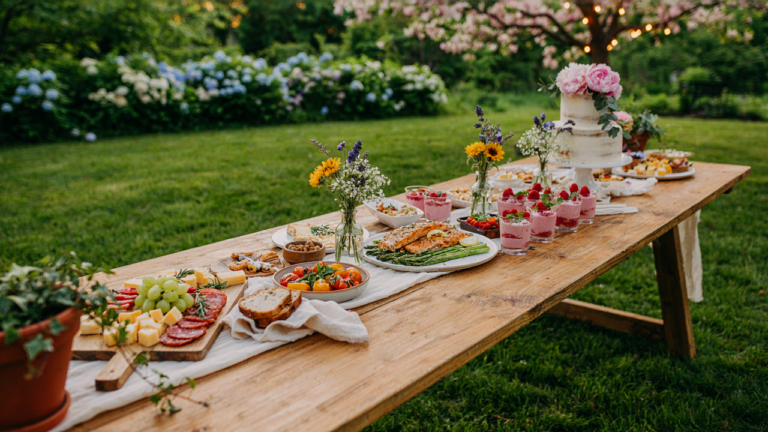
A park pavilion costs what it costs, morning or night, because the park doesn’t staff it differently. A home or backyard has zero venue markup because you’re not renting a prepared space. You bring the caterer to you. The real advantage isn’t lower cost, though it often is. The real advantage is that breakfast fits these spaces naturally. A backyard brunch with 40 people feels intentional. A backyard dinner with 40 people feels cramped and weird. Unconventional spaces align with the meal. Rent accordingly by checking local parks departments for pavilion rates and contacting private home rental platforms like Airbnb or Peerspace to see what’s available near your city center.
The Guest Experience: Elevating Wedding Brunch Ideas Beyond Expectations

Activities That Actually Hold Attention
You want people to remember this day and associate it with you, not scroll their phones while waiting for food. The mechanism is simple: boredom creates narrative space in people’s minds, and they’ll fill it with complaints, not gratitude. Morning activities work because they anchor attention before hunger and alcohol flatten the room into small talk.

The best rehearsal brunch activities demand participation without performance. A guided tasting of local coffee roasts, a short flower arrangement workshop, lawn games with actual scorekeeping, a live musician playing during the meal itself—these aren’t entertainment, they’re friction that keeps people engaged. The activity must end or transition before it exhausts the group, leaving them wanting more, not relieved it’s over.
Favors That Signal Intentionality
The generic favor industry has trained you to think small gifts prove thoughtfulness. It doesn’t. A favor that works proves you understand who attended and why they came. Favors should feel like something the couple chose, not something a vendor convinced them to buy in bulk.
- Local preserves or honey in labeled jars: Source from an actual producer within 30 miles. Guests remember the origin story, not a generic brand.
- Seed packets for spring planting: Choose species that grow in your region’s climate. Functional and tied to the season of the event.
- Personalized playlists on physical media or QR codes: A curated list of songs that mattered during your relationship, printed or coded. Rare and specific.
- Homemade granola or baked goods in kraft boxes: Prepared by you or a family member. The labor is the gift, not the item.
- Hand-poured candles in a scent you chose: Work with a local maker or DIY. Tied to a memory or inside reference.
The mechanism is reciprocity without expectation. When a guest receives something that required actual selection and sourcing, they unconsciously feel obligated to think well of you. Don’t package it like retail. Present it like a thought made tangible. Include a handwritten tag that names why you chose this specific thing for them.
Decoration Deception: Crafting Atmosphere On A Budget Rehearsal Brunch

The Light You Already Own
You’re worried that a daytime event feels cheap compared to the dinner alternative. Here’s the mechanism: you’re confusing artificial mood-setting with actual atmosphere. Brunch happens during daylight hours, which means you inherit free ambient lighting that dinner venues charge thousands to replicate. Natural light from windows is not a constraint to work around—it’s the dominant design element you build everything else around. Most venues spend money fighting this advantage instead of leveraging it.

Stop treating morning light as a liability. Large windows become your primary decor investment because they’re free. Position tables to face them, not away. Eliminate heavy curtains or sheer fabrics that diffuse the light you already have. The visual clarity of a sun-lit room reads as organized and intentional, not sparse. This is why high-end brunch spots double down on window positioning—the light does the work that centerpieces and ambient fixtures do at night, except it costs nothing.
Restraint Signals Intentionality
Common advice says “add more to make it feel complete.” This is wrong. Minimalism works in brunch contexts because it mirrors the aesthetic of modern design movements that prioritize function over ornamentation. In graphic design terminology, white space is called “negative space”—and it’s doing active work, not sitting empty. A rehearsal brunch with three strong focal points outperforms one with twelve scattered decorative objects fighting for attention.
Choose one statement element per section of the room: a single floral arrangement on the gift table, one styled board with menu details, one textured table runner. The emptiness around these pieces makes them register as deliberate, not forgotten. Guests process clarity faster than clutter. Set one aesthetic rule for the space—monochromatic, natural materials, or geometric—and apply it consistently. This creates coherence without accumulation. Tell the venue or coordinator your constraint explicitly: remove anything that doesn’t serve a function or align with the stated aesthetic.
The Logistics Loop: Streamlining Your Wedding Rehearsal Brunch

Stop Overloading The Timeline
You’re worried people will judge a brunch as less formal than dinner, so you’re cramming too much into one morning. That’s the real problem. Military logistics uses a concept called task saturation: when you assign more tasks than a system can process, execution collapses across all fronts. Your rehearsal brunch hits saturation the moment you try to run the ceremony walk-through, serve a three-course meal, and coordinate twenty moving pieces simultaneously.

The fix is ruthless subtraction. Pick one focal point: either the meal or the rehearsal logistics. Don’t try to make them equal. A smart move is scheduling the walk-through the day before, then using brunch purely for the meal and informal regrouping. This sounds like you’re doing less, but you’re actually gaining control. People stay longer, relax more, and the whole thing feels intentional instead of rushed. Brunch works because it’s naturally shorter than dinner and operates on looser time expectations.
Clear The Bottlenecks Before Day One
Bottlenecks kill small events faster than they kill large ones. You can’t hide incompetence in a thirty-person brunch. Common advice says “delegate more.” That’s incomplete. You need to map who touches what in what order, then remove the person-dependent steps. Most brunch failures happen because one person controls information that three other people need simultaneously.
Assign one person as the brunch operations lead, but only for logistics that can’t be decided before the event. Everything else gets locked down seven days prior: menu, table layout, timing, who serves what, backup plans. The operations lead isn’t making decisions on the morning of. They’re executing a pre-built system. When you operate from a pre-built checklist, bottlenecks vanish because decisions don’t flow through a single person anymore.
Common Brunch Wedding Reception Pitfalls And How To Sidestep Them

When Your Guests Don’t Actually Show Up
You’re worried people will bail. That’s the real fear here. The mechanism is simple: brunch conflicts with weekend routines in ways dinner doesn’t. People sleep late, make plans with their families, hit the gym. Brunch is optional in their mental model. Dinner feels mandatory. You solve this with start time clarity and one tactical move: send the invite with the exact arrival window, not just the time. Say “9:30 to 10:15 AM arrival window” instead of “9:30 AM brunch.” This removes the cognitive slack that kills attendance.

Rehearsal brunches fail not because of the meal but because guests treat them like suggestions. They arrive late or skip entirely because brunch hasn’t become a hard social obligation in their heads yet. The dinner rehearsal works because people recognize it as formal. You reclaim that status by treating timing like ceremony itself. Make the invitation say arrival is locked. Make the venue setup visible from the parking lot. Make people see other guests arriving. Social proof moves bodies faster than politeness ever will.
What You’re Actually Missing On The Menu
The amateur mistake is assuming dietary needs are just preferences to accommodate. They’re logistics failures waiting to happen. Think supply chain here: you have limited inventory, a single service window, and substitution requests that arrive too late to source. You’re not being nice by asking for dietary preferences two weeks before. You’re collecting data points you can’t execute on.
- Vegetarian and vegan: Don’t assume brunch proteins are flexible. Order dedicated portions, not conversions. A vegetarian omelette isn’t the same as a plant-based main course someone specified.
- Gluten-free: Brunch bread-heavy menus become logistics nightmares. Clarify if you’re sourcing separate items or building one unified menu that skips gluten entirely.
- Shellfish and tree nut allergies: These require kitchen protocol changes, not just plate modifications. Ask your caterer if they can guarantee zero cross-contamination before confirming your menu.
- Dairy-free and lactose-intolerant: Brunch relies on cream, butter, and cheese. Get exact counts, then source plant-based versions in matching quantities so you’re not scrambling service morning.
- Religious dietary restrictions: Halal, kosher, and other observances need advance sourcing. Don’t assume your vendor stocks what you need. Verify four weeks out, not four days out.
Collect dietary info eight weeks before, not two. Send a single form asking for restrictions and allergies separately. Code the responses by severity. Allergies go to your caterer immediately. Preferences get batched into menu adjustments. Your vendor needs to know exact counts by six weeks out. This isn’t about kindness. It’s about not discovering mid-service that you promised something you can’t deliver.
The Post Brunch Strategy: What To Do With Your Newfound Freedom

Reclaim Your Afternoon Without Collapse
You want this section because you’re afraid you’ll waste the time you just saved, or worse, arrive at the wedding depleted. The mechanism is simple: brunch timing creates a natural energy cliff if you don’t structure what comes after. You finish eating by 11 a.m. or noon. Dinner rehearsals end at 9 p.m. You now own five to eight hours. Most people fill this void with panic tasks or passive recovery, both of which leave them wrecked by ceremony time.
The recovery principle from sports science applies here: you need active rest, not collapse. Your nervous system spent energy on coordination, decision-making, and social performance during brunch. Passive sitting amplifies fatigue. Instead, build a three-part window: eat, move deliberately for thirty minutes, then shift into low-cognitive tasks. A walk, a shower, a light workout. Nothing that requires decision-making. The goal is restoration, not exhaustion. You arrive at the wedding grounded, not drained.
Mental Rehearsal Before The Real Thing
Pre-wedding anxiety isn’t a feeling to manage, it’s unprocessed uncertainty that compounds. A rehearsal that ends early gives you rare uninterrupted time to run through your specific responsibilities without the wedding timeline pressing down. You know exactly when you walk, where you stand, what you say. Run it once more before you shower and change. Not obsessively. Once, deliberately, in your head or out loud in an empty room.
This isn’t positive thinking. It’s cognitive rehearsal, a documented technique used by performers and athletes. Your brain treats vivid mental simulation as a dress run. You walk the aisle mentally, you see where you’ll stand, you hear your words. When the actual moment arrives, your nervous system recognizes it as something already executed. You move with less hesitation. Spend twenty minutes on this between noon and 2 p.m., before fatigue narrows your focus. Your body will thank you at the altar.
The Real Obstacle Isn’t Your Budget; It’s Your Inability To Challenge Conventional Wisdom

You don’t need permission to break the dinner tradition. You need to stop treating wedding norms like laws. Call your venue today and ask what a brunch menu costs. Not tomorrow. Today. The number you hear will shock you. Then you’ll realize the real waste wasn’t your money—it was your willingness to follow a script everyone else wrote for you. Stop paying for tradition and start paying for what actually works.